Barbary Sheep
Ammotragus lervia
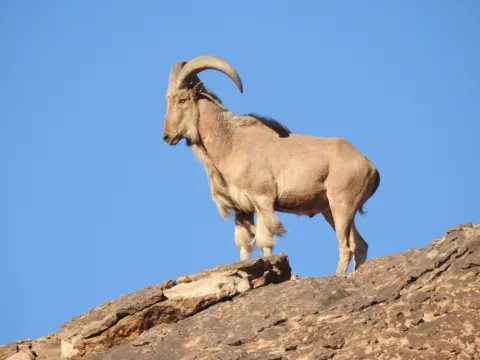
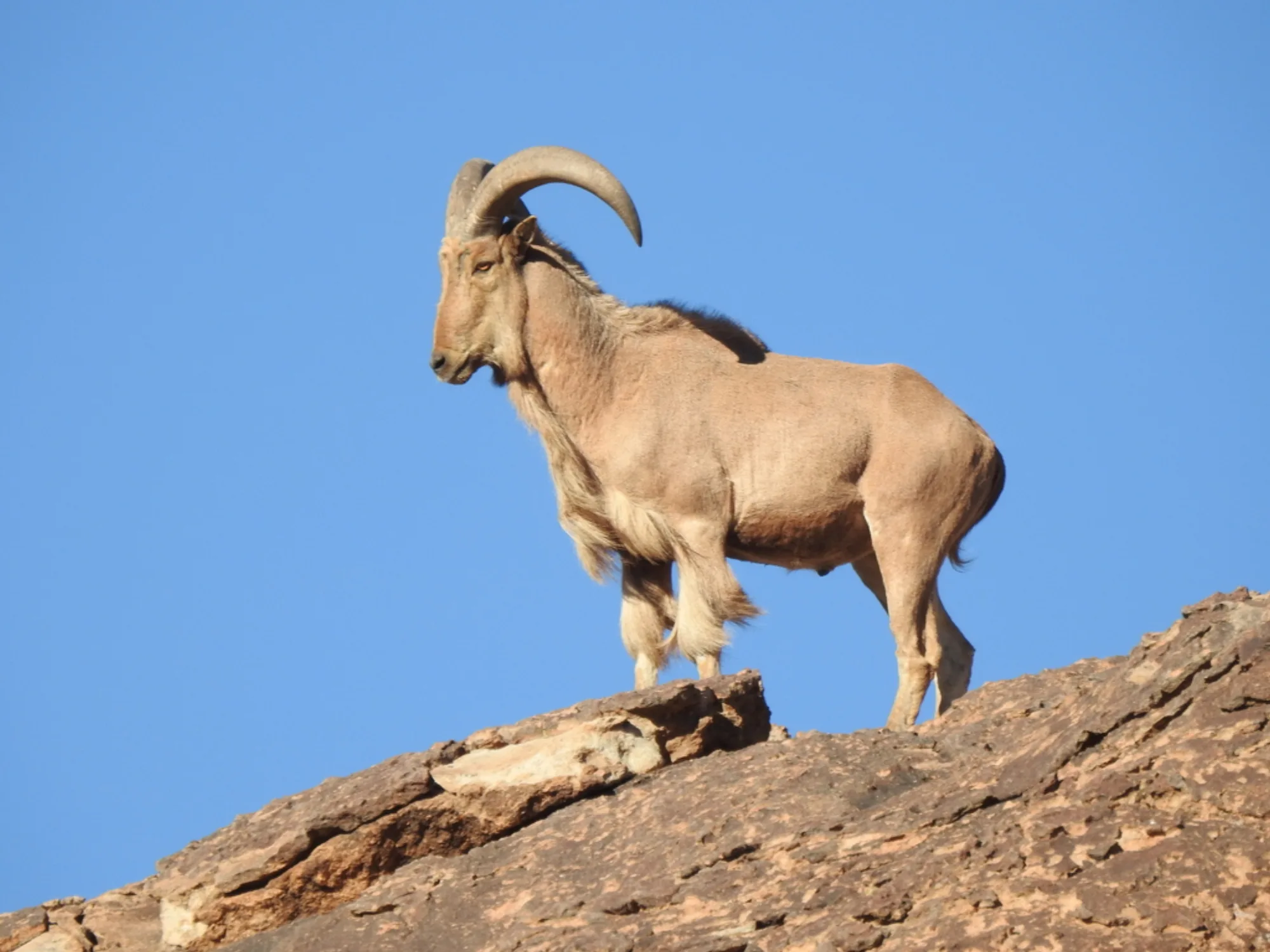
Sandy-brown and sure-footed among rocks, the Barbary Sheep is a caprine native to rocky mountain regions across North Africa and parts of West Africa. Its coat darkens with age, while the belly is slightly lighter and a dark line runs along the back. Shaggy throat hair extends to the chest in males, and the outward-curving horns sweep back and then inward, sometimes exceeding 76 cm. At the shoulder, these animals stand 75 to 110 cm tall, and they weigh 30 to 145 kg.
In its native range, the species occurs around the barren centre of the Sahara, including in Morocco, Algeria, Libya, Chad and Sudan. It favours arid mountains and canyons, with steep, rocky ground underfoot. Introduced populations also live in southeastern Spain, the Southwestern United States and elsewhere, although the animal is rare in its native North Africa. On La Palma in the Canary Islands, it has spread through northern and central areas, where it threatens native vegetation found nowhere else.
Barbary sheep feed on grasses, bushes and lichens, getting all the water they need from food when necessary. Where water is available, they also drink and wallow. They are busiest around the beginning and end of the day, resting through its hottest hours. They move constantly through mountain ranges and often escape danger by running uphill. A standing jump can carry them over 2 m. Hunting and habitat destruction have reduced populations in the native range, while feral dogs, drought and competition from overgrazing by domestic animals also pose threats.
Written from the English Wikipedia article Barbary sheep (CC BY-SA 4.0).
- Records
- 1,811
- Countries
- 5
- Atlas places
- 1
These are open occurrence records, so they show where people looked for and recorded the Barbary Sheep as much as where it lives. Cells are up to 25 km across, and every location is generalised to its cell.
Generalised encounter areas, not exact locations. Each shape is a grid cell coloured by how likely the species is there.
- Very likelySpain25 km zone · high confidence · 1685 records · updated 80 days ago
- LikelyUnited States25 km zone · medium confidence · 98 records · updated 80 days ago
- LikelyFrance25 km zone · medium confidence · 22 records · updated 80 days ago
- PossibleMexico25 km zone · medium confidence · 5 records · updated 80 days ago
- UncommonMorocco25 km zone · medium confidence · 1 record · updated 80 days ago
Conservation status not assessed here yet, so every location is generalised to its grid cell.