Brown Bullhead
Ameiurus nebulosus
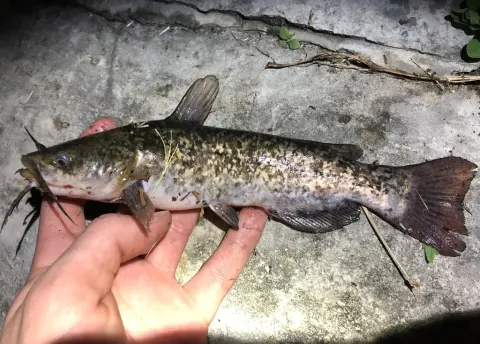
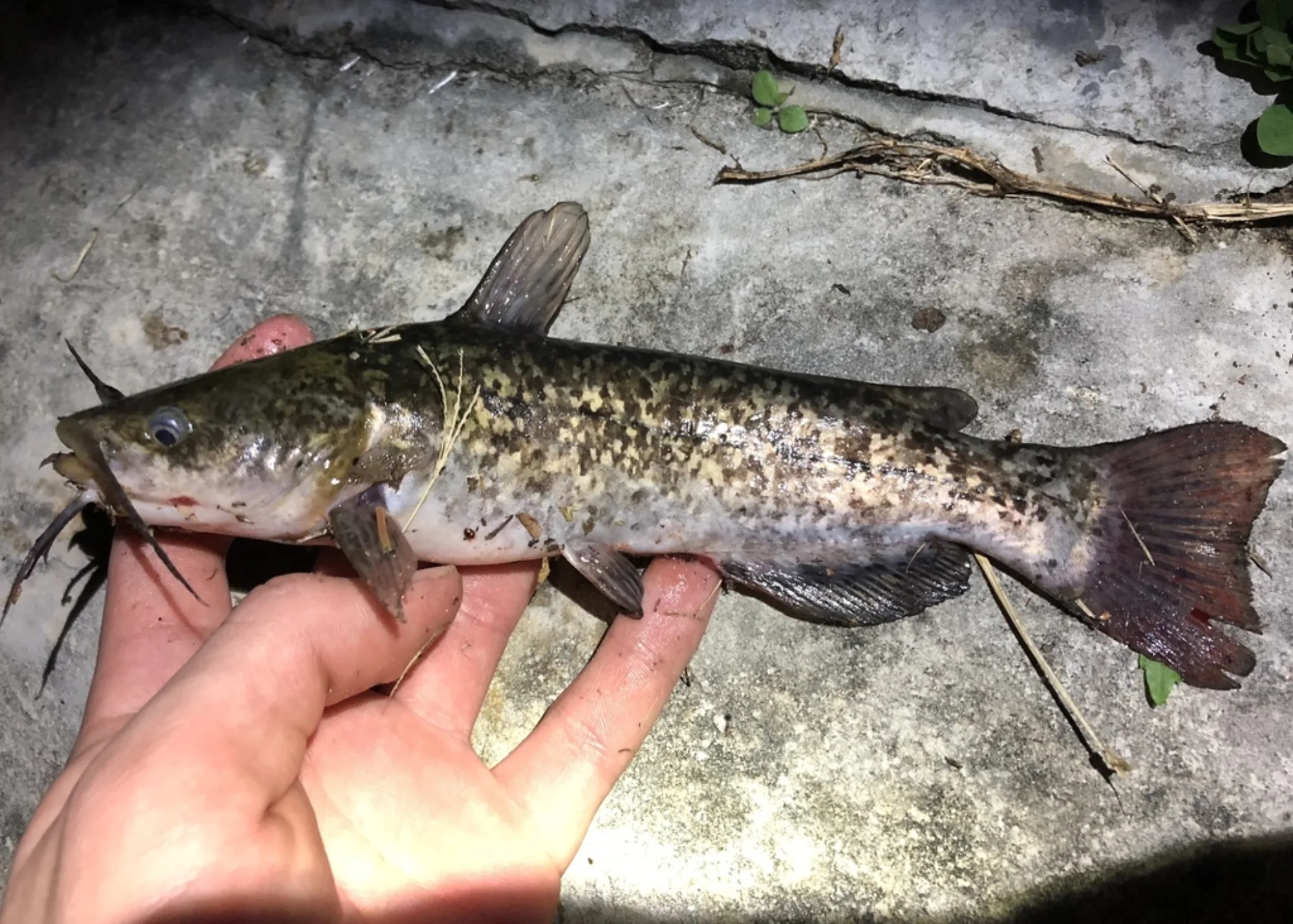
Mottled brown and green above, the Brown Bullhead is a North American catfish with a pale cream belly and no scales. Dark speckles cover its body, and eight barbels surround its mouth, with the chin barbels ranging from black to yellowish brown. Its tail is only slightly notched, while young fish are more likely to have a single solid colour. Adults measure 200 to 500 mm, though the species can grow to approximately 53 cm.
Its native range includes the Great Lakes and Mississippi River basins, as well as the area from Nova Scotia and New Brunswick south to Mobile Bay, Alabama. Stocking and introductions have carried it to other parts of North America, as well as Europe, Chile, Puerto Rico and New Zealand. Look for it in lakes, ponds and slow-moving streams, including muddy water with little oxygen. Brown Bullheads form schools and do not migrate. They usually feed at night along the bottom, using sensitive barbels to find food despite poor eyesight. Their varied diet includes algae, worms, insects, molluscs, crayfish, smaller fish and fish eggs.
Females lay their eggs in dark places, including spaces beneath rocks and inside logs. Both parents protect the eggs and generally care for the young for five days after they hatch. A parent may keep the young together in a school for up to one month, and juveniles continue to school. Eggs and small fish are vulnerable to predators, including northern pike, snapping turtles and green herons, while humans are the biggest threat to adults. In Missouri, habitat destruction threatens the species, especially where swamps in the Bootheel are drained for farmland.
Written from the English Wikipedia article Brown bullhead (CC BY-SA 4.0).
- Records
- 22,153
- Countries
- 5
No atlas park has a record of the Brown Bullhead in or around it yet.
These are open occurrence records, so they show where people looked for and recorded the Brown Bullhead as much as where it lives. Cells are up to 25 km across, and every location is generalised to its cell.
Generalised encounter areas, not exact locations. Each shape is a grid cell coloured by how likely the species is there.
- Very likelyUnited States25 km zone · medium confidence · 21884 records · updated 80 days ago
- Very likelyGermany25 km zone · high confidence · 115 records · updated 80 days ago
- Very likelyCanada25 km zone · medium confidence · 53 records · updated 80 days ago
- LikelyBelgium25 km zone · medium confidence · 67 records · updated 80 days ago
- LikelyNorway25 km zone · medium confidence · 34 records · updated 80 days ago
Conservation status not assessed here yet, so every location is generalised to its grid cell.