Tiger Salamander
Ambystoma tigrinum
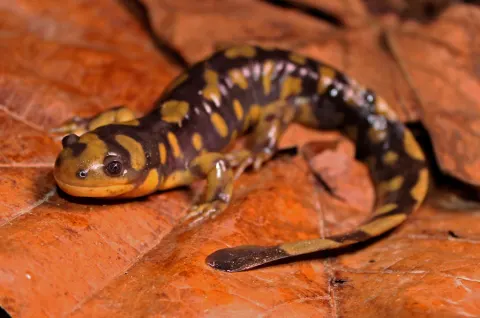
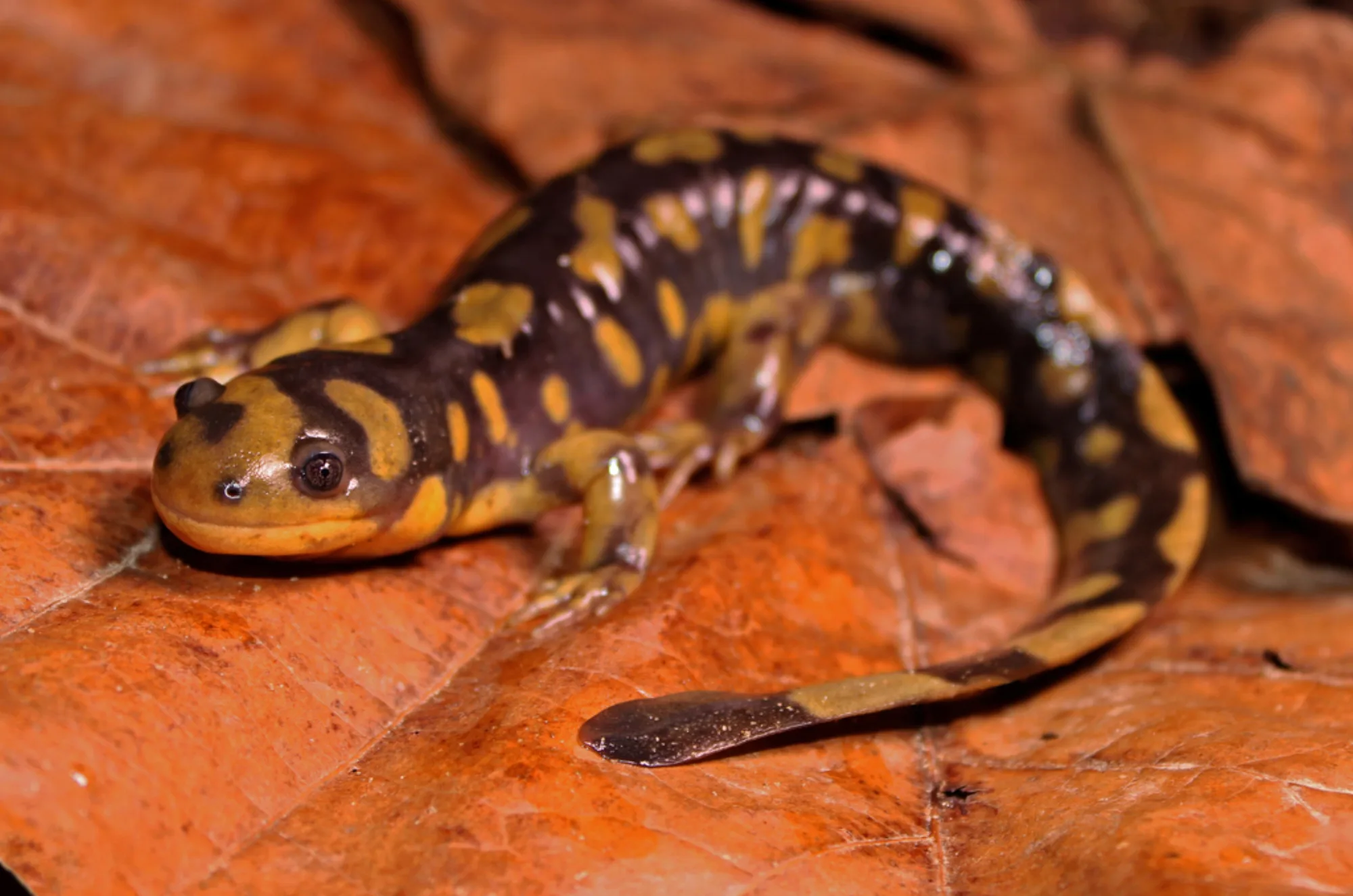
A secretive amphibian with a dark back and yellowish markings, the Tiger Salamander is one of North America's largest land-dwelling salamanders. It usually measures 15 to 20 cm, although the longest recorded reached 33 cm. Yellow spots, tinged with brown or green, stand out against its black or dark brown back. A short snout, thick neck, strong legs and long tail add to its distinctive shape. Under blue or ultraviolet light, eastern tiger salamanders glow bright yellow green.
Tiger salamanders are most often found along the Atlantic coast from New York to Florida; scattered populations also occur in southern Canada, eastern Mexico and elsewhere in the United States. They live in habitats ranging from woodland to open grassland, wherever suitable loose soil allows them to burrow. They spend most of their lives underground and can be difficult to see, sometimes digging more than 60 cm below the surface. Adults live almost entirely on land, usually returning to water to breed in places such as ponds, seasonal pools and flooded swamps. The favoured breeding period falls between late winter and early spring, when the ground has warmed and the water has thawed. Females attach their eggs to submerged twigs, grass and leaves, and the young hatch in about 12 to 15 days.
Their diet includes insects, snails, slugs, frogs and worms, though adults sometimes eat their own kind and other small animals. Some individuals retain their larval features and stay in the water. In the southeastern United States, deforestation and wetland destruction are driving population declines, while disturbed ponds, invasive fish and road construction add pressure. Vehicle strikes and contamination of aquatic habitats are further threats, and recurring ranavirus infections sometimes cause severe losses among larvae.
Written from the English Wikipedia article Tiger salamander (CC BY-SA 4.0).
- Records
- 1,571
- Countries
- 3
- Atlas places
- 2
These are open occurrence records, so they show where people looked for and recorded the Tiger Salamander as much as where it lives. Cells are up to 25 km across, and every location is generalised to its cell.
Generalised encounter areas, not exact locations. Each shape is a grid cell coloured by how likely the species is there.
- Very likelyUnited States25 km zone · medium confidence · 1382 records · updated 82 days ago
- Very likelyMexico25 km zone · medium confidence · 160 records · updated 82 days ago
- Very likelyCanada25 km zone · medium confidence · 29 records · updated 82 days ago
Conservation status not assessed here yet, so every location is generalised to its grid cell.