Spotted Salamander
Ambystoma maculatum
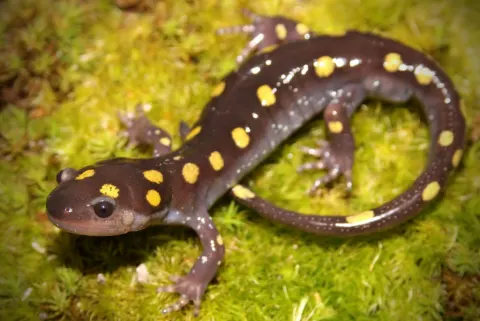
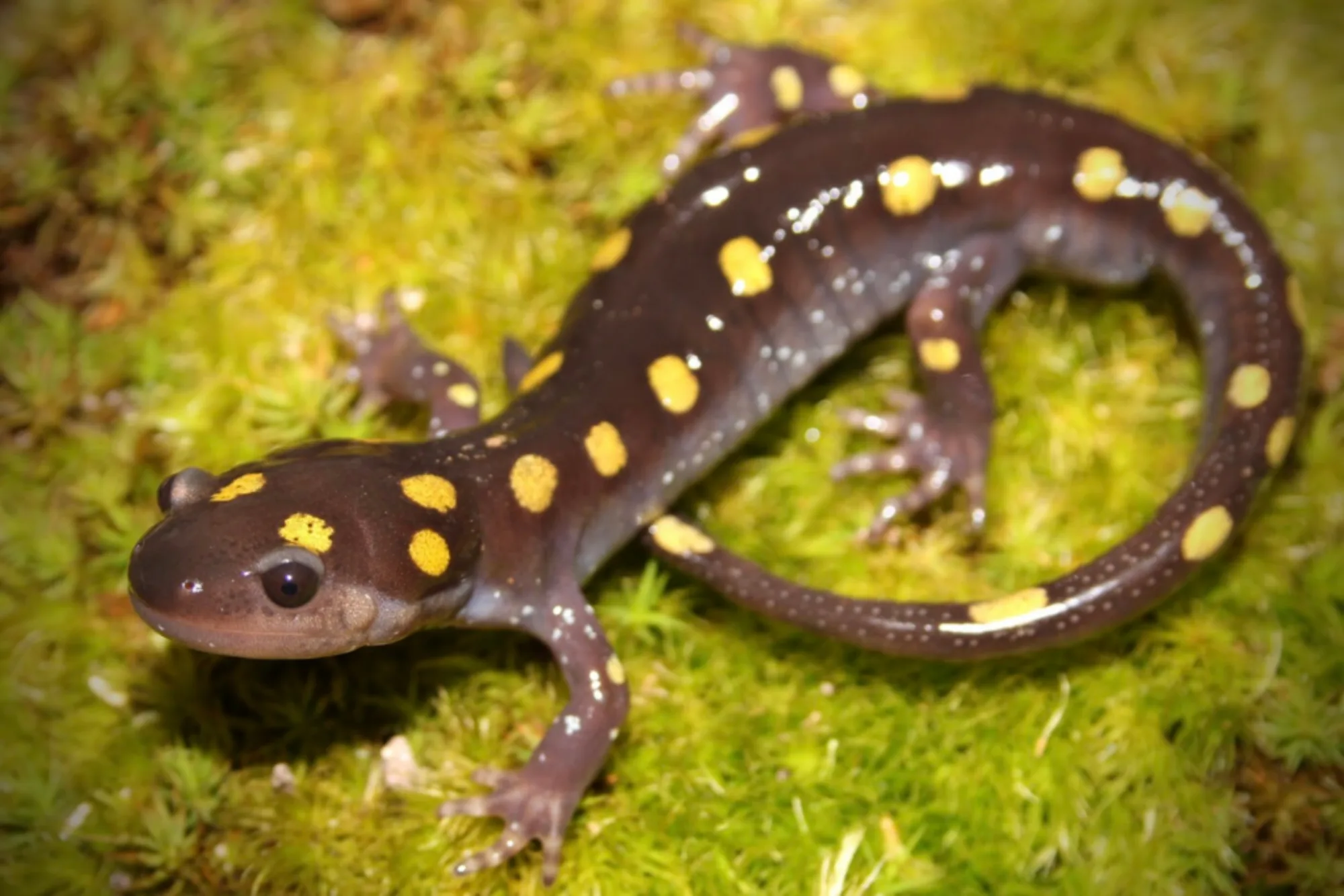
A dark body marked with two uneven rows of yellowish-orange spots gives the Spotted Salamander a distinctive appearance. The spots are more orange near the head and yellower along the rest of the body, while the underside is slate grey and pink. Stout, with a broad snout, it measures about 15 to 25 cm including the tail, and females are generally larger than males.
Across eastern Canada and the United States, its range extends from Nova Scotia to Lake Superior and south to southern Georgia and Texas. It usually inhabits mature forest with ponds or seasonal pools where it can breed. Away from the breeding season, it favours well-drained forest soils with plenty of burrows made by small mammals. It spends much of the year beneath leaves or in burrows and seldom emerges except after rain, to feed or to breed. In winter it remains underground until the spring breeding season. Its diet includes earthworms, slugs, snails, spiders, insects and other small creatures, and it sometimes eats smaller salamanders.
On warm, wet spring nights, hundreds to thousands may travel to breeding ponds, often returning to the same pool each year. Females usually lay about 100 eggs in jelly-like masses attached to underwater plants. Adults remain in the water for only a few days, while the eggs hatch after one to two months, depending on water temperature. The young leave the water after two to four months. Fish can eat the eggs and larvae, and the herbicide atrazine can reduce hatching success by eliminating algae associated with the egg masses. Adults face predators including raccoons, skunks, turtles and snakes, and are also sought for the pet trade.
Written from the English Wikipedia article Spotted salamander (CC BY-SA 4.0).
- Records
- 7,029
- Countries
- 2
- Atlas places
- 2
These are open occurrence records, so they show where people looked for and recorded the Spotted Salamander as much as where it lives. Cells are up to 25 km across, and every location is generalised to its cell.
Generalised encounter areas, not exact locations. Each shape is a grid cell coloured by how likely the species is there.
- Very likelyUnited States25 km zone · medium confidence · 6337 records · updated 80 days ago
- Very likelyCanada25 km zone · medium confidence · 692 records · updated 80 days ago
Conservation status not assessed here yet, so every location is generalised to its grid cell.