Marine Iguana
Amblyrhynchus cristatus
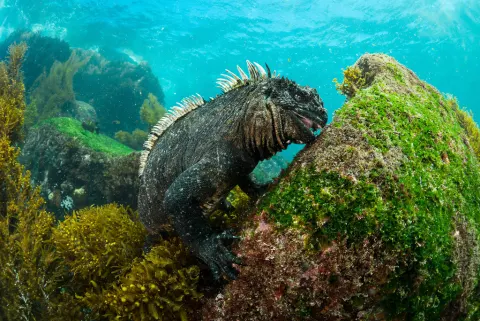
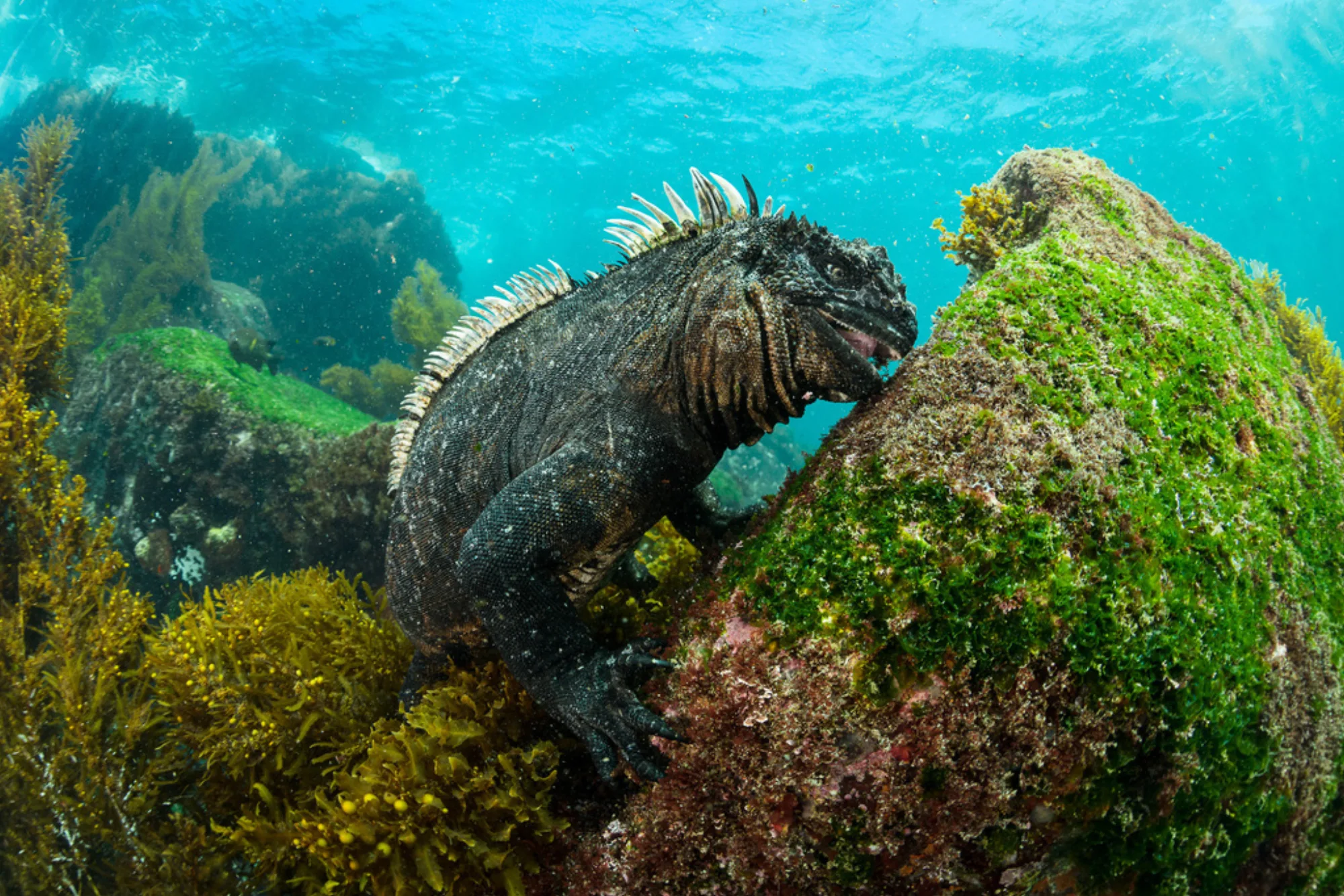
On the rocky shores of Ecuador's Galápagos Islands, Marine Iguanas gather in colonies and bask after feeding in the cool water. This sea-going lizard has a thickset body, short, sturdy limbs and a row of spines running from its neck towards its tail. Young animals have a pale stripe along the back, while adults may be black or grey, with colours varying between islands. During the breeding season, males become brighter: on Española, Floreana and Santa Fé, some have pinkish-red and turquoise markings. Females are usually dark and show less variation in colour between islands, although nesting females on Española can become brighter.
Marine Iguanas feed almost entirely on algae, mostly red and green varieties found along the shore and underwater. Large males dive for food, while females and smaller males usually graze on exposed algae at low tide, retreating as waves return. After a swim, the iguanas warm themselves in the sun, sometimes resting close together, and can also be found on beaches, in marshes and in mangrove swamps. During the breeding season, large males defend territories and sometimes fight by pushing their heads together. Females dig nests in sand or volcanic ash, and the young emerge from their eggs roughly three to four months later; on some islands, females guard buried nests for several days.
El Niño events reduce the cold water that algae need to grow, sometimes causing severe population declines and leaving iguanas short of food. Introduced dogs can take adults, while cats, pigs and rats may eat young iguanas or their eggs. Oil spills and pathogens introduced by people also pose threats, and even low levels of oil can kill these lizards.
Written from the English Wikipedia article Marine iguana (CC BY-SA 4.0).
- Records
- 156
- Countries
- 1
- Atlas places
- 1
These are open occurrence records, so they show where people looked for and recorded the Marine Iguana as much as where it lives. Cells are up to 25 km across, and every location is generalised to its cell.
Generalised encounter areas, not exact locations. Each shape is a grid cell coloured by how likely the species is there.
- Very likelyEcuador25 km zone · medium confidence · 156 records · updated 80 days ago
Conservation status not assessed here yet, so every location is generalised to its grid cell.