Rock Bass
Ambloplites rupestris
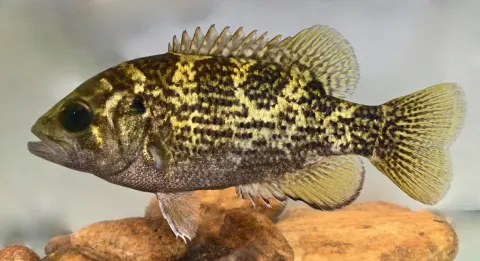
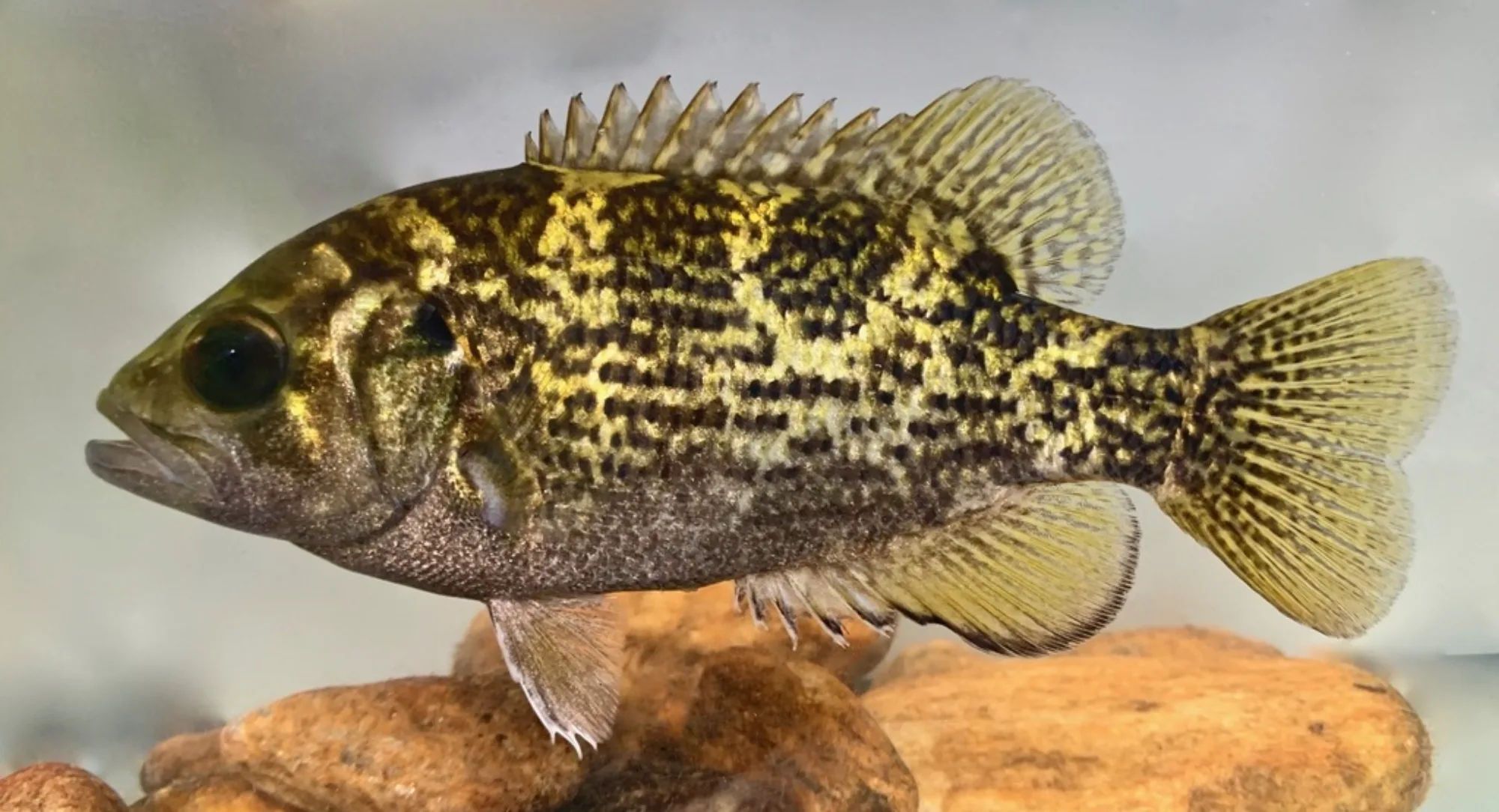
Red eyes, a large mouth and rows of dark dots along its sides help identify the Rock Bass, a freshwater member of the sunfish family. Its back and sides range from golden brown to olive, while its belly is white to silver, and it can quickly change colour to match its surroundings. Usually smaller than a smallmouth bass, it averages 150 to 250 mm in length. Few live beyond 10 to 12 years.
Native to east-central North America, the fish occurs in the Great Lakes and St Lawrence River system, as well as the upper and middle Mississippi River basin. Its range extends from Québec to Saskatchewan in the north and reaches parts of the eastern U.S. An introduced population in France's Loire River has sustained itself without expanding invasively. Look for Rock Bass near rocky shores, especially in clear stream pools and along lake margins with vegetation. They also live beneath lakeside docks and near swimming areas, seemingly undisturbed by human activity. Often seen in groups, sometimes near other sunfish, they eat smaller fish, insects and crustaceans. Adults may feed heavily in the evening and early morning, and sometimes take food from the surface.
Breeding takes place from April to early June, when males dig nests in shallow water and guard them aggressively. Several nests can lie close together in a well-used spawning area, where males defend their territories. After the eggs are laid, the male guards and fans them, then tends the young for a short time. Young Rock Bass are prey for large bass, northern pike, muskie and walleye, while Rock Bass also compete with smallmouth bass for food. They are caught as game fish across much of their range, with catch regulations in some waters.
Written from the English Wikipedia article Rock bass (CC BY-SA 4.0).
- Records
- 15,002
- Countries
- 3
No atlas park has a record of the Rock Bass in or around it yet.
These are open occurrence records, so they show where people looked for and recorded the Rock Bass as much as where it lives. Cells are up to 25 km across, and every location is generalised to its cell.
Generalised encounter areas, not exact locations. Each shape is a grid cell coloured by how likely the species is there.
- Very likelyUnited States25 km zone · medium confidence · 13321 records · updated 80 days ago
- Very likelyFrance25 km zone · high confidence · 1541 records · updated 80 days ago
- Very likelyCanada25 km zone · medium confidence · 140 records · updated 80 days ago
Conservation status not assessed here yet, so every location is generalised to its grid cell.