White-breasted Waterhen
Amaurornis phoenicurus
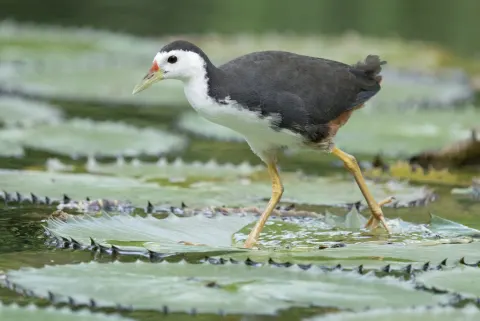
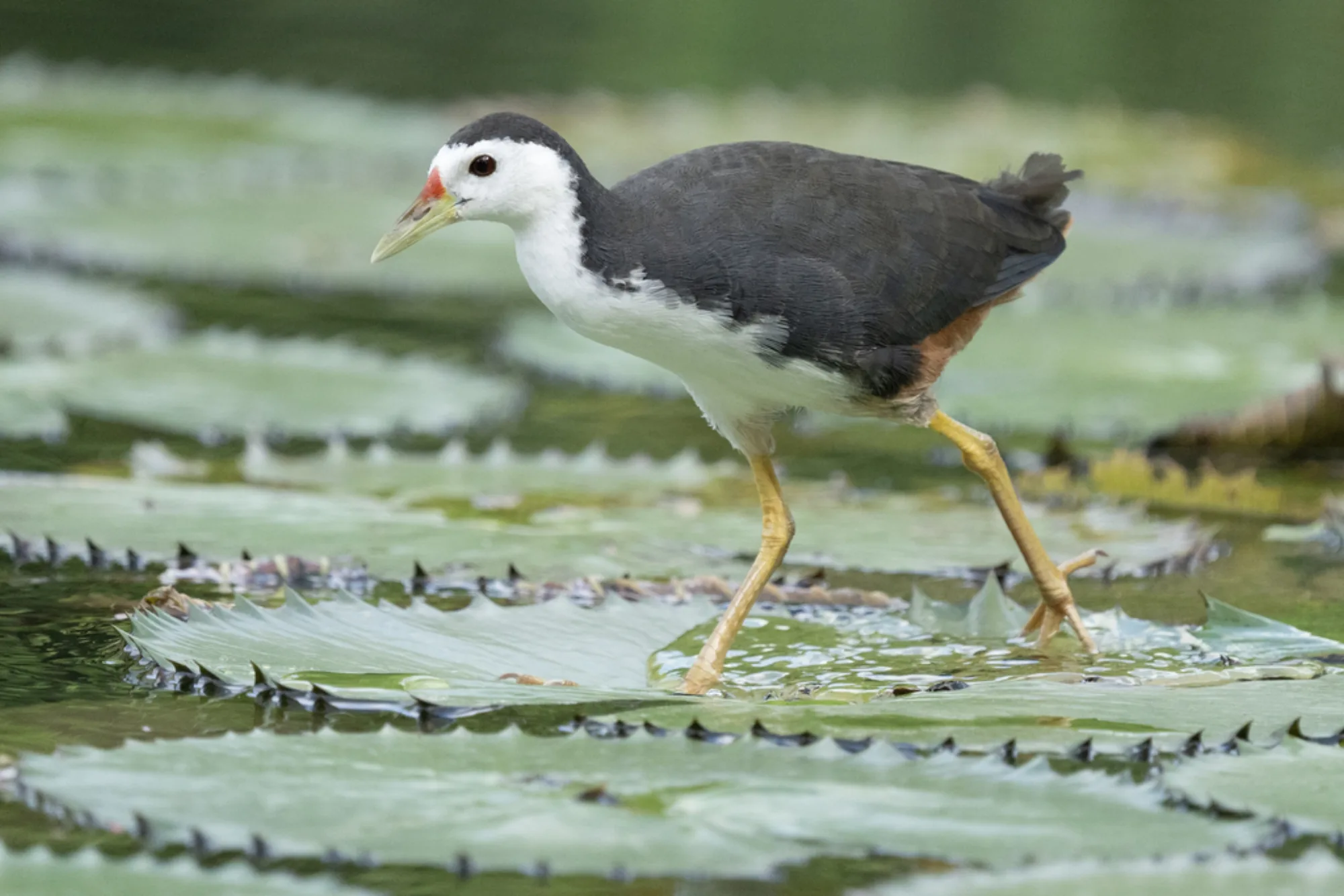
Look for a dark grey waterbird with a white face, neck and breast, a yellow bill and yellow legs. The White-breasted Waterhen is a member of the rail and crake family, with a short tail that it often holds upright as it walks. Its lower belly and undertail may be cinnamon or white, while immature birds are much duller than adults. Unlike many secretive rails, it often ventures into the open, stepping slowly through marshes or along drains near busy roads. It can be noisy at dawn and dusk, and its loud, repetitive croaking calls are especially associated with breeding after the first rains.
Across South and Southeast Asia, these waterhens live year-round within their range and breed in marshes from Pakistan east to Indonesia. They are seen mainly in the plains, although they also occur in higher hills. Freshwater is their usual setting, but they also use brackish water and, where freshwater is absent, the seashore. Birds usually forage alone or in pairs along the edge of a waterbody, walking on the ground or sometimes climbing into low vegetation. They probe mud and shallow water with their bills and pick up food by sight. Their diet includes insects, small fish, aquatic invertebrates, grains and seeds, and they sometimes feed in deeper water.
Breeding is mainly from June to October, with local variation. The nest is placed on dry ground among marsh vegetation, and a clutch contains 6 to 7 eggs. Both parents incubate the eggs and care for the chicks, which hatch after about 19 days. The young may dive underwater to escape predators.
Written from the English Wikipedia article White-breasted waterhen (CC BY-SA 4.0).
- Records
- 456,935
- Countries
- 35
- Atlas places
- 12
- Bandipur National Park· India
- Koshi Tappu Wildlife Reserve· Nepal
- Nagarhole National Park· India
- Ranthambore National Park· India
- Yala National Park· Sri Lanka
- Annapurna Conservation Area· Nepal
- Chitwan National Park· Nepal
- Eravikulam National Park· India
- Kanha National Park· India
- Kaziranga National Park· India
- Sundarbans National Park· India
- Tadoba Andhari Tiger Reserve· India
These are open occurrence records, so they show where people looked for and recorded the White-breasted Waterhen as much as where it lives. Cells are up to 25 km across, and every location is generalised to its cell.
Generalised encounter areas, not exact locations. Each shape is a grid cell coloured by how likely the species is there.
- Very likelyIndia25 km zone · high confidence · 251652 records · updated 86 days ago
- Very likelyTaiwan25 km zone · high confidence · 101086 records · updated 86 days ago
- Very likelySingapore25 km zone · high confidence · 20089 records · updated 86 days ago
- Very likelyThailand25 km zone · high confidence · 19307 records · updated 86 days ago
- Very likelySri Lanka25 km zone · high confidence · 16187 records · updated 86 days ago
- Very likelyChina25 km zone · high confidence · 13662 records · updated 86 days ago
- Very likelyMalaysia25 km zone · high confidence · 10693 records · updated 86 days ago
- Very likelyHong Kong SAR China25 km zone · high confidence · 4844 records · updated 86 days ago
- Very likelyIndonesia25 km zone · high confidence · 4647 records · updated 86 days ago
- Very likelyPhilippines25 km zone · high confidence · 3327 records · updated 86 days ago
Conservation status not assessed here yet, so every location is generalised to its grid cell.