American Shad
Alosa sapidissima
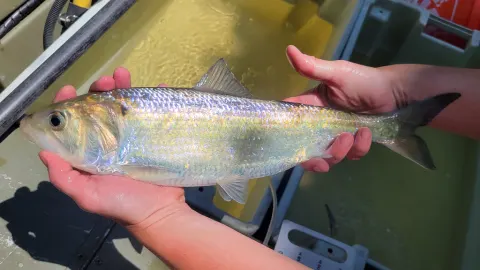
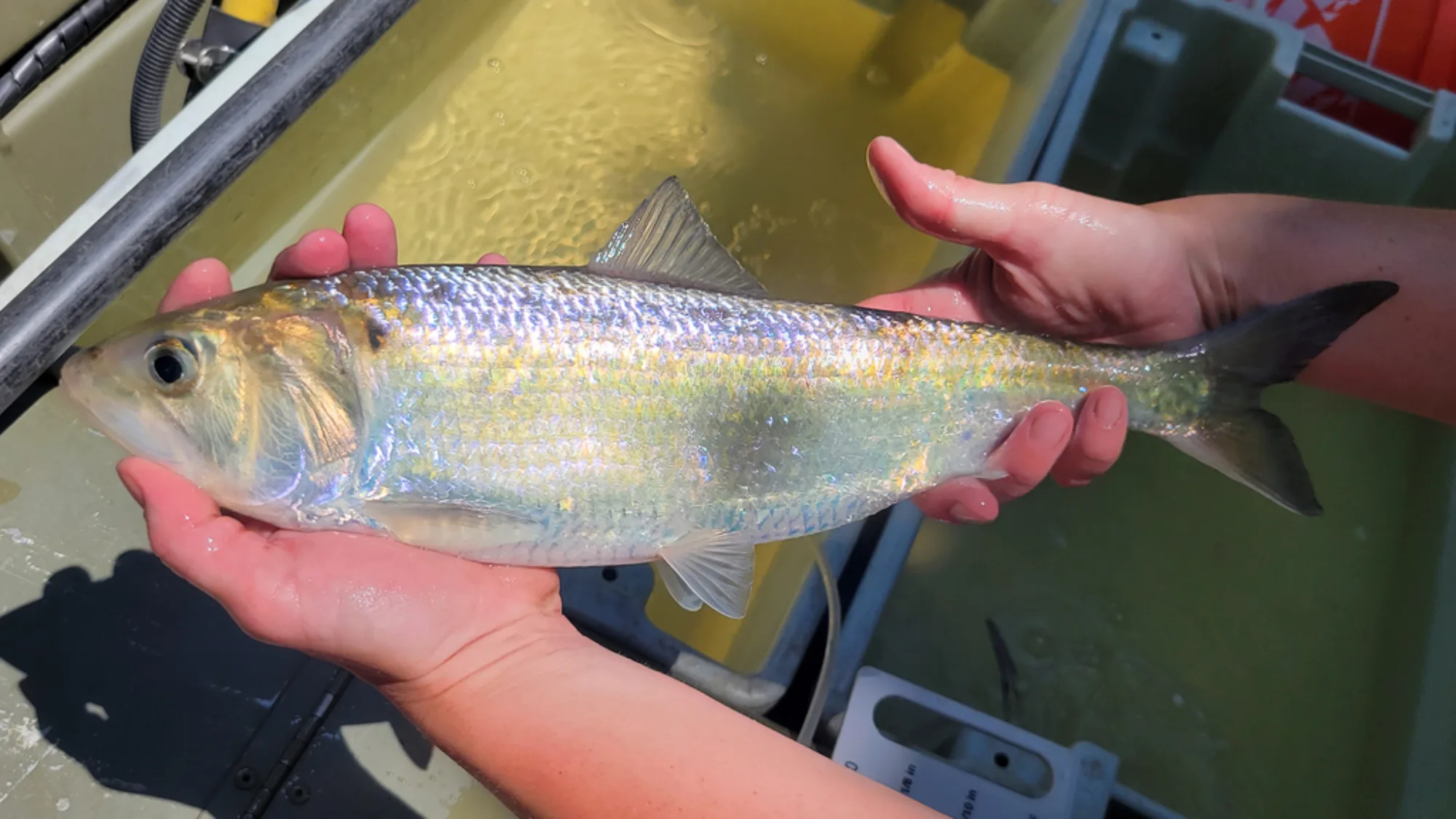
Along the Atlantic coast of North America, the American Shad spends most of its life at sea before travelling into freshwater rivers to breed. Adults range from 1.5 to 3.5 kg in weight, although the available description offers few clues to their appearance. Its natural range extends from Newfoundland to Florida, and it has also been introduced on the North Pacific coast. On the West Coast, it has spread through many river systems, with a large population in the Columbia River. It is occasionally found as far away as Kamchatka, Russia.
At sea, shad gather in schools, with thousands often visible near the water's surface through spring, summer and autumn. They are harder to find in winter, when they tend to move deeper. Their diet is mainly plankton, supplemented by small shrimp and fish eggs, with small fish eaten occasionally. After three to six years, mature shad swim up coastal rivers to spawn, usually in spring or early summer. The run moves later in the year from south to north, and fish can travel far upstream. They choose sandy or pebbly shallows for spawning, while young fish remain in rivers until autumn before moving to salt water. Some northern fish survive breeding and return to spawn again, while most in southern rivers die afterwards.
Dams have cut off many spawning grounds across the species' historic range, although fish passage efforts have begun to address the problem. Pollution in rivers may affect reproduction, and American Shad are also susceptible to commercial overfishing. Striped bass hunt them, and harbour seals sometimes do too.
Written from the English Wikipedia article American shad (CC BY-SA 4.0).
- Records
- 6,893
- Countries
- 2
- Atlas places
- 2
These are open occurrence records, so they show where people looked for and recorded the American Shad as much as where it lives. Cells are up to 25 km across, and every location is generalised to its cell.
Generalised encounter areas, not exact locations. Each shape is a grid cell coloured by how likely the species is there.
- Very likelyCanada25 km zone · high confidence · 4728 records · updated 81 days ago
- Very likelyUnited States25 km zone · medium confidence · 2165 records · updated 81 days ago
Conservation status not assessed here yet, so every location is generalised to its grid cell.