Alewife
Alosa pseudoharengus
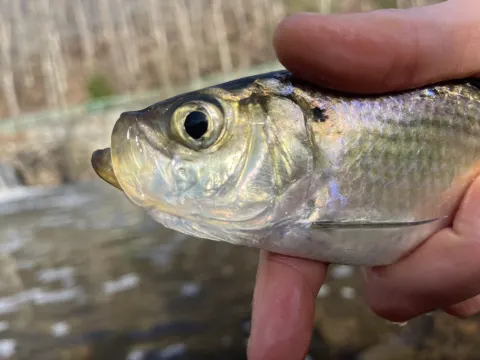
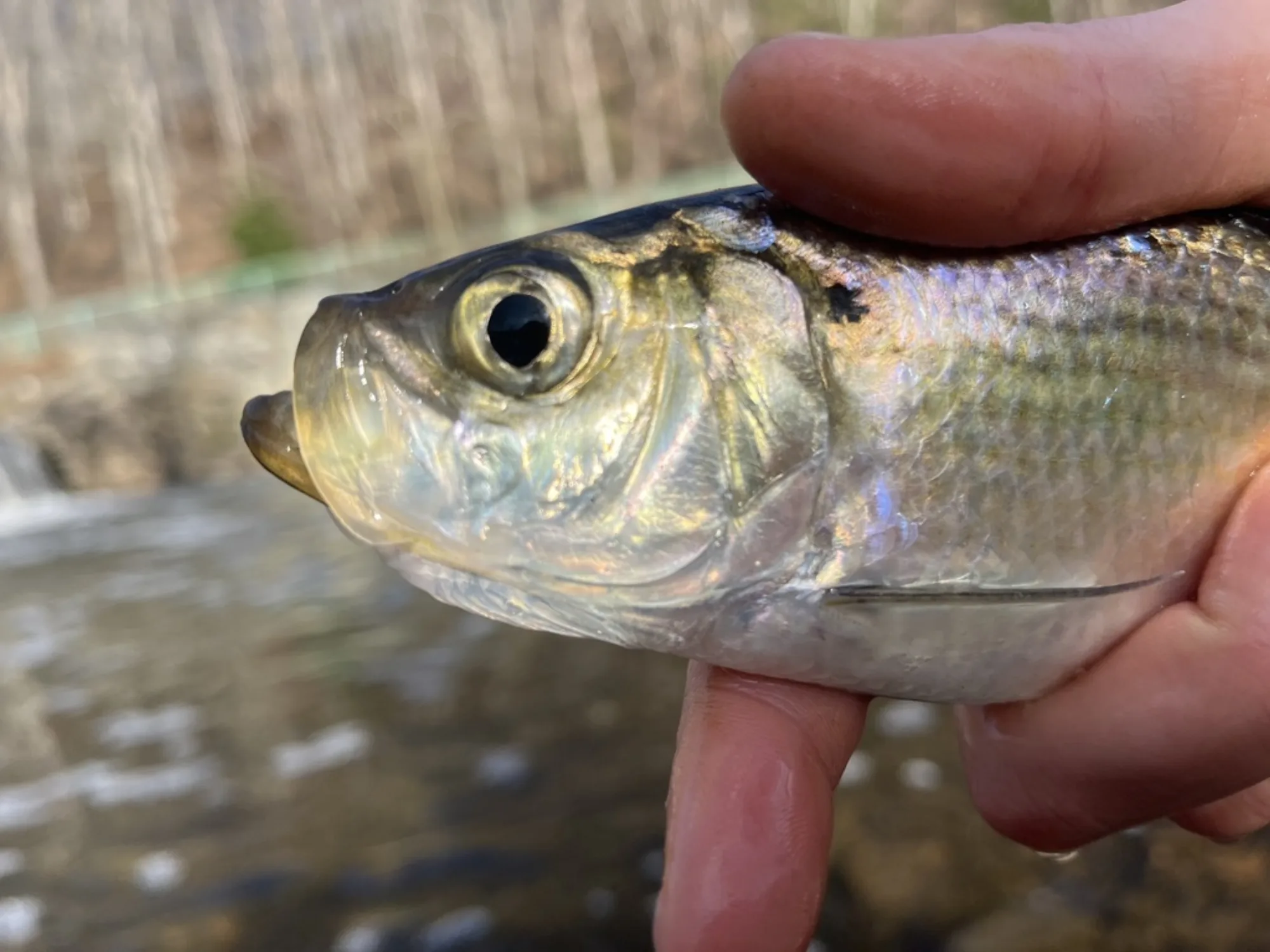
With its deep front and bronze-coloured head, the Alewife is a small North American herring with a grey-blue to greyish green back. It typically reaches about 30 centimetres in standard length, although the maximum is about 40 centimetres. Its eye is often wider than its snout is long, and a spot is often visible just behind the head.
Many adults live in the northern West Atlantic Ocean, moving through estuaries and upstream into fresh water to breed. Other populations spend their entire lives in fresh water, including in the Great Lakes. Alewives spread through the Welland Canal, bypassing Niagara Falls, and became especially abundant in Lake Huron and Lake Michigan. During the spring spawning migration, adults travel upstream through shallow, narrow areas where people catch them with large dip nets. Alewives prey on many kinds of zooplankton, including both native and non-native forms.
Their numbers have fallen substantially across much of their range, with several pressures likely contributing to the decline. Dams and other barriers can prevent access to spawning areas, while habitat degradation and fishing add further pressure. Recovering striped bass populations have also increased predation on alewives. In the Great Lakes, alewives often undergo seasonal die-offs and have washed ashore in rows along the shoreline. Pacific salmon were introduced there to prey on them, with limited success, and alewives remain linked to declines in many native fish species. In the Mystic River watershed, habitat restoration, education and a fish ladder with monitoring cameras are associated with increasing numbers returning to improving waters.
Written from the English Wikipedia article Alewife (fish) (CC BY-SA 4.0).
- Records
- 54,205
- Countries
- 2
- Atlas places
- 2
These are open occurrence records, so they show where people looked for and recorded the Alewife as much as where it lives. Cells are up to 25 km across, and every location is generalised to its cell.
Generalised encounter areas, not exact locations. Each shape is a grid cell coloured by how likely the species is there.
- Very likelyUnited States25 km zone · high confidence · 35239 records · updated 81 days ago
- Very likelyCanada25 km zone · high confidence · 18966 records · updated 81 days ago
Conservation status not assessed here yet, so every location is generalised to its grid cell.