Thresher Shark
Alopias vulpinus
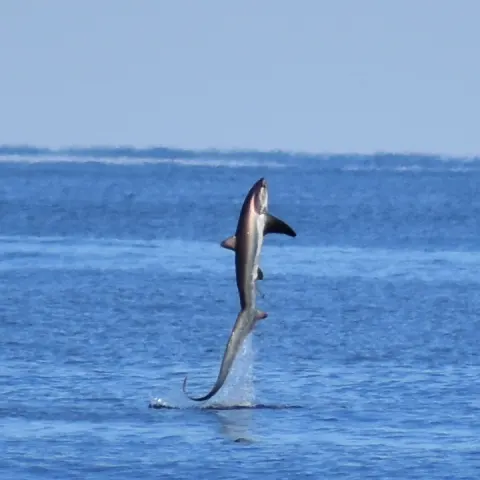
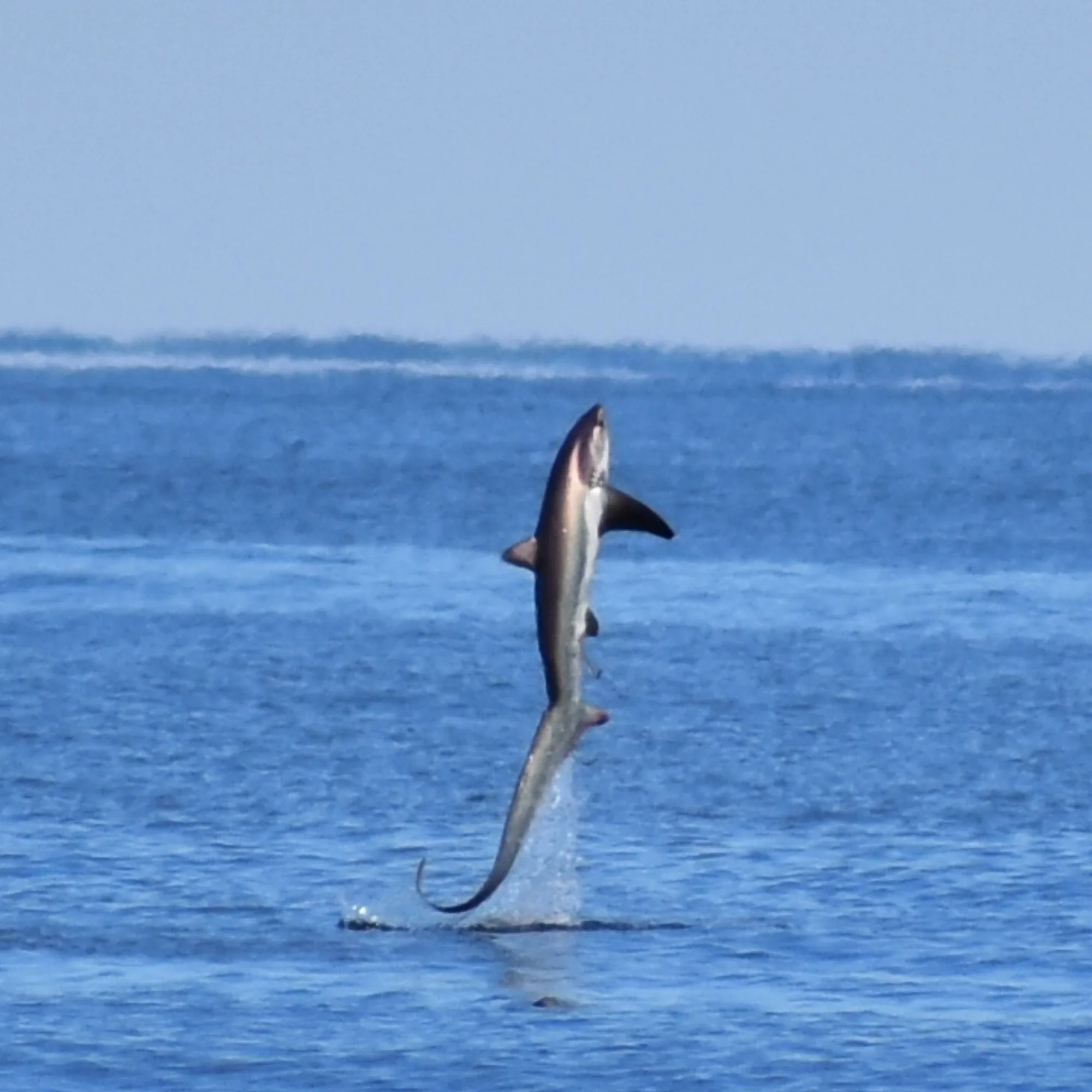
A long, sweeping tail sets the Thresher Shark (Alopias vulpinus) apart: its upper half is about as long as the rest of its body. The largest of the thresher sharks, it commonly reaches 5 m and has a streamlined body and a short, pointed snout. Its back is metallic purplish brown to grey, with bluer flanks and a white underside that extends over the bases of its fins. Most divers describe it as shy and difficult to approach underwater.
Common threshers range through tropical and temperate seas worldwide, favouring cooler water. They inhabit both coastal waters and the open ocean, although they are most abundant near land, and young sharks often use bays. Most are encountered near the surface, but the species has been recorded at depths of at least 550 m. These strong swimmers sometimes leap clear of the water and migrate with warm-water masses. They feed mainly on small schooling fish, including anchovies and herrings, using their long tails to strike and incapacitate prey. Before striking, they may swim around schools and splash with their tails to bring the fish together, often working in pairs or small groups. Females typically give birth to four pups after a pregnancy of nine months, and the Southern California Bight is a known nursery area.
Fishing places heavy pressure on the species: commercial fleets catch it for its meat, fins, skin and liver oil, while other fisheries take it as bycatch. Its slow rate of reproduction makes it susceptible to sustained fishing pressure, as shown by the rapid collapse of the Californian population after overfishing.
Written from the English Wikipedia article Common thresher (CC BY-SA 4.0).
- Records
- 71,651
- Countries
- 10
- Atlas places
- 2
These are open occurrence records, so they show where people looked for and recorded the Thresher Shark as much as where it lives. Cells are up to 25 km across, and every location is generalised to its cell.
Generalised encounter areas, not exact locations. Each shape is a grid cell coloured by how likely the species is there.
- Very likelyUnited States25 km zone · high confidence · 71538 records · updated 80 days ago
- LikelyFaroe Islands25 km zone · medium confidence · 60 records · updated 80 days ago
- LikelyAustralia25 km zone · medium confidence · 16 records · updated 80 days ago
- LikelyCanada25 km zone · medium confidence · 11 records · updated 80 days ago
- LikelyUnnamed area25 km zone · medium confidence · 9 records · updated 80 days ago
- LikelyUnited Kingdom25 km zone · medium confidence · 8 records · updated 80 days ago
- PossibleNew Zealand25 km zone · medium confidence · 9 records · updated 80 days ago
- PossibleChile25 km zone · low confidence · 0 records · updated 80 days ago
- UncommonEgypt25 km zone · low confidence · 0 records · updated 80 days ago
- UncommonMorocco25 km zone · low confidence · 0 records · updated 80 days ago
Conservation status not assessed here yet, so every location is generalised to its grid cell.