American Alligator
Alligator mississippiensis
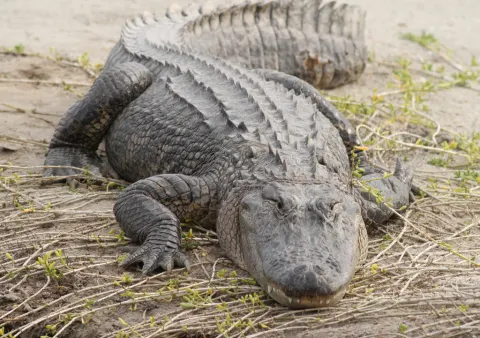
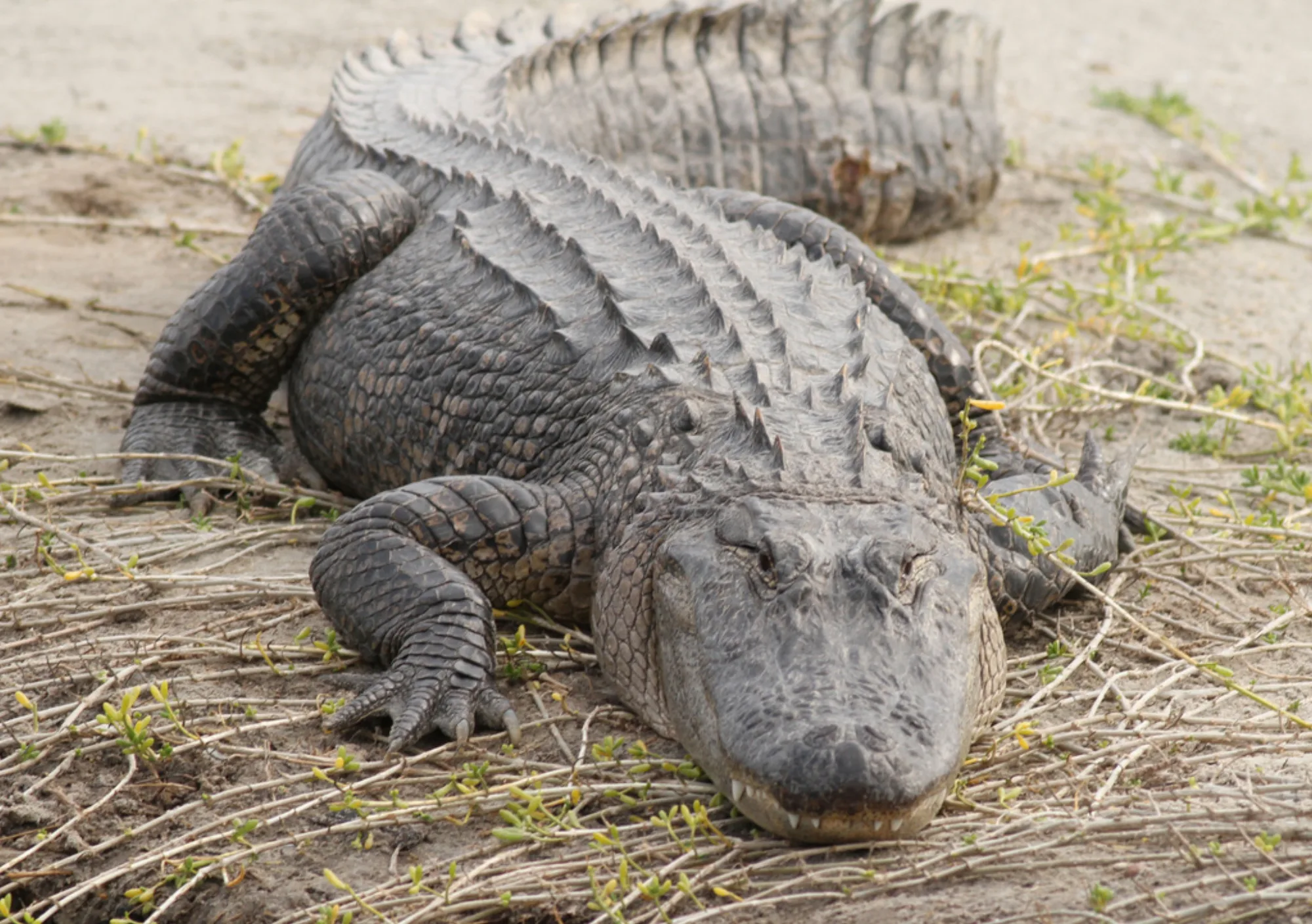
In the freshwater wetlands of the southeastern United States, the American Alligator is a large crocodilian with a broad, U-shaped snout. Adults can be olive, brown, grey or black above, with cream-coloured undersides, while the young have yellow bands around their bodies. Adult males measure 3.4 to 4.8 m long, and females are smaller, at 2.6 to 3.35 m. Marshes and cypress swamps lie within its range, which reaches North Carolina as well as southern Oklahoma and Texas. It also lives in rivers, ponds and lakes, and sometimes wanders into brackish water.
Alligators usually bask on shore, but may climb onto tree limbs when no shoreline is available. They bellow throughout the year to claim territory and find mates, with loud choruses during the breeding season. Fish and other aquatic animals form a major part of their diet, though they also take birds, reptiles and mammals. Hatchlings feed mostly on invertebrates, including insects, snails and spiders, and take small fish and frogs too. Alligators dig ponds that hold water through the dry season, offering refuge to aquatic animals.
Breeding begins in spring, and the female builds a sheltered nest from vegetation, sticks, leaves and mud. She guards the nest during incubation, then carries the hatchlings to the water in her mouth. The young gather in groups and stay in contact with their mother through yelping calls. Large fish, birds, raccoons and adult alligators prey on the young. Hunting and habitat loss have severely affected populations in the past, although protection has helped the species recover in many areas.
Written from the English Wikipedia article American alligator (CC BY-SA 4.0).
- Records
- 8,542
- Countries
- 1
- Atlas places
- 1
These are open occurrence records, so they show where people looked for and recorded the American Alligator as much as where it lives. Cells are up to 25 km across, and every location is generalised to its cell.
Generalised encounter areas, not exact locations. Each shape is a grid cell coloured by how likely the species is there.
- Very likelyUnited States25 km zone · high confidence · 8542 records · updated 80 days ago
Conservation status not assessed here yet, so every location is generalised to its grid cell.