Allen's Swamp Monkey
Allenopithecus nigroviridis
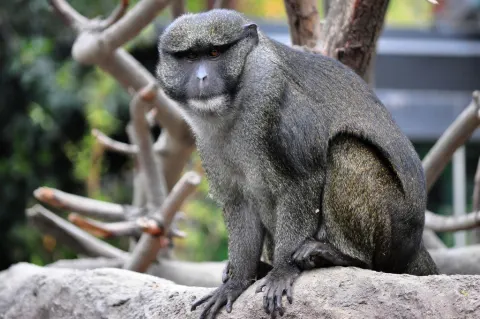
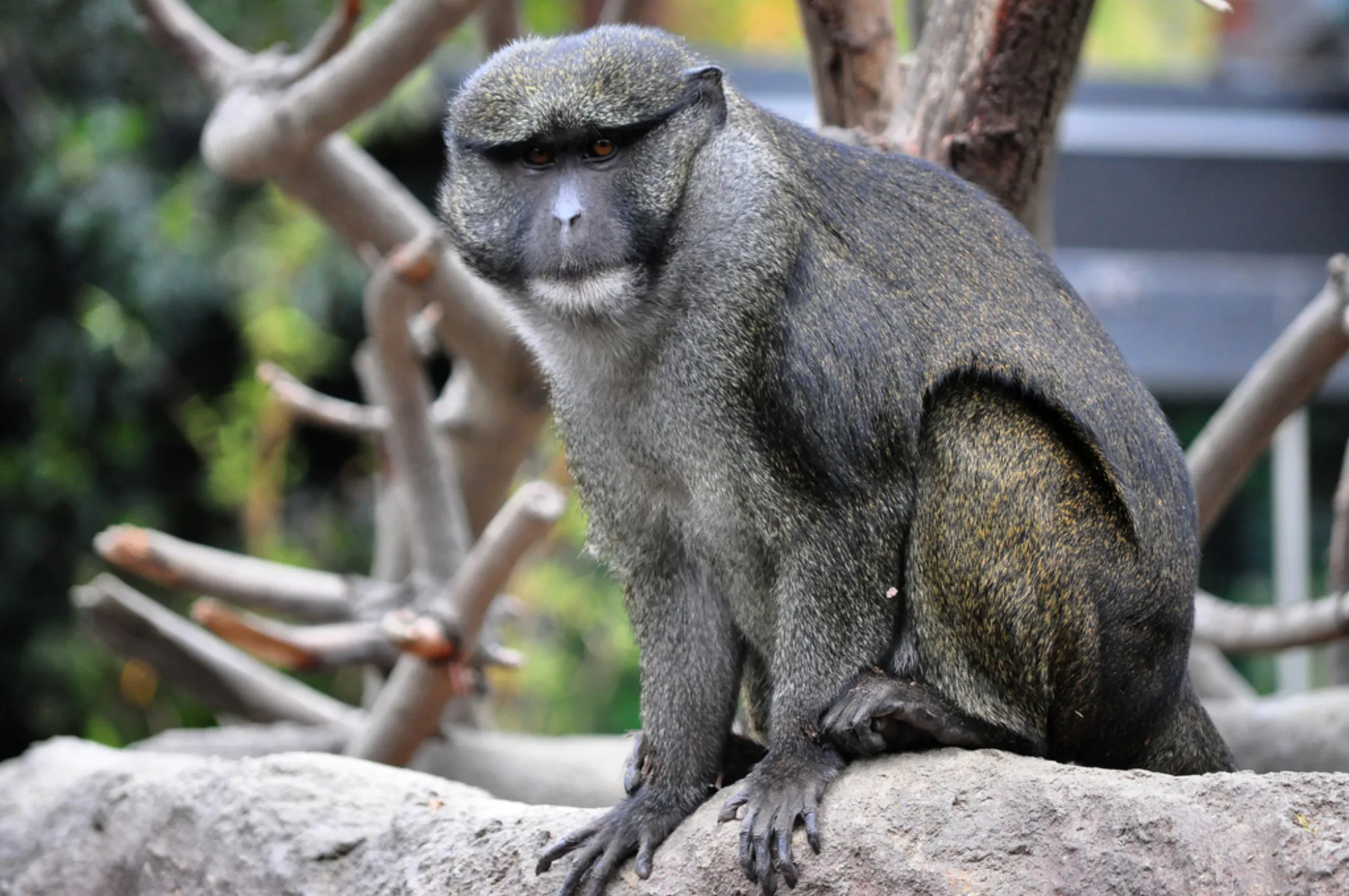
Often found in the central Congo Basin, the Allen's swamp monkey is a medium-sized primate with a notably robust build. Adults reach head and body lengths of approximately 18 in (46 cm) with tails that extend slightly further. Their coarse fur is a mix of green, gray, and brown tones, though the undersides and chest are pale. To help with a semiaquatic life, they possess webbing between their fingers. These monkeys are well-adapted for moving both on the ground and through the canopy.
Living in large social groups of more than 40 members, these diurnal animals use vocalizations like chirps to warn others of danger. They are typically seen in trees near water but regularly climb down to the ground to forage. Their diet is varied, consisting of fruit, seeds, and nectar alongside invertebrates like snails, worms, and fish. There is no specific breeding season, as they give birth throughout the year. Mothers are the main caregivers, usually looking after a single infant after a gestation of five or six months.
While populations currently remain stable, these monkeys face growing pressure from the bushmeat trade. Hunters target them for both local food and commercial sales. This poaching is expected to worsen as the logging industry expands, because new road networks allow easier access to the remote riparian forests and swamps where the monkeys live. Some individuals are also taken from the wild to be sold as exotic pets.
Written from the English Wikipedia article Allen's swamp monkey (CC BY-SA 4.0).
- Atlas places
- 0
These are open occurrence records, so they show where people looked for and recorded the Allen's Swamp Monkey as much as where it lives. Cells are up to 25 km across, and every location is generalised to its cell.
No encounter zones yet
Where and when you can expect to see Allen's Swamp Monkey is calculated from observation density. No zones have been computed for this species yet.
Conservation status not assessed here yet, so every location is generalised to its grid cell.