Red-legged Partridge
Alectoris rufa
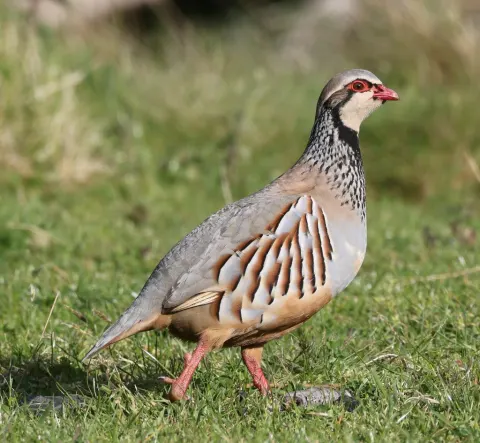
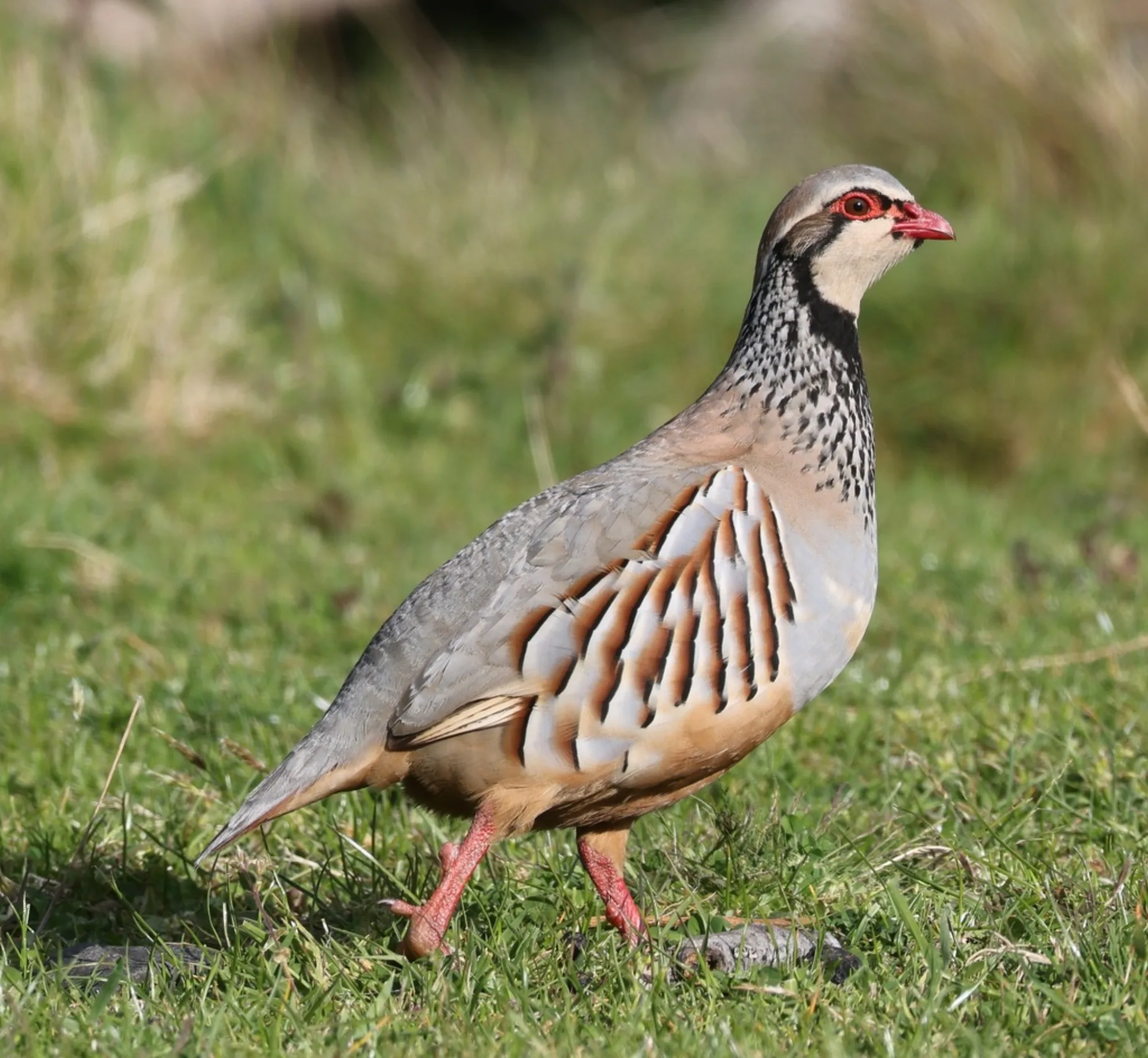
Round in shape and often seen on the ground, the Red-legged Partridge is a gamebird in the pheasant family. Its sandy-brown back, pale grey breast and pinkish-buff belly give it a muted appearance, while bold reddish-brown and black bars mark its flanks. Look for a creamy-white throat bordered in black, a bright red bill and eye-ring, and pinkish-red legs. Its call has three syllables, rendered as ka-chu-chu. When disturbed, it generally chooses to run, taking to its rounded wings for a short flight if it needs to.
The bird breeds naturally in southwestern Europe, including France, Iberia and northwest Italy. It was brought to Great Britain from France during the 18th century and has become established in flat parts of England and Wales, with breeding recorded as far north as Sutherland. It favours hot, dry places with sandy soil, and breeds in dry lowlands, including farmland and open, stony ground. A resident bird that lives on land, it gathers in flocks outside the breeding season. Seeds make up its diet, while insects are an essential source of protein, especially for young birds. It lays its eggs in a nest on the ground and can produce two clutches at the same time. Red-legged Partridges have also been known to share their habitat with wild rabbits.
The species is believed to be declining across its range. Birds are widely bred in captivity and released for shooting, and the breeding of chukars and chukar hybrids is prohibited because of its impact on wild Red-legged Partridge populations.
Written from the English Wikipedia article Red-legged partridge (CC BY-SA 4.0).
- Records
- 169,804
- Countries
- 4
No atlas park has a record of the Red-legged Partridge in or around it yet.
These are open occurrence records, so they show where people looked for and recorded the Red-legged Partridge as much as where it lives. Cells are up to 25 km across, and every location is generalised to its cell.
Generalised encounter areas, not exact locations. Each shape is a grid cell coloured by how likely the species is there.
- Very likelySpain25 km zone · high confidence · 78790 records · updated 80 days ago
- Very likelyUnited Kingdom25 km zone · high confidence · 42004 records · updated 80 days ago
- Very likelyPortugal25 km zone · high confidence · 31982 records · updated 80 days ago
- Very likelyFrance25 km zone · high confidence · 17028 records · updated 80 days ago
Conservation status not assessed here yet, so every location is generalised to its grid cell.