Common Kingfisher
Alcedo atthis
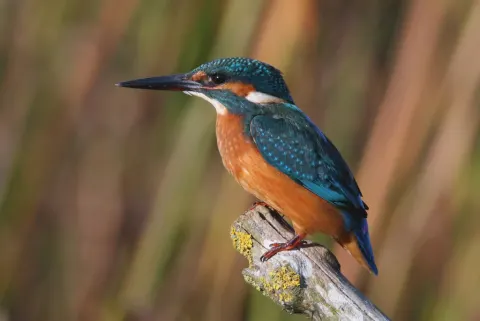
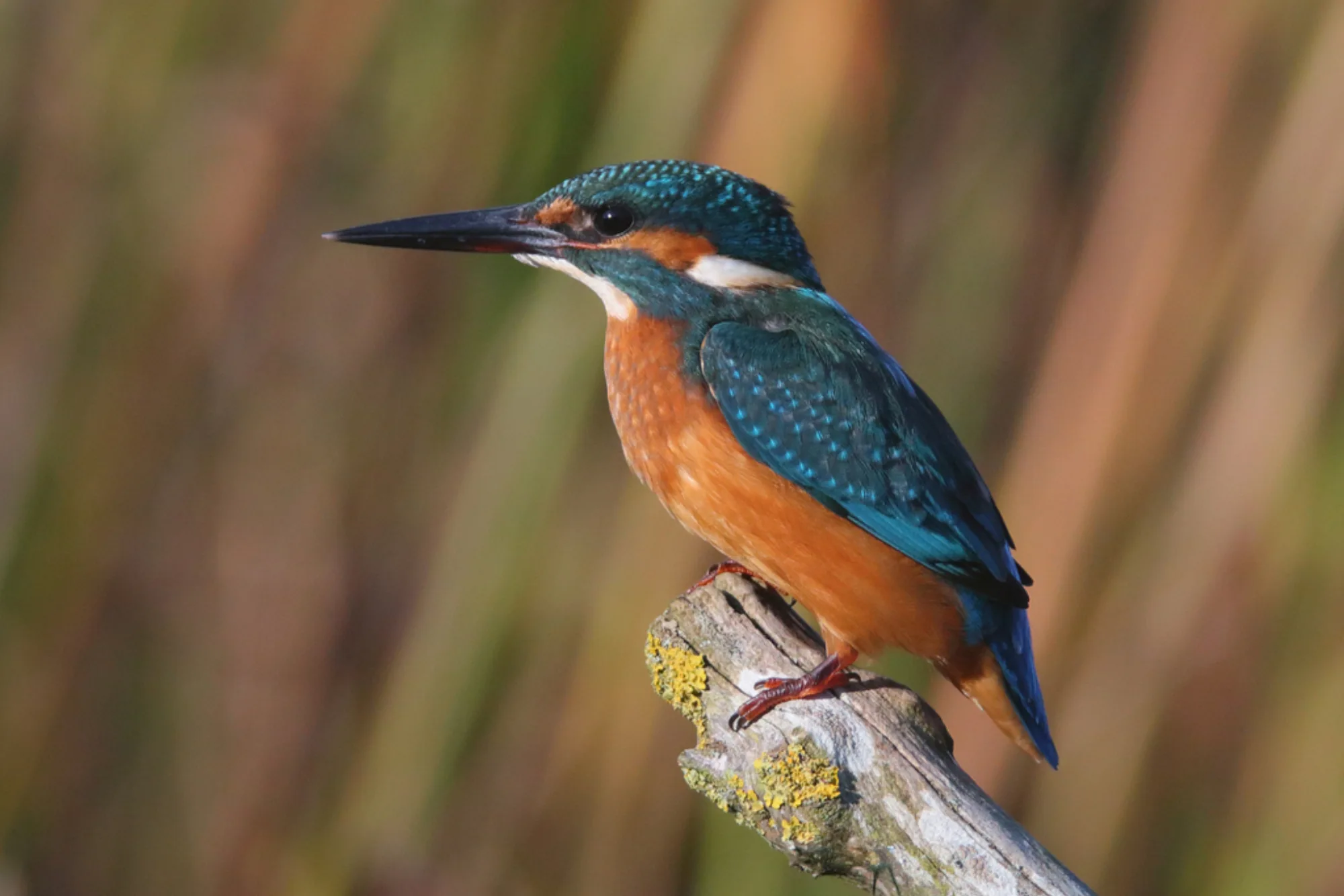
A low, fast flash of blue over water may reveal a Common Kingfisher in flight. About the size of a sparrow, it has a large head, short tail, long bill, blue upperparts and orange underparts. Its flight call is a short, sharp whistle, often repeated two or three times. In south and southeast Asia, other small blue and rufous kingfishers can look similar, and separating them may require a close look at the head pattern.
The species ranges widely across Europe, Asia and North Africa, and stays year-round in places with mild climates. Birds from regions where winter brings prolonged freezing migrate after breeding, mostly travelling at night. In temperate areas, look for it beside clear, slow-flowing rivers and streams or lakes with well-vegetated banks. It favours bushes and overhanging branches near shallow water, while tropical birds also live around mangrove creeks and swamps. In winter it often feeds around estuaries, harbours and rocky shores.
Usually solitary and territorial for much of the year, the kingfisher watches for prey from a perch before plunging into the water. Fish make up much of its food, alongside aquatic insects, crustaceans and sometimes amphibians. A pair digs a nesting burrow in a riverbank, and the female lays glossy white eggs in a chamber at its end. Both parents incubate during the day, and they may raise two broods, sometimes three, in a season. Severe winters can kill many birds, while summer floods can destroy nests or prevent parents from catching enough food. Pollution can make rivers unsuitable, and artificial riverbanks reduce prey populations; nesting birds are also disturbed by riverbank work.
Written from the English Wikipedia article Common kingfisher (CC BY-SA 4.0).
- Records
- 659,608
- Countries
- 104
- Atlas places
- 9
These are open occurrence records, so they show where people looked for and recorded the Common Kingfisher as much as where it lives. Cells are up to 25 km across, and every location is generalised to its cell.
Generalised encounter areas, not exact locations. Each shape is a grid cell coloured by how likely the species is there.
- Very likelyTaiwan25 km zone · high confidence · 133148 records · updated 86 days ago
- Very likelyIndia25 km zone · high confidence · 87320 records · updated 86 days ago
- Very likelySpain25 km zone · high confidence · 69983 records · updated 86 days ago
- Very likelyBelgium25 km zone · high confidence · 66503 records · updated 86 days ago
- Very likelyFrance25 km zone · high confidence · 55172 records · updated 86 days ago
- Very likelyUnited Kingdom25 km zone · high confidence · 40965 records · updated 86 days ago
- Very likelyPortugal25 km zone · high confidence · 27616 records · updated 86 days ago
- Very likelyIsrael25 km zone · high confidence · 17259 records · updated 86 days ago
- Very likelyJapan25 km zone · high confidence · 12690 records · updated 86 days ago
- Very likelyHong Kong SAR China25 km zone · high confidence · 10977 records · updated 86 days ago
Conservation status not assessed here yet, so every location is generalised to its grid cell.