Razorbill
Alca torda
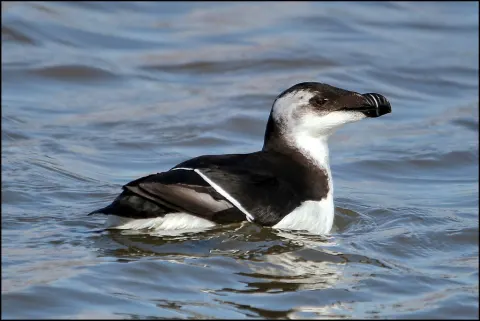
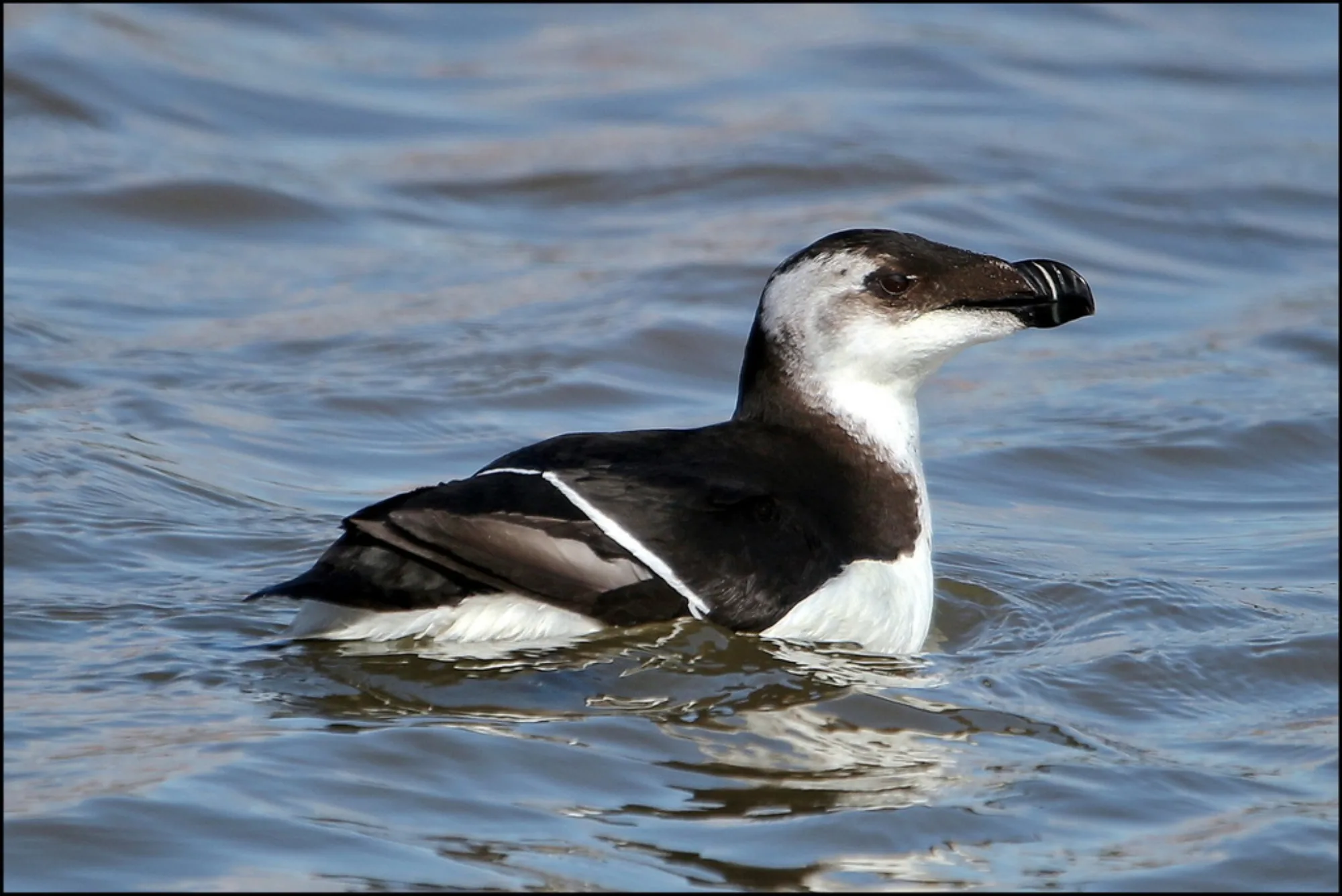
With its black upperparts, white belly and deep, blunt bill, the Razorbill cuts a distinctive figure among North Atlantic seabirds. In the breeding season, a fine white line runs from each eye towards the tip of the bill, which also bears a broken white mark. Outside the breeding season, its throat and the face behind the eye turn white, while the line becomes less prominent. Males and females look much alike, although males are generally larger. At 37 to 39 cm long, this thick-set auk can both fly and dive, and has a noticeably long tail.
Razorbills spend most of their lives on the water, coming ashore to breed in colonies on islands, rocky shores and cliffs. Their breeding range extends from eastern North America to western Europe, with approximately half of breeding pairs in Iceland. In winter, North American birds move offshore and south, while many western European birds stay close to their breeding sites. At sea, Razorbills use their wings to propel themselves underwater, usually spreading out rather than feeding in groups. They eat schooling fish including sandeels, sprats and herring, as well as crustaceans and marine worms.
Pairs stay together for life and often return to the same nesting site each year, choosing crevices among cliffs or boulders. The female usually lays a single egg between late April and May, and both parents take turns incubating it. Once the chick hatches, one parent stays at the nest while the other collects food at sea. After 17 to 23 days, the chick jumps from the cliff and heads to sea with its father. Oil pollution can damage breeding sites, while fishing nets can entangle birds and overfishing can reduce their prey.
Written from the English Wikipedia article Razorbill (CC BY-SA 4.0).
- Records
- 266,134
- Countries
- 19
- Atlas places
- 1
These are open occurrence records, so they show where people looked for and recorded the Razorbill as much as where it lives. Cells are up to 25 km across, and every location is generalised to its cell.
Generalised encounter areas, not exact locations. Each shape is a grid cell coloured by how likely the species is there.
- Very likelyUnited States25 km zone · high confidence · 83638 records · updated 80 days ago
- Very likelyCanada25 km zone · high confidence · 40912 records · updated 80 days ago
- Very likelyNorway25 km zone · high confidence · 39940 records · updated 80 days ago
- Very likelyUnited Kingdom25 km zone · high confidence · 38701 records · updated 80 days ago
- Very likelyFinland25 km zone · high confidence · 23765 records · updated 80 days ago
- Very likelySweden25 km zone · high confidence · 10776 records · updated 80 days ago
- Very likelyBelgium25 km zone · high confidence · 5767 records · updated 80 days ago
- Very likelyÅland Islands25 km zone · high confidence · 4988 records · updated 80 days ago
- Very likelyIreland25 km zone · high confidence · 2625 records · updated 80 days ago
- Very likelyPortugal25 km zone · high confidence · 2496 records · updated 80 days ago
Conservation status not assessed here yet, so every location is generalised to its grid cell.