Eurasian Skylark
Alauda arvensis
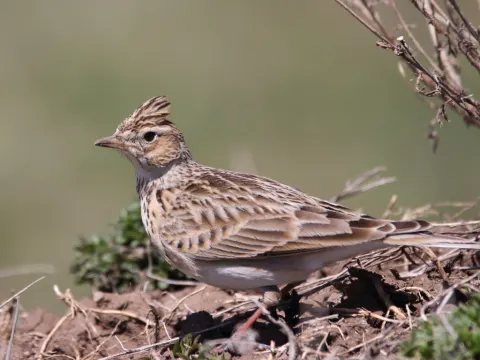
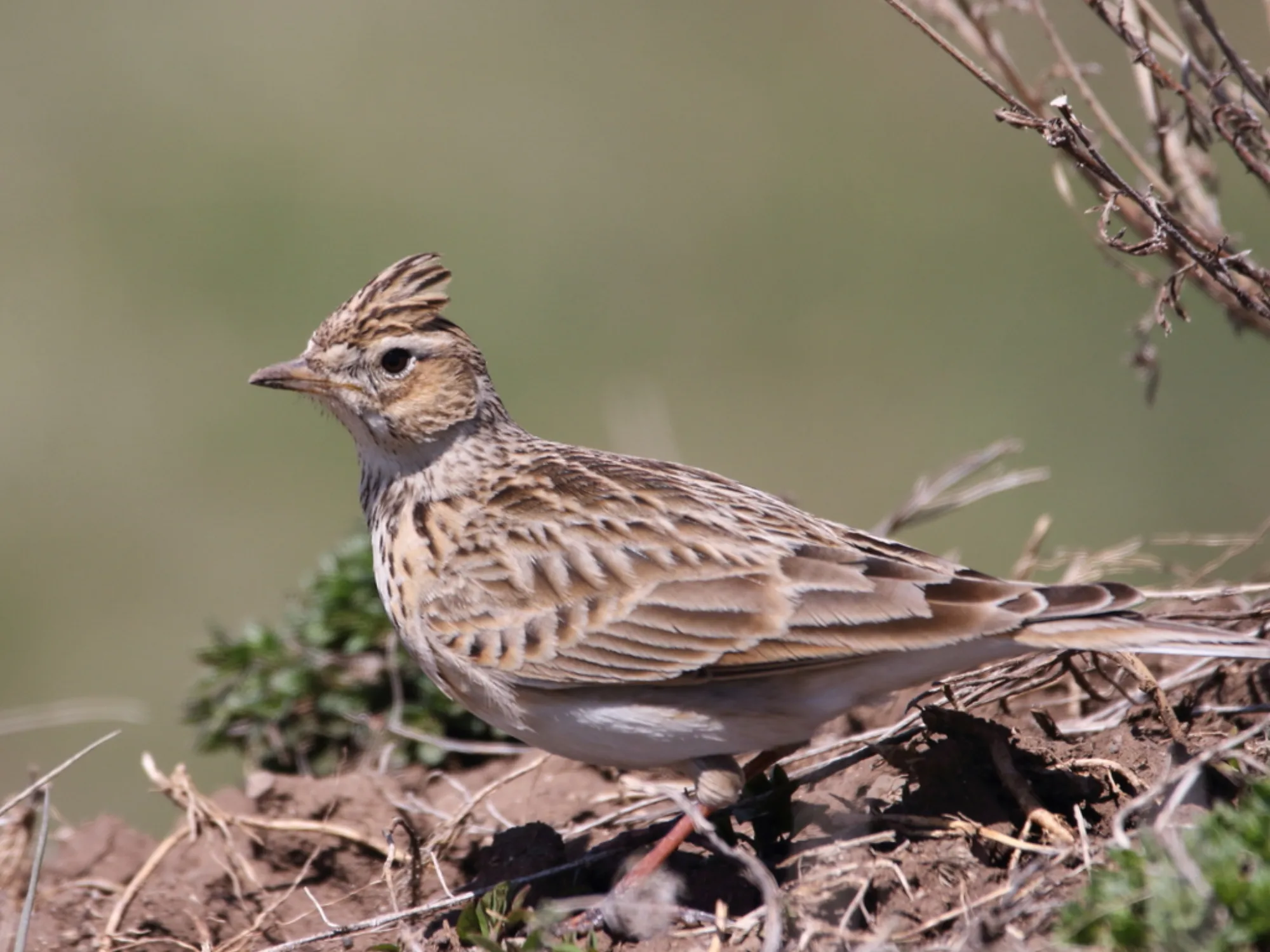
Above open farmland and heath, the song of a Eurasian Skylark can carry from a bird hovering high in the air. Its clear, bubbling warble continues without a break as the male rises, circles or hovers, sometimes appearing as little more than a dot from the ground. The bird is 18 to 19 cm long, with streaked greyish-brown upperparts and breast, a buff-white belly and a short crest it can raise or lower. In flight, look for white edges on the tail and the back of the wings as it flies away.
Its breeding range covers most of Europe and Asia, as well as the mountains of north Africa. It has also been introduced to Australia, New Zealand, Canada and the Hawaiian Islands. Birds in the west of its range mostly stay resident, while eastern populations are more migratory and move south for winter. It walks over the ground looking for insects, seeds and young leaves, with insects especially important in summer. The female makes an open nest in a shallow hollow, away from trees, bushes and hedges, and lays three to five eggs. Both parents feed the chicks, which leave the nest before they can fly and hide among vegetation while their parents continue to feed them. A pair can raise several broods in a season.
Larger birds and small mammals take a heavy toll on nests. In the UK, changes in farming practices have driven much of the decline, with pesticides playing a smaller part. Winter-grown cereal fields become too dense in summer for skylarks to move between the wheat stems and find food; habitat loss has also reduced numbers on Vancouver Island.
Written from the English Wikipedia article Eurasian skylark (CC BY-SA 4.0).
- Records
- 648,217
- Countries
- 21
- Atlas places
- 1
These are open occurrence records, so they show where people looked for and recorded the Eurasian Skylark as much as where it lives. Cells are up to 25 km across, and every location is generalised to its cell.
Generalised encounter areas, not exact locations. Each shape is a grid cell coloured by how likely the species is there.
- Very likelyUnited Kingdom25 km zone · high confidence · 211477 records · updated 81 days ago
- Very likelyNorway25 km zone · high confidence · 149883 records · updated 81 days ago
- Very likelyBelgium25 km zone · high confidence · 96038 records · updated 81 days ago
- Very likelyFrance25 km zone · high confidence · 42814 records · updated 81 days ago
- Very likelyNew Zealand25 km zone · high confidence · 30953 records · updated 81 days ago
- Very likelyAustralia25 km zone · high confidence · 22305 records · updated 81 days ago
- Very likelySweden25 km zone · high confidence · 13528 records · updated 81 days ago
- Very likelyUnited States25 km zone · high confidence · 13002 records · updated 81 days ago
- Very likelyFinland25 km zone · high confidence · 12281 records · updated 81 days ago
- Very likelySpain25 km zone · high confidence · 12143 records · updated 81 days ago
Conservation status not assessed here yet, so every location is generalised to its grid cell.