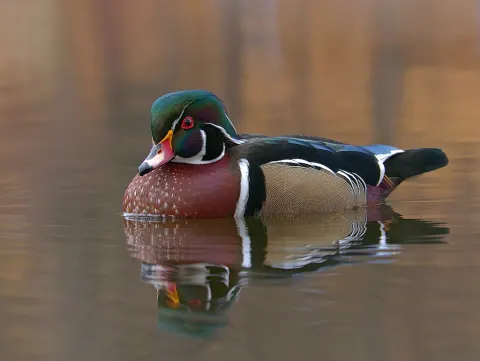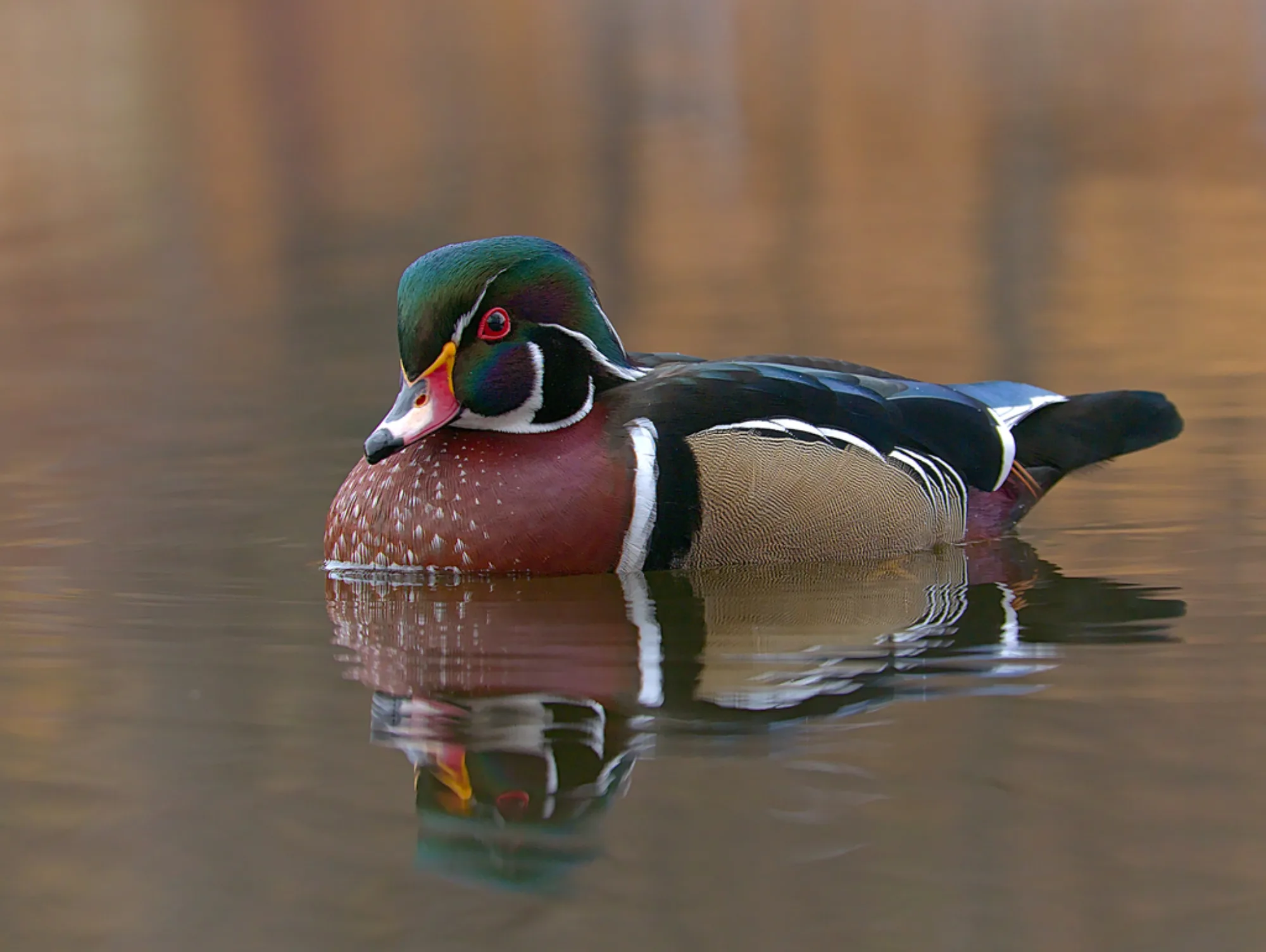
Wood Duck
Aix sponsa
Look for the Wood Duck in wooded wetlands across parts of North America, where it perches and nests in trees. This medium-sized duck has a crested head, and an adult typically measures 47 to 54 cm in length. The male has iridescent, multicoloured plumage, red eyes and a distinctive white mark down his neck. The less colourful female has a pale throat and a white ring around her eye. Listen for the male's rising whistle or the female's drawn-out, rising squeal when she is flushed.
It breeds around marshes, ponds, creeks, shallow lakes and wooded swamps, from the eastern United States to the west coast, as well as in neighbouring southern Canada and coastal western Mexico. Most breeding now takes place in the Mississippi alluvial valley, and the species has extended its breeding range towards the Great Plains. Some birds stay year-round in southern areas, but northern populations move south for winter. Wood Ducks feed at the water's surface or graze on land, eating mainly berries, acorns and seeds, along with insects. They usually nest in tree cavities near water, though they also use nest boxes in wetlands. Females generally lay seven to fifteen eggs, and the ducklings leave the nest the day after hatching. Their mother calls them down and guides them to water, where they can already swim and find food.
Wood Ducks face predators including owls, mink, raccoons and foxes, while other animals compete with them for nesting cavities. Habitat loss and hunting for meat and feathers caused a severe decline in the late 19th century. Habitat protection, hunting regulations and nest boxes helped populations recover, though the Wood Duck remains a commonly hunted species in North America.
Written from the English Wikipedia article Wood duck (CC BY-SA 4.0).
- Records
- 2,004,459
- Countries
- 2
- Atlas places
- 1
These are open occurrence records, so they show where people looked for and recorded the Wood Duck as much as where it lives. Cells are up to 25 km across, and every location is generalised to its cell.
Generalised encounter areas, not exact locations. Each shape is a grid cell coloured by how likely the species is there.
- Very likelyUnited States25 km zone · high confidence · 1616329 records · updated 80 days ago
- Very likelyCanada25 km zone · high confidence · 388130 records · updated 80 days ago
Conservation status not assessed here yet, so every location is generalised to its grid cell.