Mandarin Duck
Aix galericulata
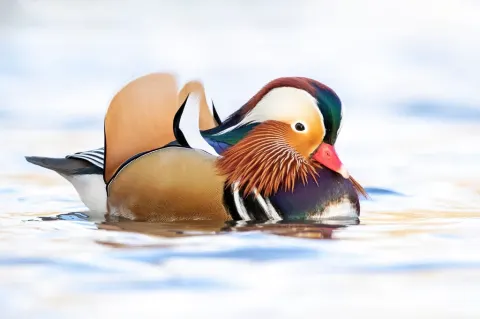
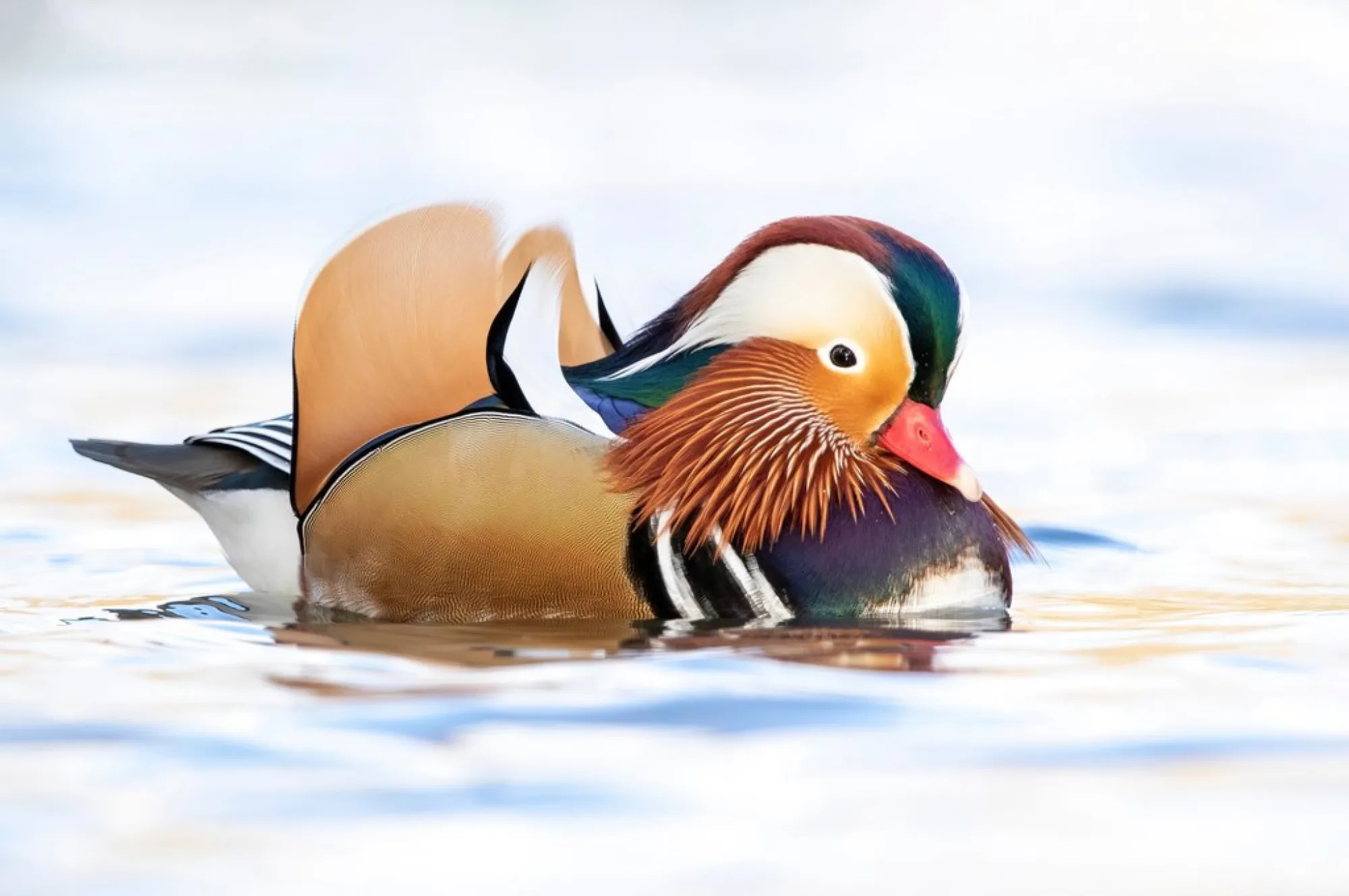
A male Mandarin Duck in breeding plumage is easy to pick out, with a red bill, a white crescent above the eye and two orange feathers raised like sails on its back. His purple breast has two white bars, while his face and whiskers are reddish. The female is more subdued, with greyish-brown plumage and a fine white ring and stripe around and behind the eye. After the mating season, the male moults into plumage resembling the female's, though his bright bill and less distinct eye stripe can help distinguish him.
Native to East and Northeast Asia, this perching duck favours densely wooded, shrubby shores along rivers and lakes. Asian populations migrate, spending winter in lowland eastern China and southern Japan, where the birds also use marshes, flooded fields and open rivers. Introduced populations live in the British Isles and Western Europe, often around lakes, water meadows and cultivated land near woods. Shy birds, they tend to shelter beneath trees and gather in small flocks, though they can become bolder around people. Look for them feeding near dawn or dusk, dabbling or walking on land for plants and seeds, as well as snails, insects and small fish.
In spring, pairs nest in tree cavities near water, with nine to twelve eggs laid in April or May. Soon after hatching, the ducklings leap from the tree and follow their mother to water. Logging destroys forest habitat and is the species' greatest threat. Some birds are shot accidentally by hunters who cannot identify them in flight, while others are poached for their plumage.
Written from the English Wikipedia article Mandarin duck (CC BY-SA 4.0).
- Records
- 80,180
- Countries
- 25
No atlas park has a record of the Mandarin Duck in or around it yet.
These are open occurrence records, so they show where people looked for and recorded the Mandarin Duck as much as where it lives. Cells are up to 25 km across, and every location is generalised to its cell.
Generalised encounter areas, not exact locations. Each shape is a grid cell coloured by how likely the species is there.
- Very likelyUnited Kingdom25 km zone · high confidence · 36344 records · updated 80 days ago
- Very likelyGermany25 km zone · high confidence · 7547 records · updated 80 days ago
- Very likelyUnited States25 km zone · high confidence · 6755 records · updated 80 days ago
- Very likelyChina25 km zone · high confidence · 5931 records · updated 80 days ago
- Very likelyNorway25 km zone · high confidence · 3898 records · updated 80 days ago
- Very likelySouth Korea25 km zone · high confidence · 2936 records · updated 80 days ago
- Very likelyTaiwan25 km zone · high confidence · 2461 records · updated 80 days ago
- Very likelyJapan25 km zone · high confidence · 2395 records · updated 80 days ago
- Very likelyFrance25 km zone · high confidence · 2179 records · updated 80 days ago
- Very likelyBelgium25 km zone · high confidence · 2130 records · updated 80 days ago
Conservation status not assessed here yet, so every location is generalised to its grid cell.