Red Panda
Ailurus fulgens
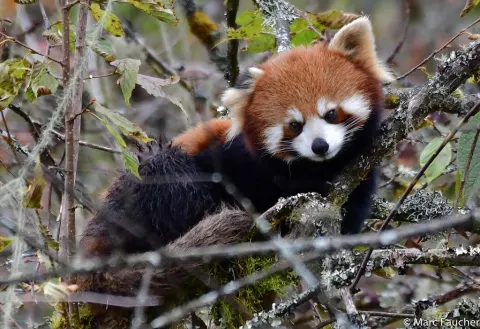
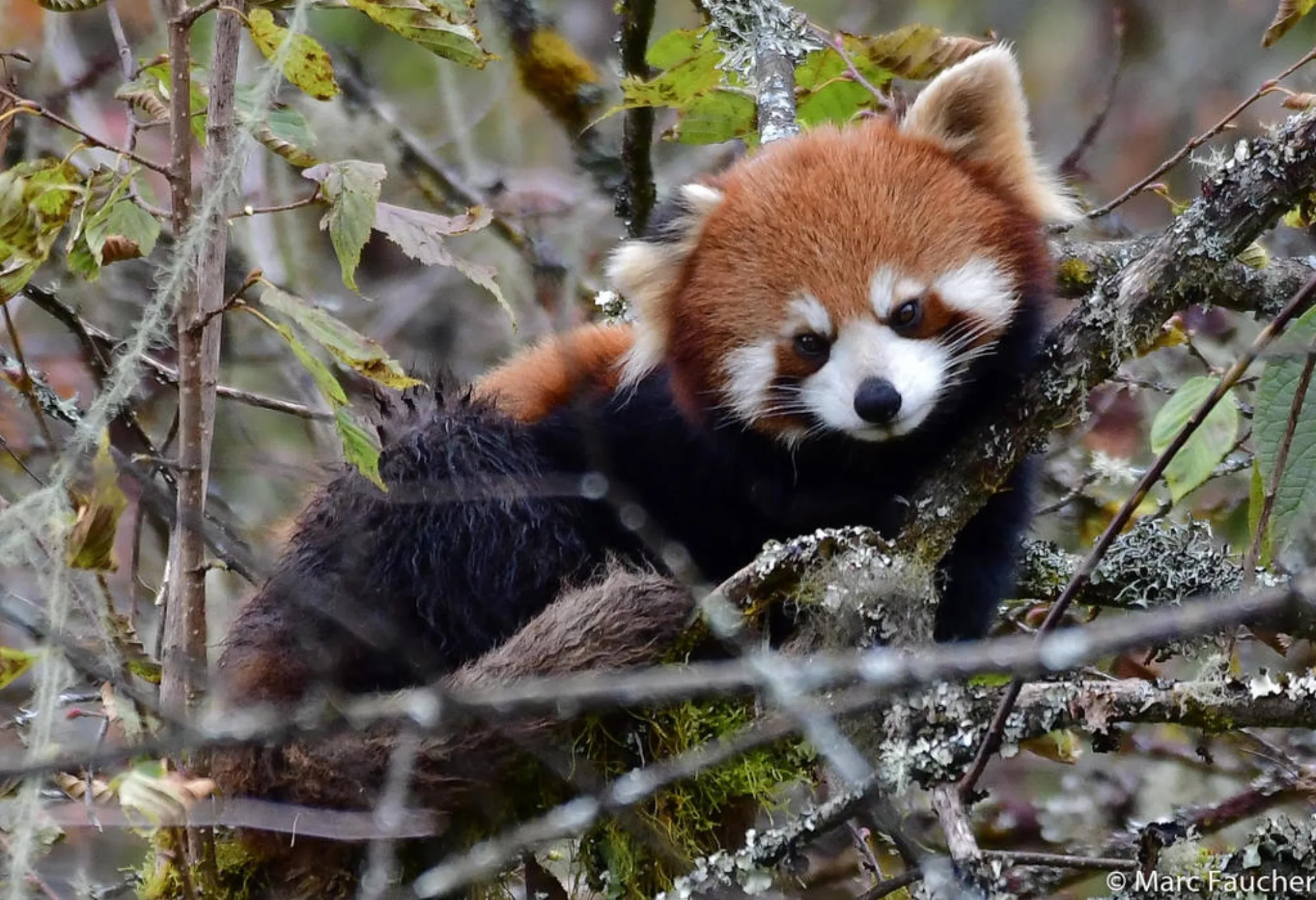
A small mammal of the eastern Himalayas and southwestern China, the Red Panda has dense reddish-brown fur, black legs and belly, and a bushy, ringed tail. Its mostly white muzzle, pale ear margins and white cheeks stand out against the darker coat. The tail helps it balance as it climbs, while fur on the soles of its paws helps it walk in snow.
Its range includes Nepal, Bhutan, northern Myanmar, parts of India and southern China. It inhabits coniferous, temperate broadleaf and mixed forests, often on steep slopes with thick bamboo cover near water. Fallen logs and stumps help it reach bamboo leaves. Difficult to observe in the wild, it spends much of its life in trees and appears to be active at night and around dawn and dusk. In warm weather it may rest stretched along a branch with its legs hanging down; when cold, it curls up. Adults generally live alone and mark their territories with scent.
Bamboo shoots and leaves form the main part of its diet, although it also eats fruit, blossoms, eggs, birds and small mammals. It usually feeds sitting or standing, holding food in a front paw. Females give birth from May to August, typically in litters of one to four cubs. Beforehand, a mother makes a nest in a hollow tree, log or stump, or in a rock crevice. Habitat loss and fragmentation are major threats, driven by deforestation and disturbance from people and livestock. Roads can block movement between forest patches, while poaching and traps set for other wildlife also kill red pandas.
Written from the English Wikipedia article Red panda (CC BY-SA 4.0).
- Records
- 11
- Countries
- 2
- Atlas places
- 1
These are open occurrence records, so they show where people looked for and recorded the Red Panda as much as where it lives. Cells are up to 25 km across, and every location is generalised to its cell.
Generalised encounter areas, not exact locations. Each shape is a grid cell coloured by how likely the species is there.
- Very likelyUnited States25 km zone · medium confidence · 8 records · updated 80 days ago
- PossibleNepal25 km zone · medium confidence · 3 records · updated 80 days ago
Conservation status not assessed here yet, so every location is generalised to its grid cell.