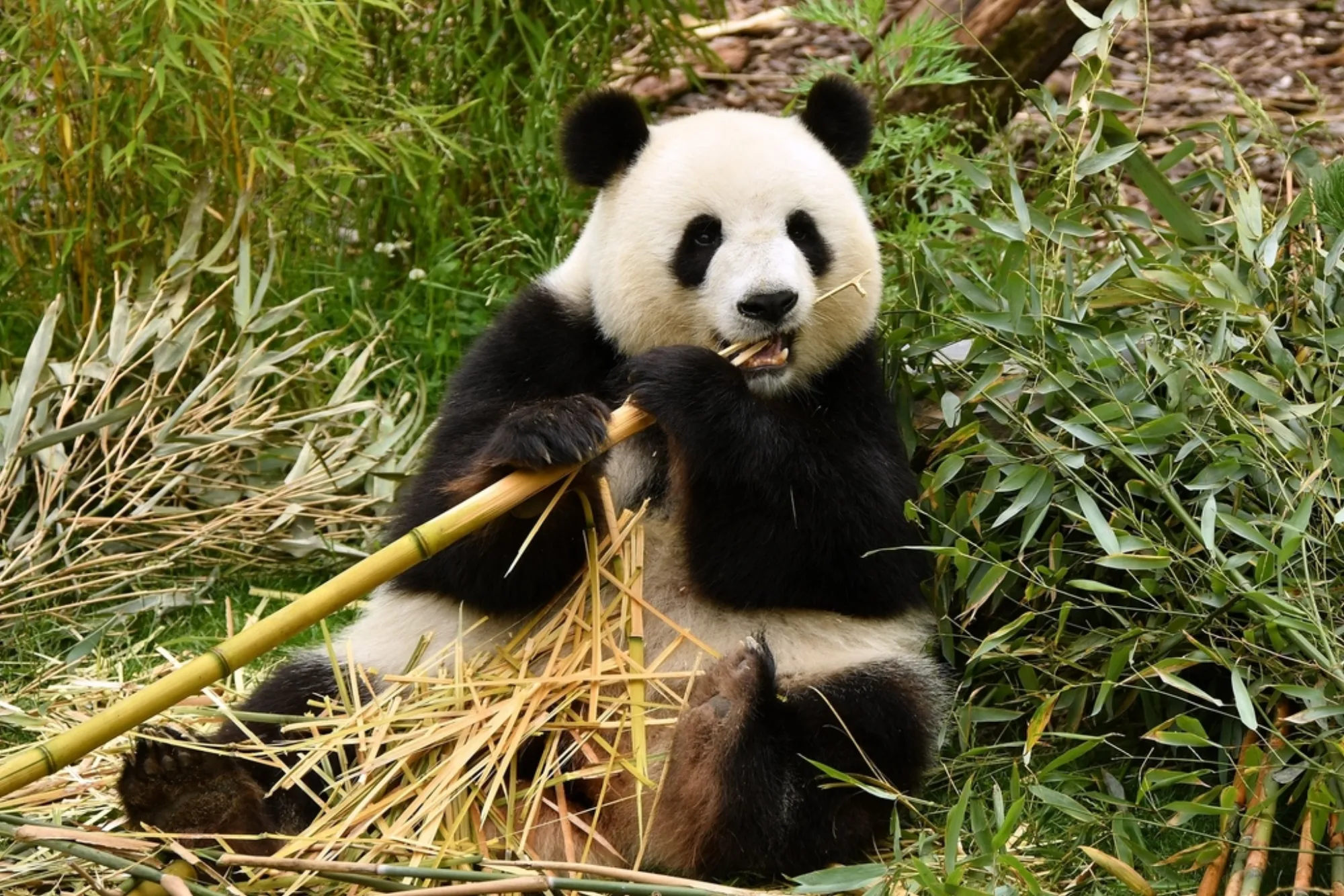
Giant Panda
Ailuropoda melanoleuca
Characterised by a rotund body and white coat with black patches over the eyes, ears, and limbs, the Giant Panda is a bear endemic to China. Adults generally weigh between 100 and 115 kg and reach lengths of 1.2 to 1.9 m. Their distinctive fur serves as camouflage in both summer and winter, as they do not hibernate. While the white areas blend with snow, the black shoulders and legs provide concealment in the shade.
Today, these bears live in fragmented populations across six mountainous regions, primarily in Sichuan, Shaanxi, and Gansu. They inhabit old-growth forests and montane regions at elevations up to 3,000 m. Though they are solitary animals that only gather for brief breeding seasons between March and May, they communicate year-round using scent marks on trees and rocks. Females raise their cubs alone for up to two years.
Despite their taxonomic classification as carnivorans, bamboo makes up approximately 99% of their diet. To compensate for the low energy content of this food, an adult giant panda eats 9 to 14 kg of bamboo shoots per day. They even possess a modified bone in the paw that acts like a thumb to help them hold the stalks. The species faces significant threats from habitat loss due to farming, deforestation, and the construction of roads. They are also susceptible to climate change and diseases from livestock or domestic pets.
Written from the English Wikipedia article Giant panda (CC BY-SA 4.0).
- Records
- 4
- Countries
- 1
- Atlas places
- 0
These are open occurrence records, so they show where people looked for and recorded the Giant Panda as much as where it lives. Cells are up to 25 km across, and every location is generalised to its cell.
Generalised encounter areas, not exact locations. Each shape is a grid cell coloured by how likely the species is there.
- Very likelyChina50 km zone · medium confidence · 4 records · updated 4 days ago