Cottonmouth
Agkistrodon piscivorus
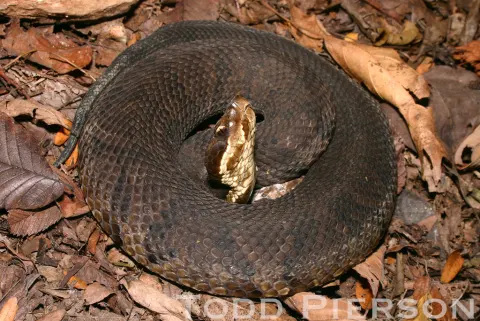
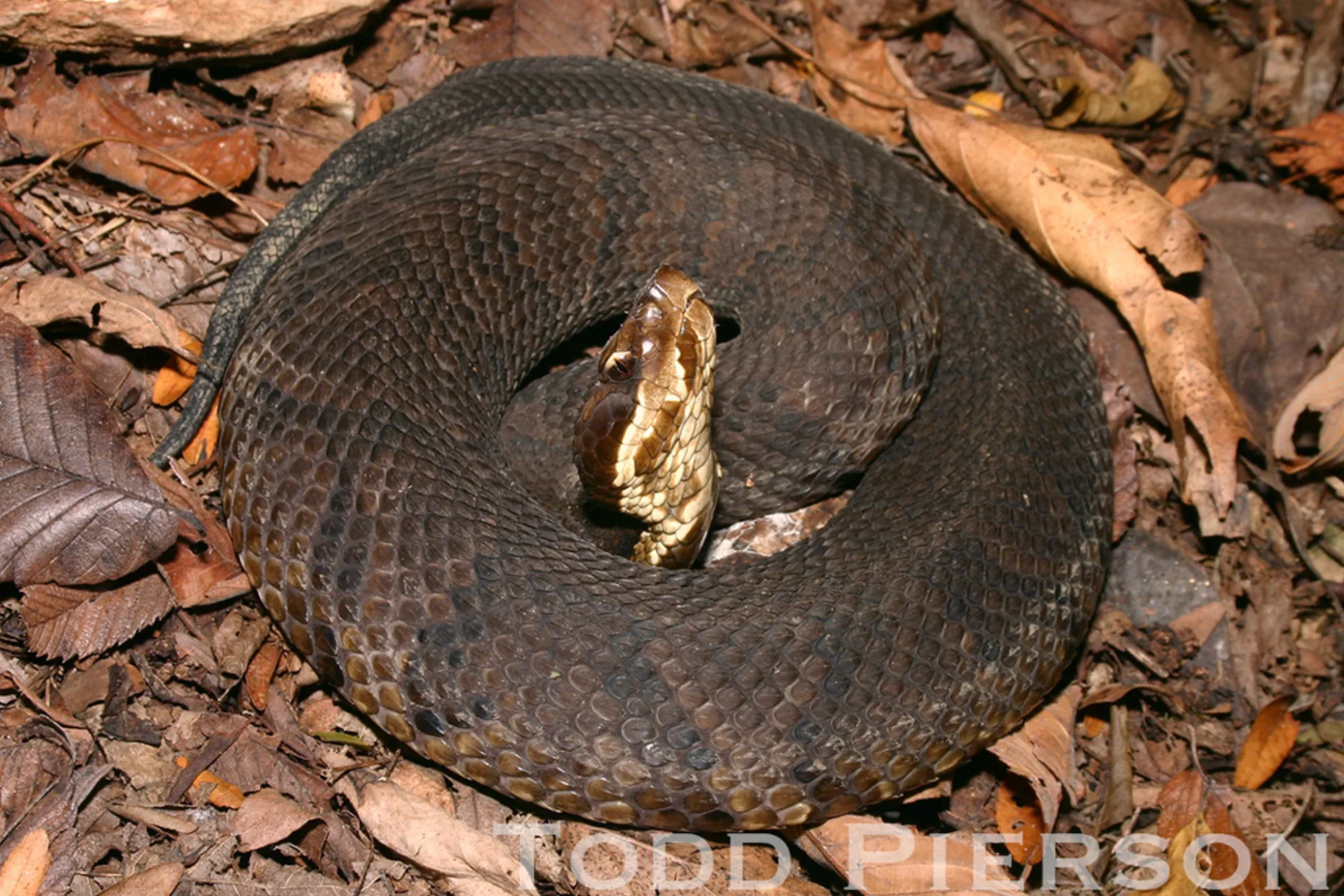
A broad, triangular head and a heavy body give the Cottonmouth a distinctive shape. This venomous, semiaquatic viper commonly exceeds 80 cm in length as an adult. Its colouring ranges from brown and grey to yellowish-olive or blackish, sometimes with dark crossbands. The bands fade with age, and older snakes can be almost uniformly dark. Young snakes have a more contrasting pattern and usually a yellowish tail tip. When threatened, a Cottonmouth may stand its ground and open its mouth, showing the white lining that gives it its name. It can also coil and display its fangs, and may bite if threatened or handled.
Native to the southeastern United States, it lives around creeks, streams, marshes, swamps and the edges of ponds and lakes. It also inhabits barrier islands, where it tends to favour freshwater marshes, and can turn up in drier places such as pine woods and prairies. A capable swimmer, it sometimes crosses between barrier islands and the mainland. Look for it basking in the morning or on cool days; on bright, sunny days it is usually in the shade. It can be active by day or night and often emerges at sunset before becoming active through the night.
Fish and frogs make up much of its diet, though it also eats animals ranging from insects to birds and small turtles. Young snakes wiggle their tail tips to lure prey within striking distance. Females usually give birth to one to sixteen live young, with six to eight most common. Persecution and the drainage of wetlands for development have taken a heavy toll on local populations, and some Cottonmouths are hunted for their skins.
Written from the English Wikipedia article Agkistrodon piscivorus (CC BY-SA 4.0).
- Records
- 1,660
- Countries
- 1
- Atlas places
- 1
These are open occurrence records, so they show where people looked for and recorded the Cottonmouth as much as where it lives. Cells are up to 25 km across, and every location is generalised to its cell.
Generalised encounter areas, not exact locations. Each shape is a grid cell coloured by how likely the species is there.
- Very likelyUnited States25 km zone · medium confidence · 1660 records · updated 80 days ago
Conservation status not assessed here yet, so every location is generalised to its grid cell.