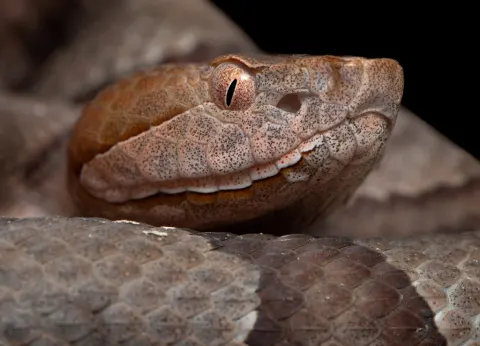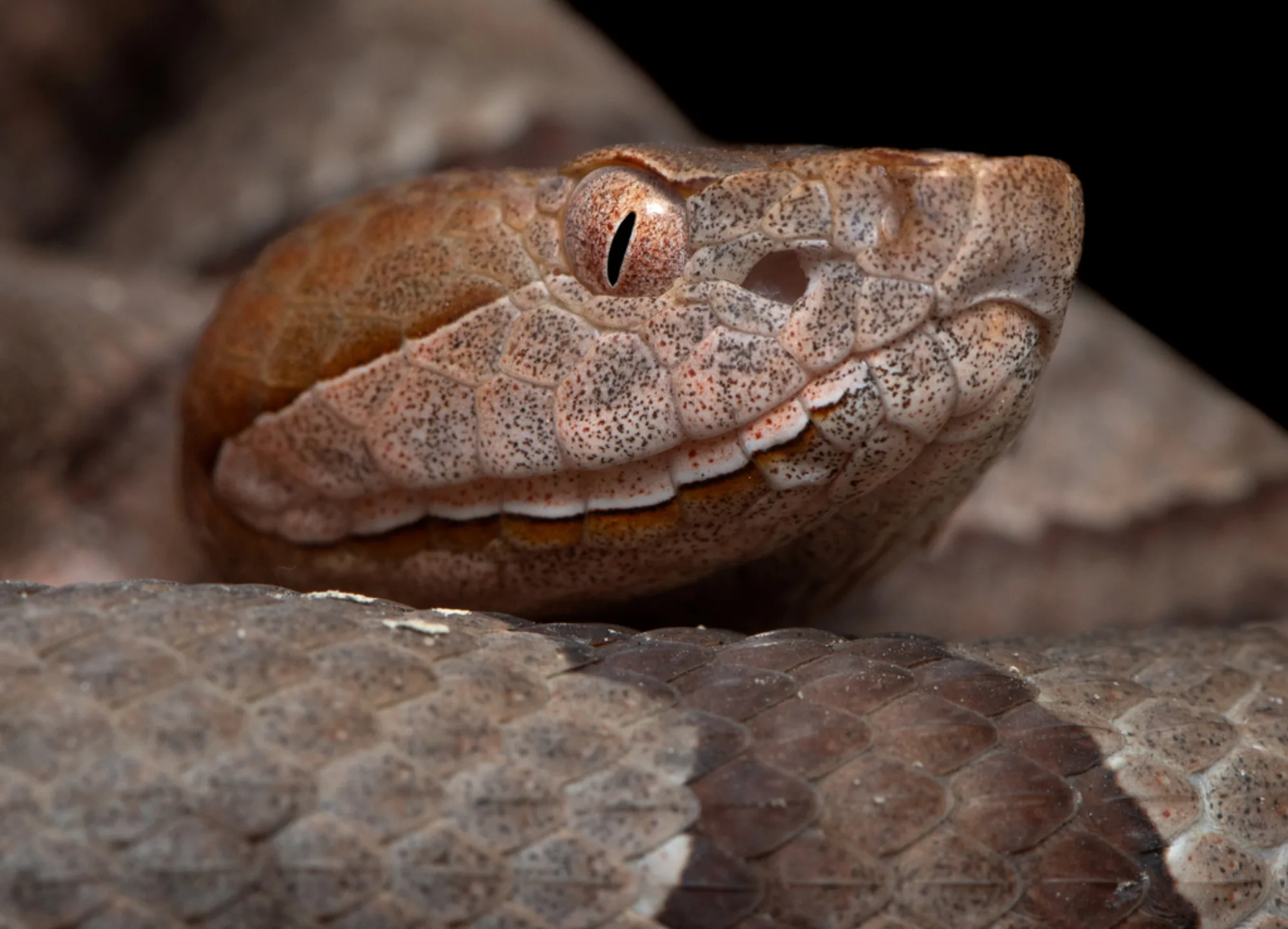
Northern Copperhead
Agkistrodon contortrix
Among the leaf litter of eastern American woodlands, the Northern Copperhead can be difficult to spot. This venomous snake has a heavy body, a broad head and dark brown hourglass markings against a lighter reddish brown or brown-grey background. Adults typically measure 50 to 95 cm, while newborns have green or yellow tail tips that darken as they grow.
Its range extends across many states in the eastern United States and into Chihuahua and Coahuila in Mexico. Deciduous forest and mixed woodland are favoured habitats, though the snake also occupies rocky ledges, swamps and, around the Gulf of Mexico, coniferous forest. In the Chihuahuan Desert, it inhabits waterside areas, usually close to lasting or seasonal water sources, and occasionally dry arroyos. It hibernates through winter in dens or limestone crevices, often sharing them with black rat snakes and timber rattlesnakes. In the southern United States, it is active at night during hot summers but often ventures out by day in spring and autumn.
Copperheads usually wait in ambush, although they actively pursue insects such as caterpillars and freshly moulted cicadas. Their varied diet also includes lizards, frogs, mice and other small animals. Females give birth to live young, typically four to seven in a litter, though they do not breed every year. When a person approaches, a copperhead is more likely to stay concealed or flee than behave defensively, but it may strike if threatened. Habitat fragmentation can limit access to feeding, winter shelter and breeding sites; potential predators include bullfrogs, opossums, birds of prey and other snakes.
Written from the English Wikipedia article Eastern copperhead (CC BY-SA 4.0).
- Records
- 2,157
- Countries
- 1
- Atlas places
- 2
These are open occurrence records, so they show where people looked for and recorded the Northern Copperhead as much as where it lives. Cells are up to 25 km across, and every location is generalised to its cell.
Generalised encounter areas, not exact locations. Each shape is a grid cell coloured by how likely the species is there.
- Very likelyUnited States25 km zone · medium confidence · 2157 records · updated 80 days ago
Conservation status not assessed here yet, so every location is generalised to its grid cell.