Agkistrodon conanti
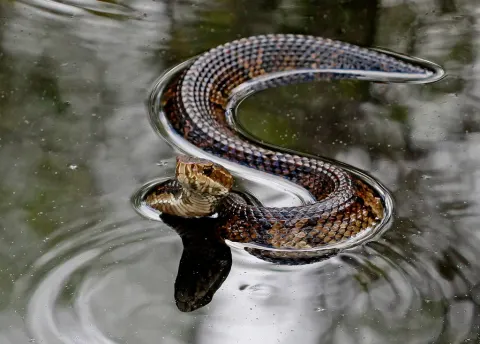
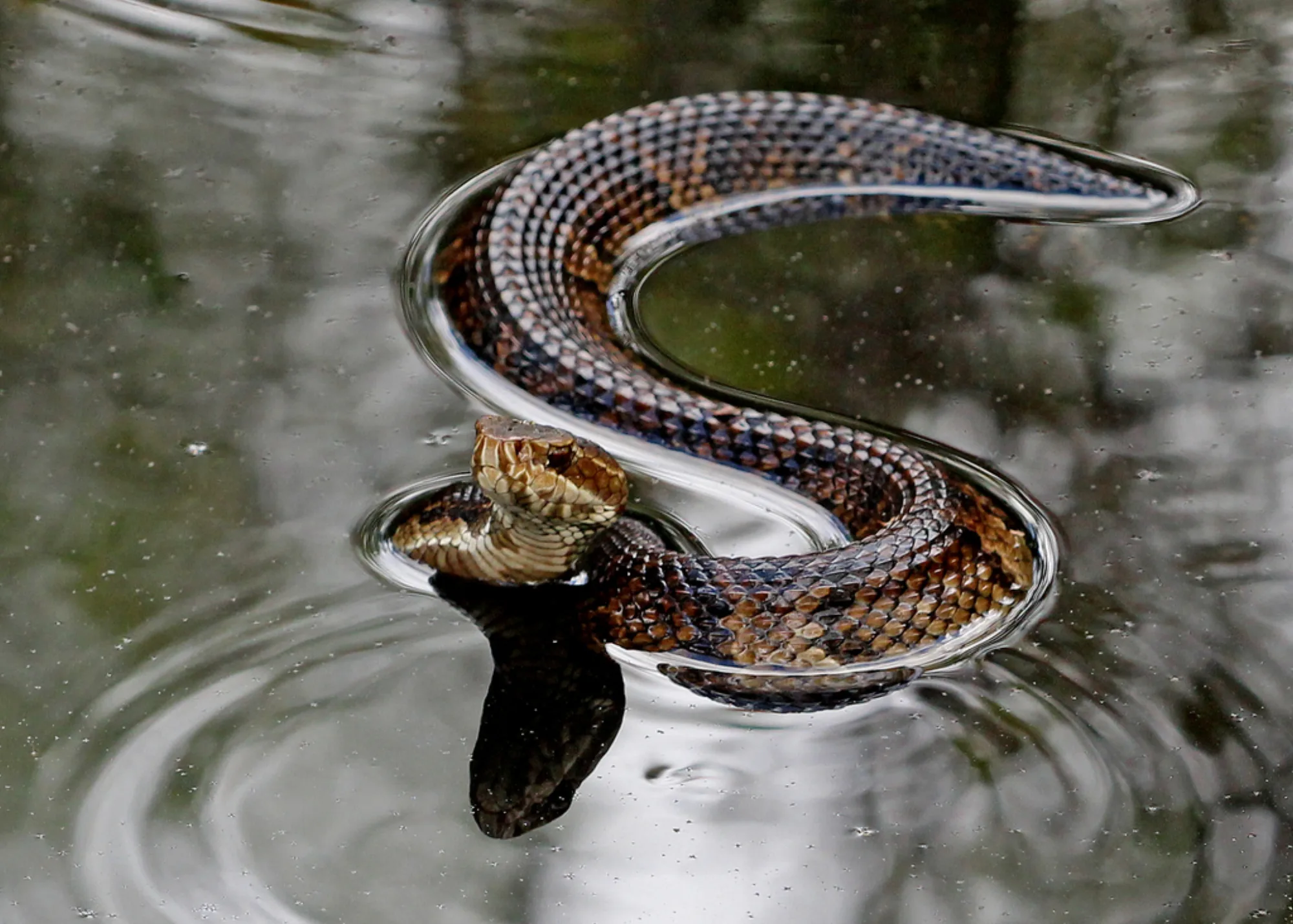
A thick body and boldly marked head help distinguish the Florida cottonmouth, Agkistrodon conanti, a venomous pit viper. Adults average 76 to 122 cm in length, although rare individuals can exceed 183 cm. Black stripes run along each cheek, bordered above and below by cream or white. Its body ranges from olive brown to black, with 10 to 17 dark bands that may have paler, irregularly marked centres. Cottonmouths often darken as they age, and adults can have faint bands or none visible at all. The species can be confused with harmless watersnakes and other snakes that share its wetland habitat.
Found in the southeastern United States, it ranges across the Florida peninsula and into southern Georgia, including barrier islands and keys. It lives in nearly every kind of wetland in the region, including places with brackish water, but can also be encountered up to 1.6 km from surface water. In the Okefenokee Swamp, look for its habitat along wooded water edges and in thickets beside cypress ponds. In the Everglades, it has been found among palmetto clumps away from water. Cottonmouths also gather around drying water holes, probably because prey becomes concentrated there. Females generally breed every other year, with most births taking place in summer. A litter can contain one to 15 young; the newborns have adult-like patterns but are clay-red in colour. A record from Key West is questionable, and no suitable habitat remains there.
Written from the English Wikipedia article Florida cottonmouth (CC BY-SA 4.0).
- Records
- 326
- Countries
- 1
- Atlas places
- 1
These are open occurrence records, so they show where people looked for and recorded the Agkistrodon conanti as much as where it lives. Cells are up to 25 km across, and every location is generalised to its cell.
Generalised encounter areas, not exact locations. Each shape is a grid cell coloured by how likely the species is there.
- Very likelyUnited States25 km zone · medium confidence · 326 records · updated 80 days ago
Conservation status not assessed here yet, so every location is generalised to its grid cell.