Red-winged Blackbird
Agelaius phoeniceus
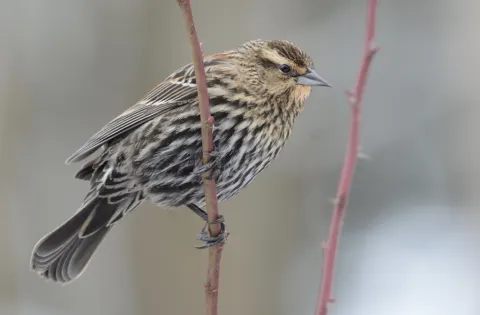
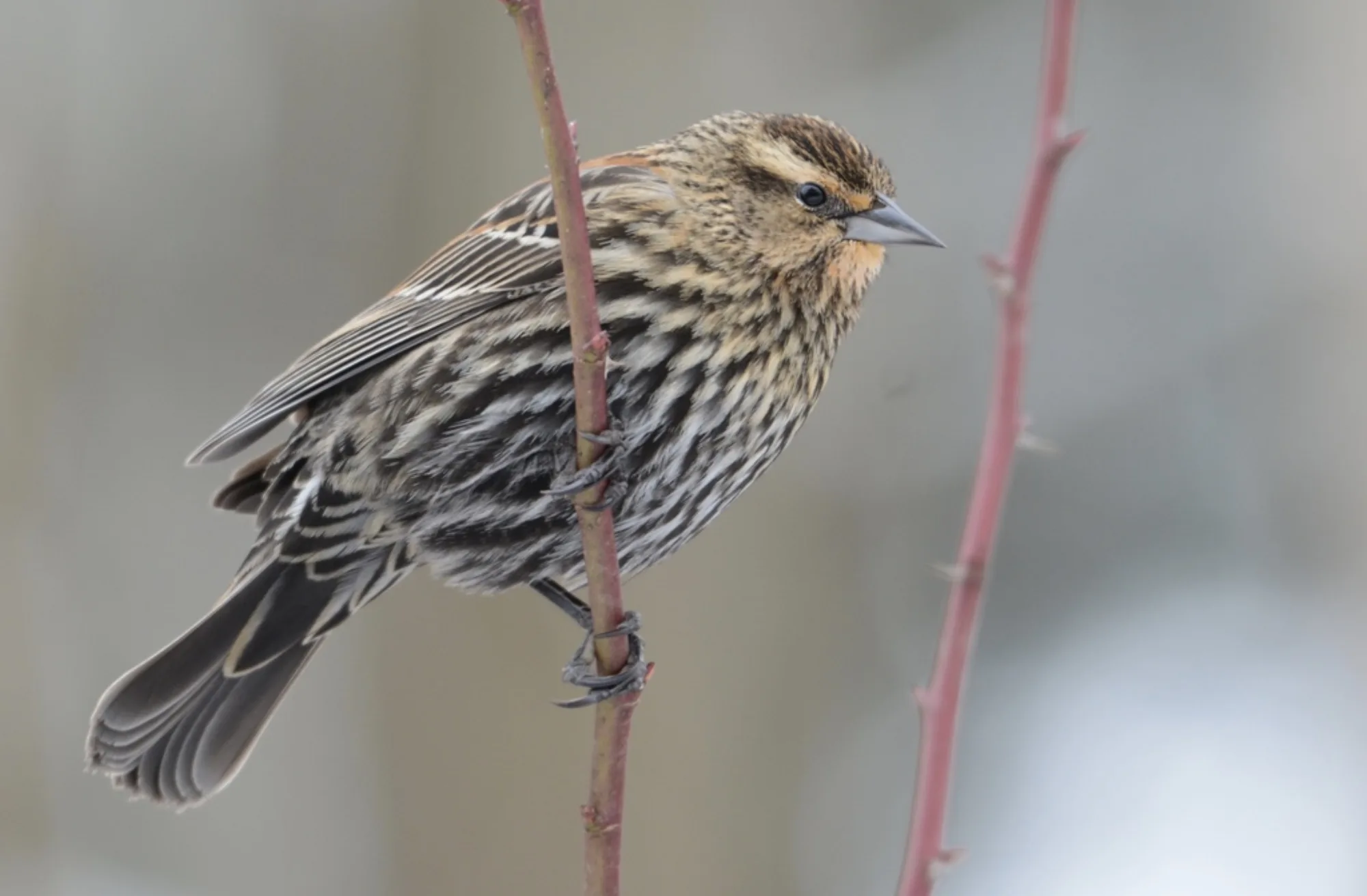
A flash of red on a black bird's shoulder can announce a male Red-winged Blackbird, especially when he flies or displays. At rest, a pale yellow wing bar is also visible, although males in some populations lack the yellow band. Females are smaller and dark brown, with paler, heavily streaked underparts; young birds resemble them but are paler below. Listen, too, for the male's scratchy song, often rendered as oak-a-lee.
The species occurs across much of North and Central America, breeding from Alaska and Newfoundland south to Central America. Northern birds generally migrate south for winter, while populations in western and Central America are generally resident. Look for them in open, grassy places, especially freshwater or saltwater marshes with cattails, as well as meadows, prairies and old fields. Males often perch conspicuously on trees, bushes, fences or telephone lines, while females tend to keep low among vegetation. Outside the breeding season, birds can gather in large flocks, sometimes feeding alongside grackles, cowbirds and starlings in open fields.
Seeds and insects make up much of their food, with insects and other small animals becoming more prominent during breeding. They pick insects from plants or catch them in flight, and also eat fruit in season. Red-winged Blackbirds nest in loose colonies, and the female builds a grass, sedge and moss basket among plants or bushes. She incubates the eggs alone; after hatching, the chicks can leave their nest in 11 to 14 days. Nests face predators such as the marsh wren; some blackbirds breed among more scattered vegetation, where nests are easier to defend from these birds.
Written from the English Wikipedia article Red-winged blackbird (CC BY-SA 4.0).
- Records
- 6,423,106
- Countries
- 14
- Atlas places
- 1
These are open occurrence records, so they show where people looked for and recorded the Red-winged Blackbird as much as where it lives. Cells are up to 25 km across, and every location is generalised to its cell.
Generalised encounter areas, not exact locations. Each shape is a grid cell coloured by how likely the species is there.
- Very likelyUnited States25 km zone · high confidence · 5130109 records · updated 86 days ago
- Very likelyCanada25 km zone · high confidence · 1175216 records · updated 86 days ago
- Very likelyMexico25 km zone · high confidence · 75301 records · updated 86 days ago
- Very likelyCosta Rica25 km zone · high confidence · 19609 records · updated today
- Very likelyBelize25 km zone · high confidence · 8398 records · updated today
- Very likelyBahamas25 km zone · high confidence · 5547 records · updated today
- LikelyGuatemala25 km zone · high confidence · 3146 records · updated today
- LikelyHonduras25 km zone · high confidence · 2028 records · updated today
- LikelyEl Salvador25 km zone · high confidence · 2000 records · updated today
- LikelyNicaragua25 km zone · high confidence · 1519 records · updated today
Conservation status not assessed here yet, so every location is generalised to its grid cell.