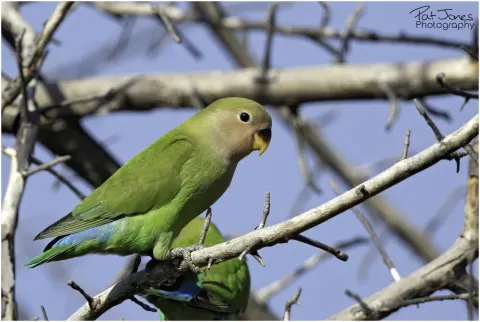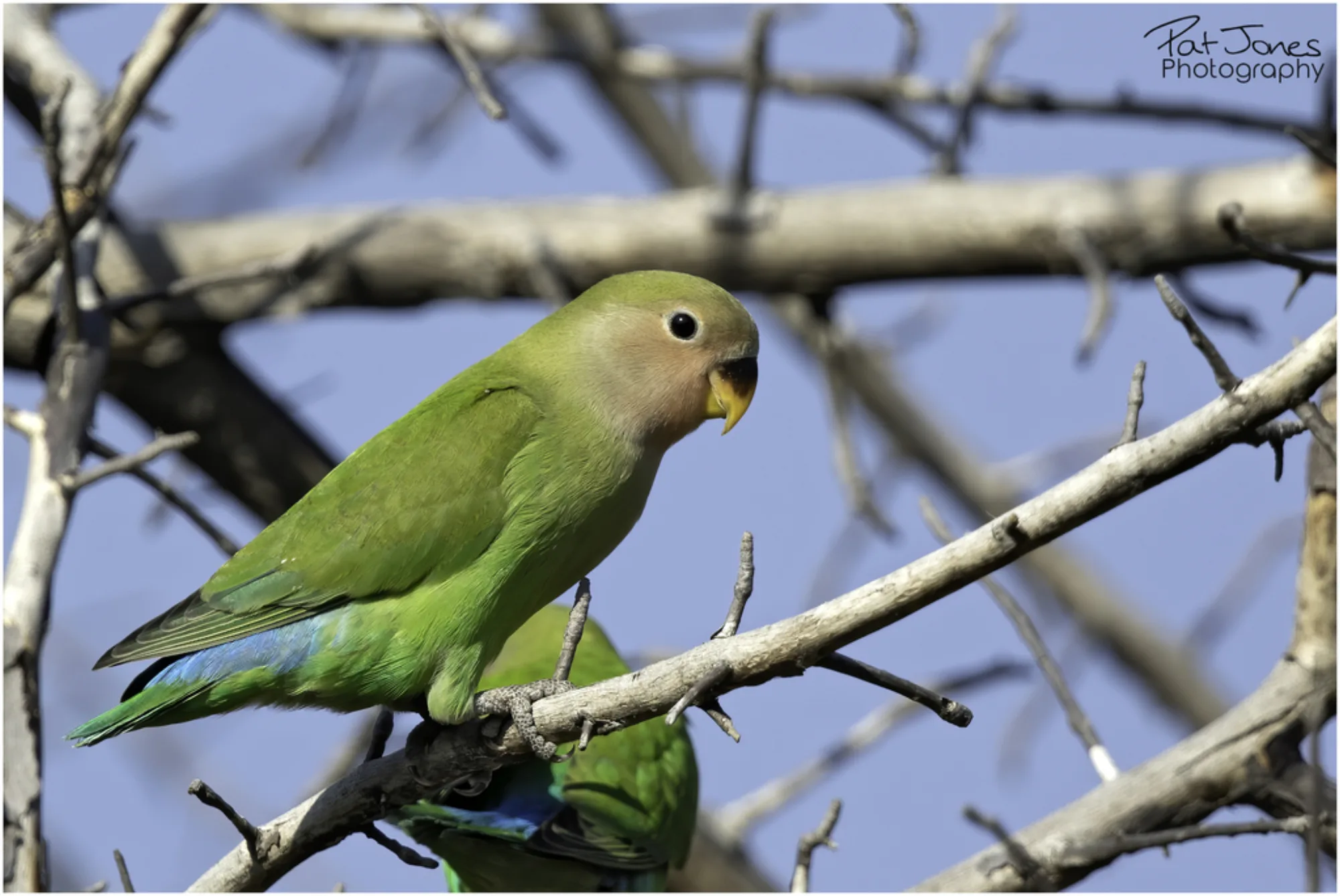
Rosy-faced Lovebird
Agapornis roseicollis
A small, noisy bird of southwest Africa, the Rosy-faced Lovebird measures 17 to 18 cm from end to end. In the wild, its green plumage gives way to blue at the rump, while the pink of its face and throat deepens across the forehead and just above the eye. Males and females look alike, while young birds have paler pink faces and throats and brownish bases to their beaks. Colour varies considerably between populations.
Its native range runs from southwest Angola through much of Namibia, extending south into northwestern South Africa's lower Orange River valley. Look for it in dry, open country, including broad-leaved woodland, semi-desert and mountains, at elevations up to 1,600 metres. Water is essential: the birds gather at pools to drink and bathe frequently. They are sociable, calling persistently and often gathering in small groups, although hundreds may flock together where food is plentiful. Seeds and berries make up most of their diet, and they sometimes feed on crops such as millet. At rest, companions sit side by side to sleep, turning their faces towards one another.
Nests may occupy a rock crevice, a chamber in the large communal nest of sociable weavers, or a human-made structure such as a house roof. Females carry nesting material back over substantial distances, having torn it into strips and tucked it onto their backs. Between February and April, females lay 4 to 6 dull white eggs; incubation lasts about 23 days, and the chicks fledge after 43 days. Trapping for the pet trade has reduced numbers in some areas, though new water sources and artificial nesting sites may have helped populations increase elsewhere.
Written from the English Wikipedia article Rosy-faced lovebird (CC BY-SA 4.0).
- Records
- 59,202
- Countries
- 31
- Atlas places
- 14
- Namib-Naukluft· Namibia
- Kunene / Kaokoveld· Namibia
- Skeleton Coast· Namibia
- Dorob National Park· Namibia
- Etosha National Park· Namibia
- Ai-Ais/Richtersveld Transfrontier Park· Namibia
- Waterberg Plateau Park· Namibia
- Augrabies Falls National Park· South Africa
- Kgalagadi Transfrontier Park· South Africa
- Walvis Bay· Namibia
- Everglades National Park· United States
- Hardap Game Park· Namibia
- Table Mountain National Park· South Africa
- Tsau ǁKhaeb (Sperrgebiet) National Park· Namibia
These are open occurrence records, so they show where people looked for and recorded the Rosy-faced Lovebird as much as where it lives. Cells are up to 25 km across, and every location is generalised to its cell.
Generalised encounter areas, not exact locations. Each shape is a grid cell coloured by how likely the species is there.
- Very likelyUnited States25 km zone · high confidence · 44666 records · updated 86 days ago
- Very likelyNamibia25 km zone · high confidence · 10121 records · updated 86 days ago
- Very likelySouth Africa25 km zone · high confidence · 3705 records · updated 86 days ago
- Very likelySpain25 km zone · high confidence · 180 records · updated 86 days ago
- Very likelyAngola25 km zone · high confidence · 147 records · updated 86 days ago
- LikelyBahamas25 km zone · medium confidence · 56 records · updated 86 days ago
- LikelyAustralia25 km zone · medium confidence · 45 records · updated 86 days ago
- LikelyFrance25 km zone · medium confidence · 39 records · updated 86 days ago
- LikelyPhilippines25 km zone · medium confidence · 36 records · updated 86 days ago
- LikelyGuadeloupe25 km zone · medium confidence · 33 records · updated 86 days ago
Conservation status not assessed here yet, so every location is generalised to its grid cell.