Common Agama
Agama agama
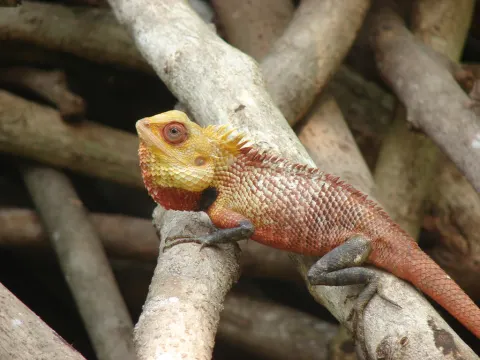
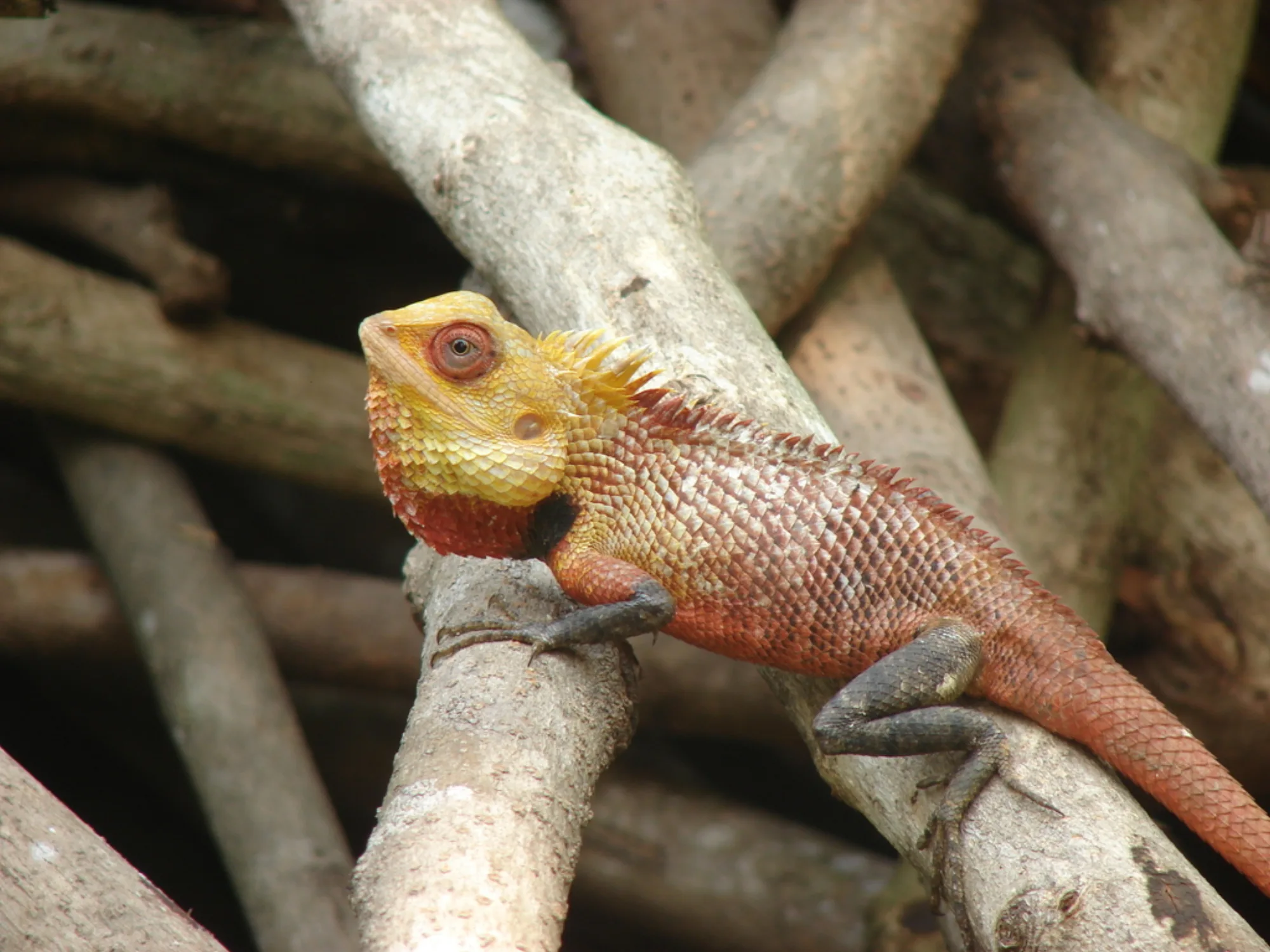
Look for the Common Agama on a tree or boulder, where members of a social group gather within their territory. This lizard ranges from 13 to 30 cm in total length, with males typically 7.5 to 12 cm longer than the average female. It has a white underside, brown back legs and a tail marked by a pale central stripe. Along the stripe are about six to seven dark patches. Females, young animals and subordinate males have olive green heads; the dominant male is blue with a yellow tail.
Common Agamas occur across much of sub-Saharan Africa and are well adapted to dry conditions. They have also been introduced to southern Florida through the reptile trade and have become extremely common there. They are active during the day, apart from the hottest hour, when even shaded places can reach 38 °C. Ants, grasshoppers, beetles and termites make up much of their diet, though they also eat small mammals and reptiles, as well as flowers, grasses and fruit. The lizards use their tongues to catch prey.
A group has one leading male, subordinate males and around six females. Males defend territory and fight one another for space, with fights occurring more often in urban areas where space is limited. Breeding tends to take place during the wet season, although it can also happen where rainfall is constant. A female digs a 5 cm deep hole in damp, sandy soil, under plant cover and in a spot that receives sunlight for most of the day. She lays 5 to 7 eggs, which hatch within 8 to 10 weeks.
Written from the English Wikipedia article Agama agama (CC BY-SA 4.0).
- Records
- 660
- Countries
- 23
- Atlas places
- 1
These are open occurrence records, so they show where people looked for and recorded the Common Agama as much as where it lives. Cells are up to 25 km across, and every location is generalised to its cell.
Generalised encounter areas, not exact locations. Each shape is a grid cell coloured by how likely the species is there.
- Very likelyRéunion25 km zone · medium confidence · 280 records · updated 80 days ago
- Very likelyGhana25 km zone · medium confidence · 146 records · updated 80 days ago
- Very likelyBenin25 km zone · medium confidence · 19 records · updated 80 days ago
- Very likelyFrance25 km zone · medium confidence · 14 records · updated 80 days ago
- Very likelySouth Sudan25 km zone · medium confidence · 11 records · updated 80 days ago
- LikelyNigeria25 km zone · medium confidence · 31 records · updated 80 days ago
- LikelySenegal25 km zone · medium confidence · 22 records · updated 80 days ago
- LikelyEgypt25 km zone · medium confidence · 18 records · updated 80 days ago
- LikelyMali25 km zone · medium confidence · 17 records · updated 80 days ago
- LikelyKenya25 km zone · medium confidence · 14 records · updated 80 days ago
Conservation status not assessed here yet, so every location is generalised to its grid cell.