Congo Peacock
Afropavo congensis
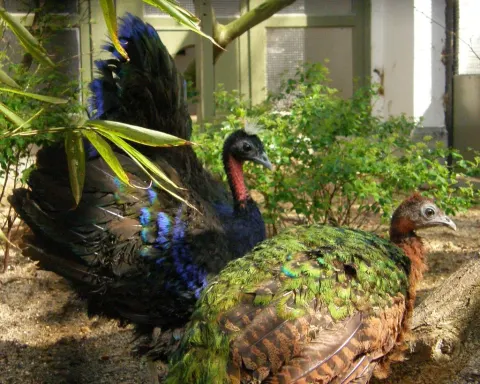
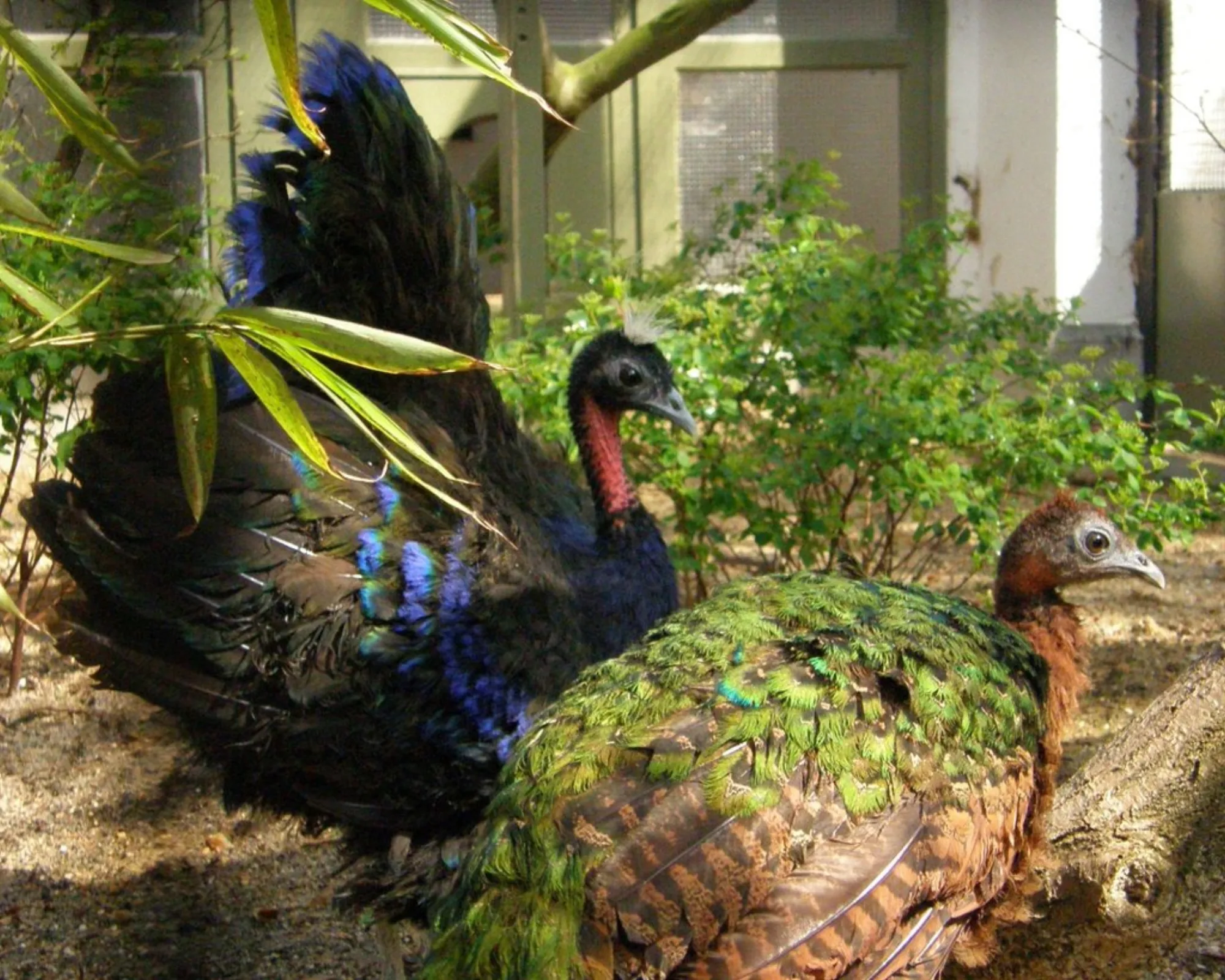
Deep blue plumage with a metallic green and violet sheen distinguishes the male Congo Peacock, a large bird reaching 64 to 70 cm in length. He also has bare red skin on his neck, grey feet and a black tail, while upright white feathers form a crest on his crown. The female reaches 60 to 63 centimetres and is mostly chestnut brown; her belly is black, her back shines metallic green, and a short crest tops her head. Young Asian peafowl look similar to both male and female Congo peafowl.
This bird lives only in the Democratic Republic of the Congo, in the lowland forests of the central Congo region. Salonga National Park has the bird in primary forest as well as secondary growth, with feathers and droppings found more often in regenerating secondary forest. There, droppings were found close to watercourses, among smaller trees and lower plant diversity than in primary forest. In Maiko National Park, records from the 1990s placed it chiefly on low hills and ridges between watersheds. Travellers may hear a high-pitched "gowe" from the male or a low "gowah" from the female, as well as loud duets from both sexes.
Fruit and insects make up most of its diet, although in Salonga it also eats spiders, mollusks and worms. The male fans his tail feathers in a display, and the birds are monogamous, though details of their breeding in the wild are still needed. Mining, shifting cultivation and logging all cause habitat loss that threatens the species. Its use of regenerating forest suggests that secondary forests could be important to its conservation.
Written from the English Wikipedia article Congo peafowl (CC BY-SA 4.0).
- Records
- 71
- Countries
- 2
No atlas park has a record of the Congo Peacock in or around it yet.
These are open occurrence records, so they show where people looked for and recorded the Congo Peacock as much as where it lives. Cells are up to 25 km across, and every location is generalised to its cell.
Generalised encounter areas, not exact locations. Each shape is a grid cell coloured by how likely the species is there.
- Very likelyCongo - Kinshasa25 km zone · medium confidence · 62 records · updated 81 days ago
- LikelyUnited States25 km zone · medium confidence · 9 records · updated 81 days ago
Conservation status not assessed here yet, so every location is generalised to its grid cell.