Spotted Eagle Ray
Aetobatus narinari
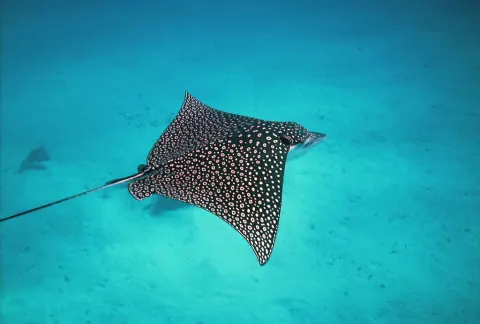
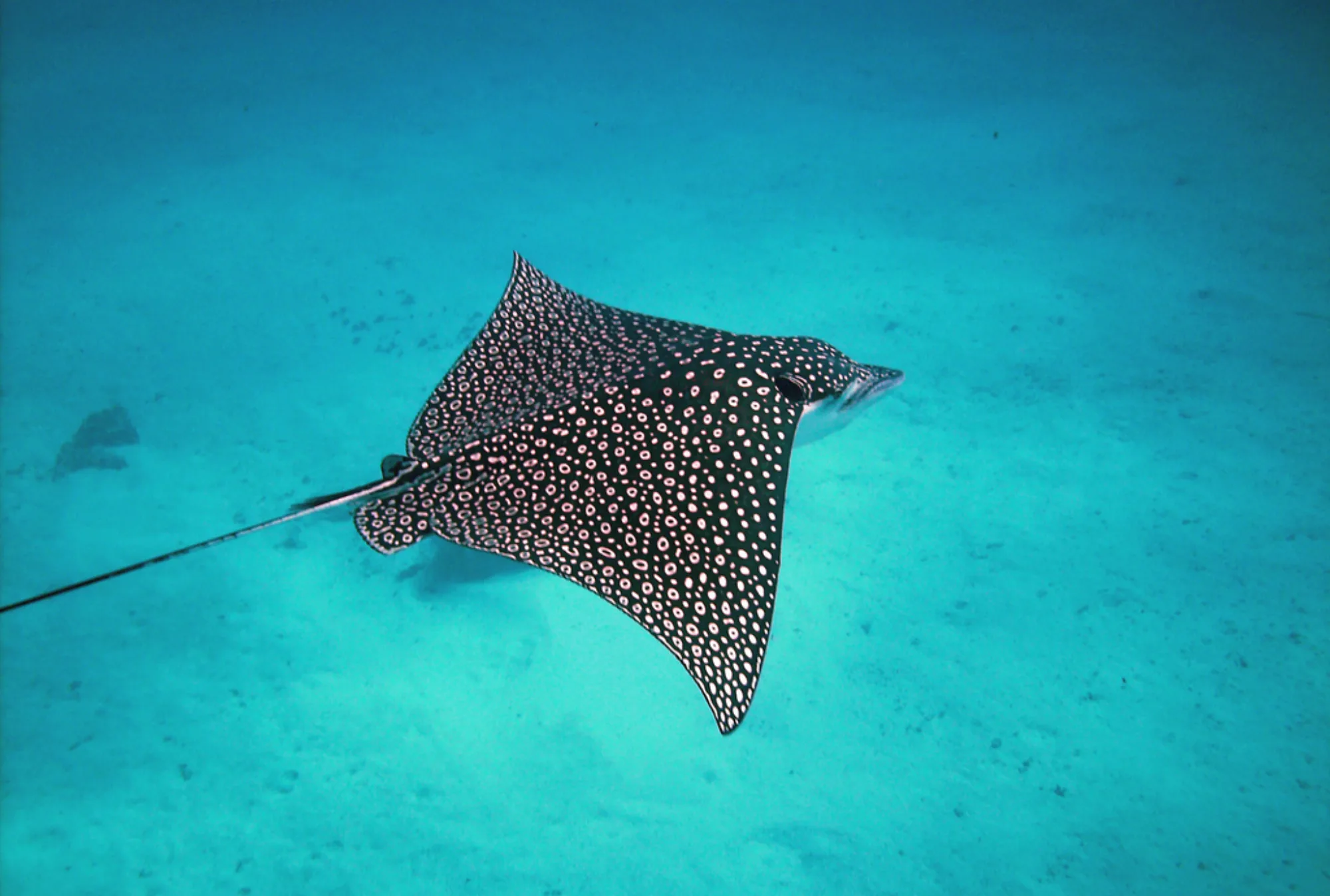
A dark, spot-covered back makes the Spotted Eagle Ray easy to recognise as it moves through the water. Its flat, disc-shaped body is deep blue or black above and white underneath, with a snout shaped rather like a duck's bill. Its long tail carries venomous barbed spines near the base. The largest individuals can reach 3 meters across and weigh 230 kilograms.
Recent authorities restrict Aetobatus narinari to Atlantic waters, from the Caribbean to the Gulf of Mexico, although the name has traditionally been used for rays across tropical oceans worldwide. Look for these rays in shallow coastal waters around bays and coral reefs, or swimming freely in open water near the surface. They are often seen alone, though they also gather in groups and schools. They can travel long distances in a day and are sometimes seen leaping clear of the water. One tracking study found that they were more active at high tide. Around Jamaica, snorkelers have reported encounters with rays that slowed down near them.
The ray searches for food by digging into the seabed with its snout, raising a cloud of sand around itself. Its varied diet includes crabs, bivalves, shrimp, octopuses and small fish. Females retain their eggs internally and give birth to as many as four live young after a year. Sharks hunt the rays, and have been observed following females during the birthing season to feed on newborn pups. Fishing also takes a toll: rays are caught unintentionally as bycatch, while entanglement in shark nets has caused deaths.
Written from the English Wikipedia article Spotted eagle ray (CC BY-SA 4.0).
- Records
- 525
- Countries
- 31
- Atlas places
- 2
These are open occurrence records, so they show where people looked for and recorded the Spotted Eagle Ray as much as where it lives. Cells are up to 25 km across, and every location is generalised to its cell.
Generalised encounter areas, not exact locations. Each shape is a grid cell coloured by how likely the species is there.
- Very likelyUnited States25 km zone · medium confidence · 135 records · updated 80 days ago
- Very likelyCayman Islands25 km zone · medium confidence · 56 records · updated 80 days ago
- Very likelyBelize25 km zone · medium confidence · 51 records · updated 80 days ago
- Very likelyMozambique25 km zone · medium confidence · 50 records · updated 80 days ago
- Very likelySeychelles25 km zone · medium confidence · 30 records · updated 80 days ago
- Very likelyAustralia25 km zone · medium confidence · 27 records · updated 80 days ago
- Very likelySouth Africa25 km zone · medium confidence · 26 records · updated 80 days ago
- Very likelyPuerto Rico25 km zone · medium confidence · 22 records · updated 80 days ago
- Very likelyMarshall Islands25 km zone · medium confidence · 12 records · updated 80 days ago
- Very likelyCaribbean Netherlands25 km zone · medium confidence · 11 records · updated 80 days ago
Conservation status not assessed here yet, so every location is generalised to its grid cell.