Edible-nest Swiftlet
Aerodramus fuciphagus
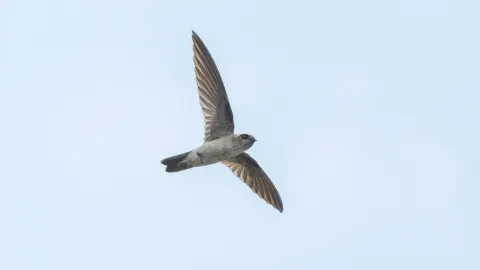
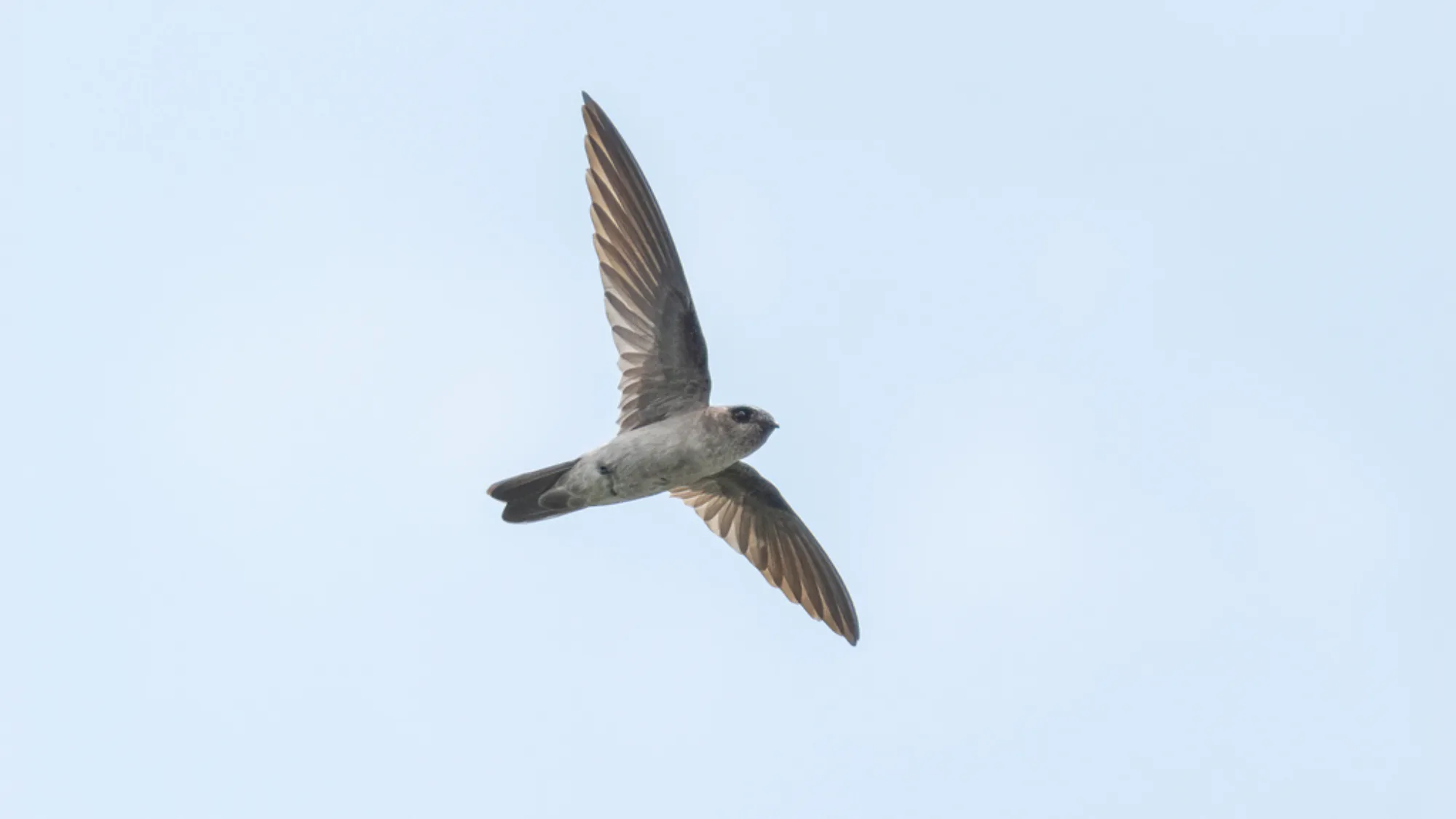
Over forests, along forest edges and across open country, the Edible-nest Swiftlet spends most of its life in the air. This small member of the swift family lives in Southeast Asia, feeding from coastal areas to mountains as high as 2,800 metres on Sumatra and Borneo. Its range also includes the Andaman and Nicobar Islands, the Malay Peninsula, Java, Bali and parts of the Philippines. Around 14 cm long, it has a slender, blackish-brown upper body and underparts that range from white to blackish-brown. Its tail is short and slightly notched, while its long, narrow wings look like crescents when swept back in flight. The bill and feet are black.
Flying insects make up its diet, and it catches them in flight, often feeding in large flocks alongside other swiftlets and swallows. It drinks on the wing too, and never voluntarily settles on the ground. Breeding colonies occupy coastal sites including limestone caves, rock crevices and cliff clefts, and sometimes buildings. At these colonies, listen for high-pitched, burbling calls and a rattling call that helps the birds find their nesting sites in dark caves. The white, bracket-shaped nest is made from layers of hardened saliva and attached to a vertical surface, and a typical clutch contains two white, oval eggs. These nests are the main ingredient of bird's nest soup and can command high prices, encouraging commercial harvesting at many colonies. Extensive harvesting has left some populations, including those on the Andaman and Nicobar Islands, critically threatened. In Indonesia and Malaysia, nests are also farmed in purpose-built structures or empty houses, where recorded calls attract the birds.
Written from the English Wikipedia article Edible-nest swiftlet (CC BY-SA 4.0).
- Records
- 83,938
- Countries
- 14
- Atlas places
- 6
These are open occurrence records, so they show where people looked for and recorded the Edible-nest Swiftlet as much as where it lives. Cells are up to 25 km across, and every location is generalised to its cell.
Generalised encounter areas, not exact locations. Each shape is a grid cell coloured by how likely the species is there.
- Very likelyThailand25 km zone · high confidence · 43252 records · updated 86 days ago
- Very likelyCambodia25 km zone · high confidence · 12985 records · updated 86 days ago
- Very likelyMalaysia25 km zone · high confidence · 11847 records · updated 86 days ago
- Very likelyVietnam25 km zone · high confidence · 5225 records · updated 86 days ago
- Very likelyIndonesia25 km zone · high confidence · 4651 records · updated 86 days ago
- Very likelyIndia25 km zone · high confidence · 3258 records · updated 86 days ago
- Very likelyLaos25 km zone · high confidence · 1760 records · updated 86 days ago
- Very likelyMyanmar (Burma)25 km zone · high confidence · 448 records · updated 86 days ago
- Very likelyPhilippines25 km zone · high confidence · 341 records · updated 86 days ago
- LikelyChina25 km zone · medium confidence · 86 records · updated today
Conservation status not assessed here yet, so every location is generalised to its grid cell.