Cinereous Vulture
Aegypius monachus
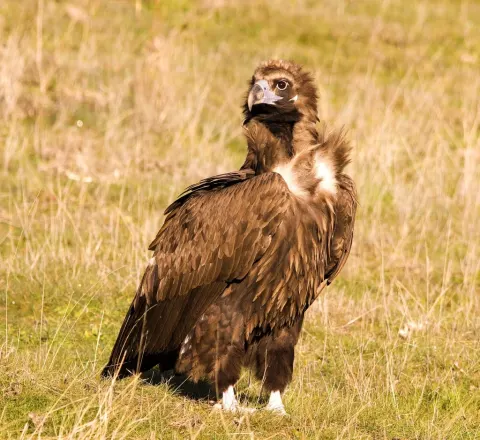
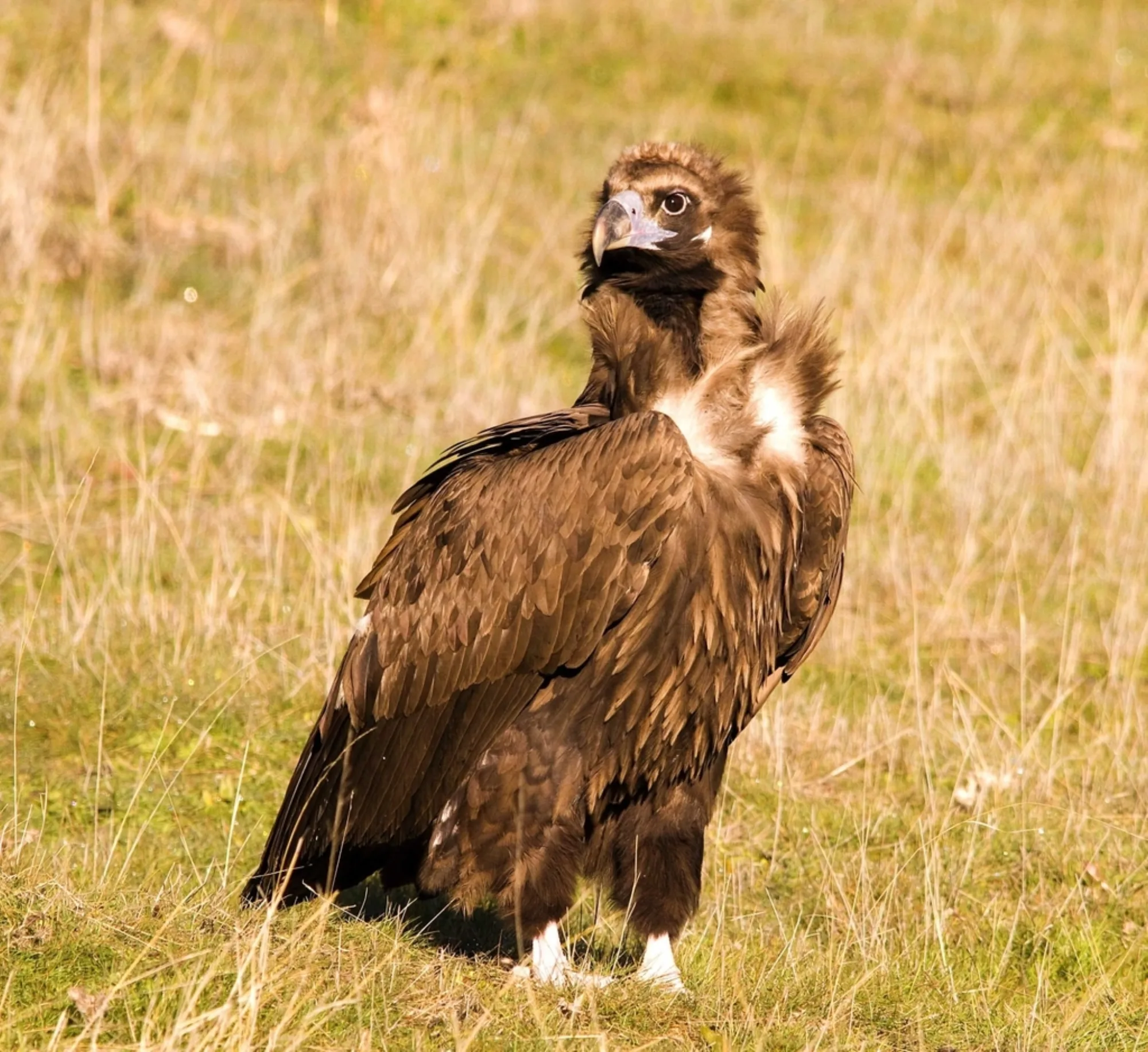
With broad wings held straight or slightly arched, the Cinereous Vulture moves through the air with a slow, buoyant flight. This huge bird of prey is dark blackish-brown, with a paler head in adults, and can look entirely black from a distance. Its wingspan reaches 3.1 m, and its massive bill adds to its distinctive appearance.
Its range stretches across temperate Eurasia, from Spain and inland Portugal eastwards through the Middle East and into central Asia, though its distribution is fragmented. It favours remote, undisturbed hills and mountains, especially dry, partly open places such as high meadows. It searches for carcasses across a variety of landscapes, including steppe, grassland, open woodland and mountain terrain. Most birds remain in their range year-round, although some move in response to hard winters, and northern birds at the eastern edge may migrate south.
Usually seen alone or in pairs, these vultures sometimes gather in small groups around a large carcass or feeding site. They eat mostly carrion, from large mammals to fish and reptiles, using their powerful bills to tear open tough skins. Pairs breed in loose colonies, building large nests of sticks and twigs in trees or occasionally on cliff ledges. They usually lay a single egg, and both parents protect the nest and feed the young. Poisoned bait set for dogs and other predators can kill vultures, while improved hygiene has reduced the carrion available to them. Shooting, trapping, hunting, development and habitat destruction also threaten the species, and nests have historically been disturbed by egg and firewood collectors.
Written from the English Wikipedia article Cinereous vulture (CC BY-SA 4.0).
- Records
- 161,125
- Countries
- 50
- Atlas places
- 5
These are open occurrence records, so they show where people looked for and recorded the Cinereous Vulture as much as where it lives. Cells are up to 25 km across, and every location is generalised to its cell.
Generalised encounter areas, not exact locations. Each shape is a grid cell coloured by how likely the species is there.
- Very likelySpain25 km zone · high confidence · 65807 records · updated 86 days ago
- Very likelyMongolia25 km zone · high confidence · 56004 records · updated 86 days ago
- Very likelySouth Korea25 km zone · high confidence · 16202 records · updated 86 days ago
- Very likelyChina25 km zone · high confidence · 5035 records · updated 86 days ago
- Very likelyFrance25 km zone · high confidence · 3756 records · updated 86 days ago
- Very likelyPortugal25 km zone · high confidence · 3592 records · updated 86 days ago
- Very likelyIndia25 km zone · high confidence · 2775 records · updated 86 days ago
- Very likelyNorth Korea25 km zone · high confidence · 2363 records · updated 86 days ago
- Very likelyTürkiye25 km zone · high confidence · 1077 records · updated 86 days ago
- Very likelyAzerbaijan25 km zone · high confidence · 762 records · updated 86 days ago
Conservation status not assessed here yet, so every location is generalised to its grid cell.