Boreal Owl
Aegolius funereus
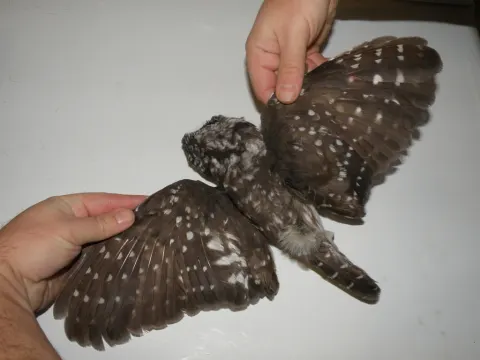
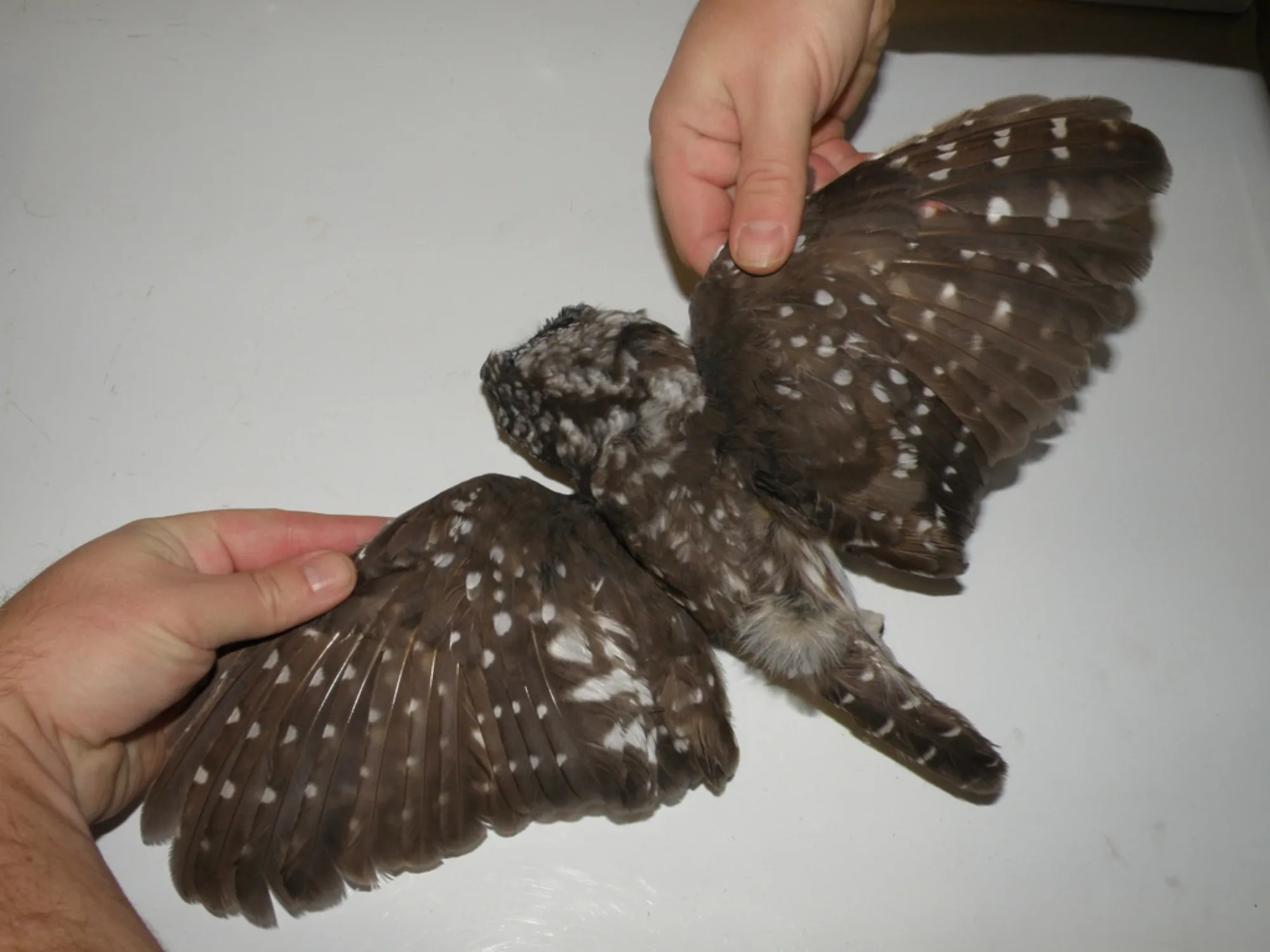
Small, large-headed and yellow-eyed, the Boreal Owl has brown upperparts marked with pearly white spots and pale underparts streaked with rust. A dark border frames its whitish face, while white markings above the eyes give it a surprised look. Females are larger than males, measuring 25 to 28 cm in length compared with 21 to 25 cm for males. Its flight is straight and relatively quiet.
The owl ranges across northern North America and through parts of Europe and Asia, including Scandinavia, Siberia and mountain areas. It breeds in dense boreal and subalpine forest and mixed woodland, favouring old growth that offers prey and shelter from predatory birds. Its nocturnal habits and preference for remote taiga forest make it difficult to see, although an owl encountered by people may show little fear. In the far north, it also hunts by day during the short summer nights. It waits on a perch for prey, taking mainly voles and other small mammals, as well as birds, amphibians, insects and other invertebrates.
A tree hole, often made by a woodpecker, usually serves as the nest, though the owls also use nest boxes. The female cares for the young while the male brings food to the nest during their first three weeks. Logging reduces prey, makes foraging less efficient and removes suitable nest sites, while clear-cutting has been linked to substantial declines in northern Europe. Pesticides from agricultural and forestry effluents also harm the owls, and the decline of the black woodpecker in Eurasia has reduced the supply of nesting cavities.
Written from the English Wikipedia article Boreal owl (CC BY-SA 4.0).
- Records
- 128,568
- Countries
- 10
- Atlas places
- 1
These are open occurrence records, so they show where people looked for and recorded the Boreal Owl as much as where it lives. Cells are up to 25 km across, and every location is generalised to its cell.
Generalised encounter areas, not exact locations. Each shape is a grid cell coloured by how likely the species is there.
- Very likelyFinland25 km zone · high confidence · 112977 records · updated 80 days ago
- Very likelySweden25 km zone · high confidence · 4653 records · updated 80 days ago
- Very likelyNorway25 km zone · high confidence · 4260 records · updated 80 days ago
- Very likelyCanada25 km zone · high confidence · 3243 records · updated 80 days ago
- Very likelyFrance25 km zone · high confidence · 1928 records · updated 80 days ago
- Very likelyUnited States25 km zone · high confidence · 1020 records · updated 80 days ago
- Very likelyRussia25 km zone · high confidence · 487 records · updated 80 days ago
Conservation status not assessed here yet, so every location is generalised to its grid cell.