Long-tailed Tit
Aegithalos caudatus
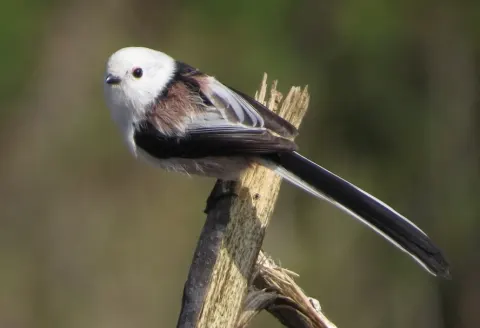
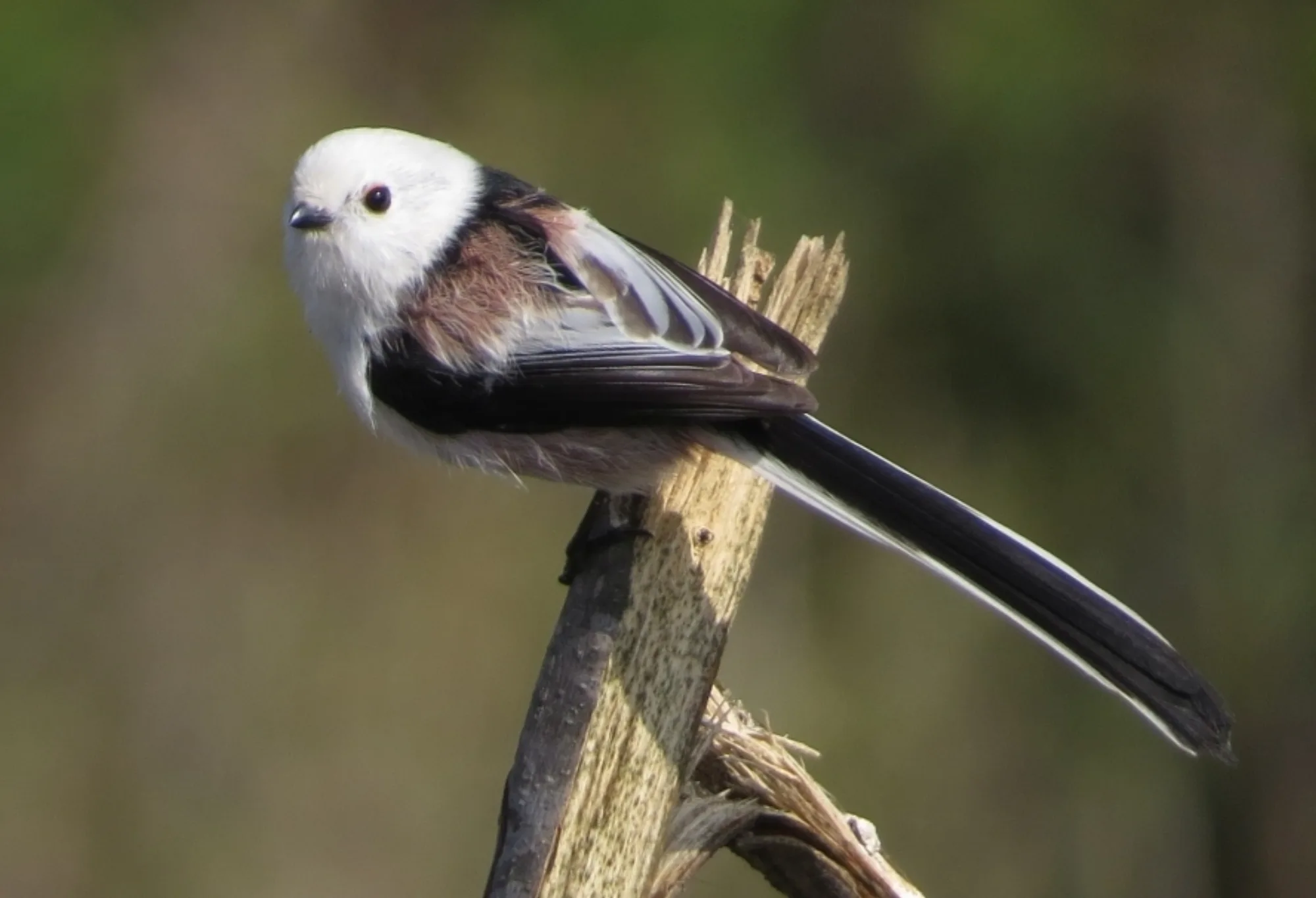
A small, round bird with a long, narrow tail, the Long-tailed Tit measures 13 to 15 cm from bill to tail tip. Its feathers combine mostly black and white with touches of grey and pink that vary between birds. Birds in northern populations are paler, with entirely white heads, while southern birds have prominent dark eyebrows. Listen for a flock before looking for it: the birds keep in touch with constant calls, including high notes, trills and rattles. Their calls grow faster and louder as they cross open ground or when a bird becomes separated from its companions.
Found across Eurasia, this bird favours woodland edges and deciduous or mixed woods with plenty of shrubs beneath the trees. It also visits scrub, heathland with scattered trees and bushes, farmland, riverine woodland, parks and gardens. Most birds stay close to home, although some white-headed northern birds travel south or west to escape severe winters. It eats insects year-round, favouring moth and butterfly eggs and larvae, and occasionally takes seeds in autumn and winter. Outside the breeding season, family groups gather in compact flocks of six to seventeen birds and huddle together on cold nights.
For nesting, pairs favour scrub and often choose a thorny bush less than 3 metres above ground. They build a flexible, feather-lined nest from moss, spider silk and other materials, with pale lichen on the outside for camouflage. In Britain and Ireland, a first clutch typically holds six to eight eggs, laid between late March and late April. Birds whose nests fail may help relatives raise their young, bringing food and defending the nest. Predation causes many nests to fail, while prolonged extreme cold can cause heavy population losses.
Written from the English Wikipedia article Long-tailed tit (CC BY-SA 4.0).
- Records
- 736,373
- Countries
- 18
No atlas park has a record of the Long-tailed Tit in or around it yet.
These are open occurrence records, so they show where people looked for and recorded the Long-tailed Tit as much as where it lives. Cells are up to 25 km across, and every location is generalised to its cell.
Generalised encounter areas, not exact locations. Each shape is a grid cell coloured by how likely the species is there.
- Very likelyUnited Kingdom25 km zone · high confidence · 376570 records · updated 80 days ago
- Very likelyFinland25 km zone · high confidence · 88071 records · updated 80 days ago
- Very likelyBelgium25 km zone · high confidence · 77455 records · updated 80 days ago
- Very likelySpain25 km zone · high confidence · 68767 records · updated 80 days ago
- Very likelyFrance25 km zone · high confidence · 49948 records · updated 80 days ago
- Very likelySweden25 km zone · high confidence · 24942 records · updated 80 days ago
- Very likelyPortugal25 km zone · high confidence · 7136 records · updated 80 days ago
- Very likelyCzechia25 km zone · high confidence · 5847 records · updated 80 days ago
- Very likelyNetherlands25 km zone · high confidence · 5800 records · updated 80 days ago
- Very likelySouth Korea25 km zone · high confidence · 5220 records · updated 80 days ago
Conservation status not assessed here yet, so every location is generalised to its grid cell.