Addax
Addax nasomaculatus
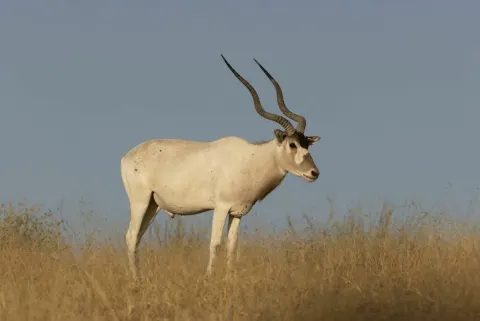
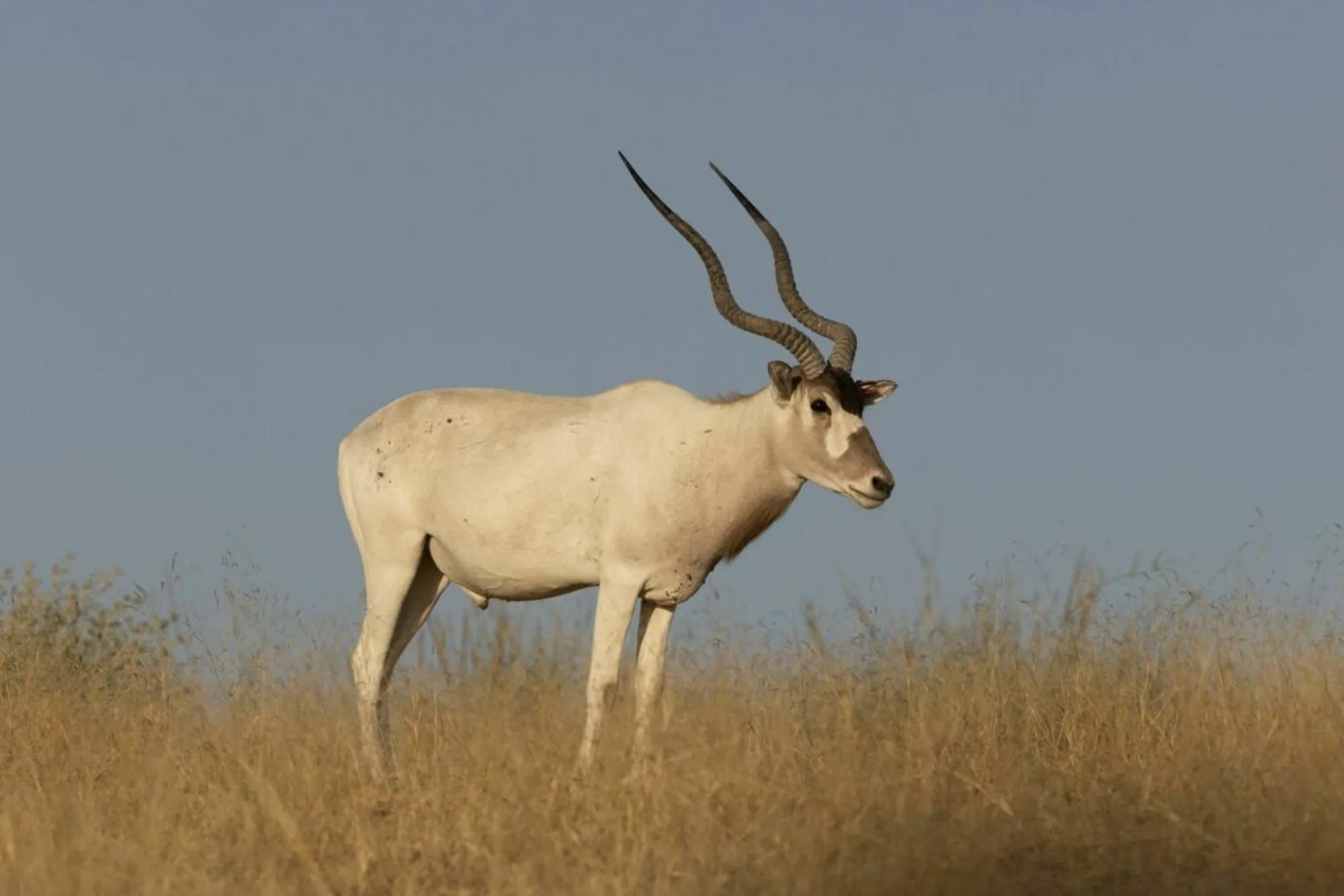
Spiral horns and a pale summer coat make the Addax a distinctive antelope of the Sahara. Its coat changes with the seasons, from greyish-brown in winter to almost white or sandy blonde in summer. Brown or black patches form an X over the nose, while long black hairs rise between the horns. Males stand 105 to 115 cm at the shoulder, and females, generally smaller, stand 95 to 110 cm.
Addax live in arid parts of North Africa, including semideserts and sandy or stony deserts. Niger's Termit Massif Reserve holds the only known self-sustaining population, with sightings also reported in Chad's Bodélé region and Niger's eastern Air Mountains. Herds of five to 20 males and females usually stay in one place, but wander widely to find food and track rainfall towards fresh vegetation. During the day they gather in shade, while on cool nights they rest in hollows in the sand. They graze mainly on grasses, turning to leaves when these are unavailable, and obtain moisture from food and dew on plants. Breeding takes place throughout the year, peaking in winter and early spring, and females give birth to one calf.
Once abundant across North Africa, the Addax has become rare and restricted largely because of overhunting. Its slow movement makes it easy to hunt, and its meat and leather are highly valued. Roadkill, settlements near waterholes, chronic drought, habitat destruction and agriculture have also contributed to its decline. Addax have been reintroduced into national parks in Tunisia and Morocco, and a small population now exists in Chad's Ouadi Rimé-Ouadi Achim Faunal Reserve.
Written from the English Wikipedia article Addax (CC BY-SA 4.0).
- Records
- 12
- Countries
- 1
No atlas park has a record of the Addax in or around it yet.
These are open occurrence records, so they show where people looked for and recorded the Addax as much as where it lives. Cells are up to 25 km across, and every location is generalised to its cell.
Generalised encounter areas, not exact locations. Each shape is a grid cell coloured by how likely the species is there.
- Very likelyMorocco25 km zone · medium confidence · 12 records · updated 80 days ago
Conservation status not assessed here yet, so every location is generalised to its grid cell.