Common Myna
Acridotheres tristis
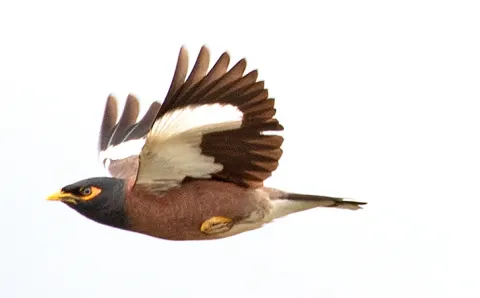
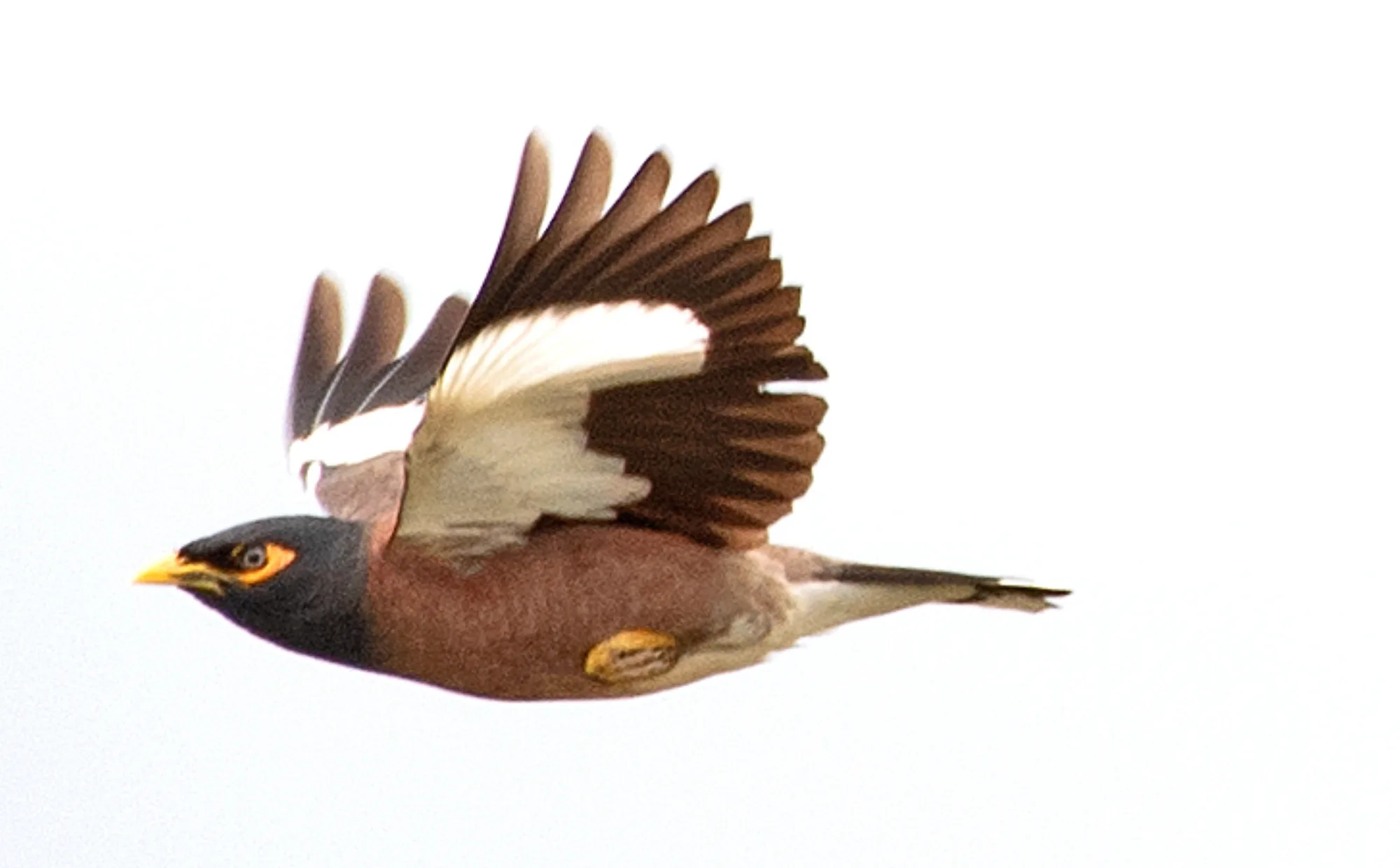
Look for a brown bird with a black hood, a bare yellow patch behind each eye and a bright yellow bill and legs. The Common Myna also has white markings on its wings and tail, and the sexes are similar in colour. Usually seen in pairs, it has a repertoire of croaks, squawks, chirps, clicks, whistles and growls. While singing, it often puffs up its plumage and moves its head up and down; it screeches a warning when predators are close.
Native to Asia, the bird's original range spans countries from Iran and India to Malaysia, Japan and China. It has also been introduced to Australia, New Zealand, South Africa, the United States and many islands. Look for it in open woodland, farmland and around buildings, including in cities and suburbs. On the ground, it alternates walking with occasional hops, picking up insects and taking food as varied as fruit, seeds and discarded human waste. It also catches insects disturbed by grazing cattle and sometimes wades in shallow water for fish. At dusk, mynas gather in communal roosts, sometimes with other bird species, and leave before sunrise.
Pairs are believed to stay together for life and, in some locations, can breed for much of the year. They build nests in holes in trees or walls, using twigs, roots and rubbish, and normally lay 4 to 6 eggs. The Asian koel sometimes lays its eggs in a myna's nest. In places where mynas have been introduced, people kill or chase them away to control their numbers. Cooler summer temperatures also appear to have limited their breeding success on New Zealand's South Island.
Written from the English Wikipedia article Common myna (CC BY-SA 4.0).
- Records
- 1,868,281
- Countries
- 87
- Atlas places
- 18
- Blue Mountains National Park· Australia
- Chobe National Park· Botswana
- Zambezi National Park· Zimbabwe
- Bandipur National Park· India
- Bwabwata National Park· Namibia
- Kanha National Park· India
- Okavango Delta· Botswana
- West Bali National Park· Indonesia
- Annapurna Conservation Area· Nepal
- Baluran National Park· Indonesia
- Chitwan National Park· Nepal
- Everglades National Park· United States
- iSimangaliso Wetland Park· South Africa
- Kaziranga National Park· India
- Langtang National Park· Nepal
- Madikwe Game Reserve· South Africa
- Matobo National Park· Zimbabwe
- Yala National Park· Sri Lanka
These are open occurrence records, so they show where people looked for and recorded the Common Myna as much as where it lives. Cells are up to 25 km across, and every location is generalised to its cell.
Generalised encounter areas, not exact locations. Each shape is a grid cell coloured by how likely the species is there.
- Very likelyIndia25 km zone · high confidence · 718615 records · updated 86 days ago
- Very likelyAustralia25 km zone · high confidence · 399521 records · updated 86 days ago
- Very likelyTaiwan25 km zone · high confidence · 204327 records · updated 86 days ago
- Very likelyUnited States25 km zone · high confidence · 141929 records · updated 86 days ago
- Very likelySouth Africa25 km zone · high confidence · 73069 records · updated 86 days ago
- Very likelyIsrael25 km zone · high confidence · 54150 records · updated 86 days ago
- Very likelyNew Zealand25 km zone · high confidence · 37481 records · updated 86 days ago
- Very likelySri Lanka25 km zone · high confidence · 25457 records · updated 86 days ago
- Very likelyThailand25 km zone · high confidence · 24499 records · updated 86 days ago
- Very likelyUnited Arab Emirates25 km zone · high confidence · 19707 records · updated 86 days ago
Conservation status not assessed here yet, so every location is generalised to its grid cell.