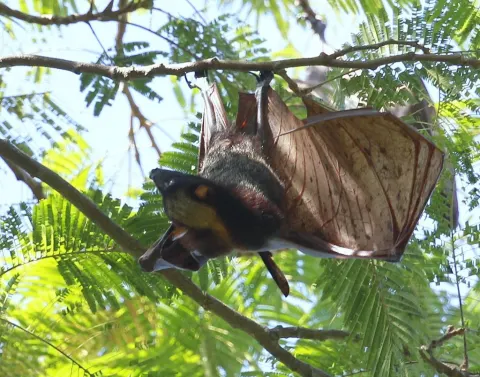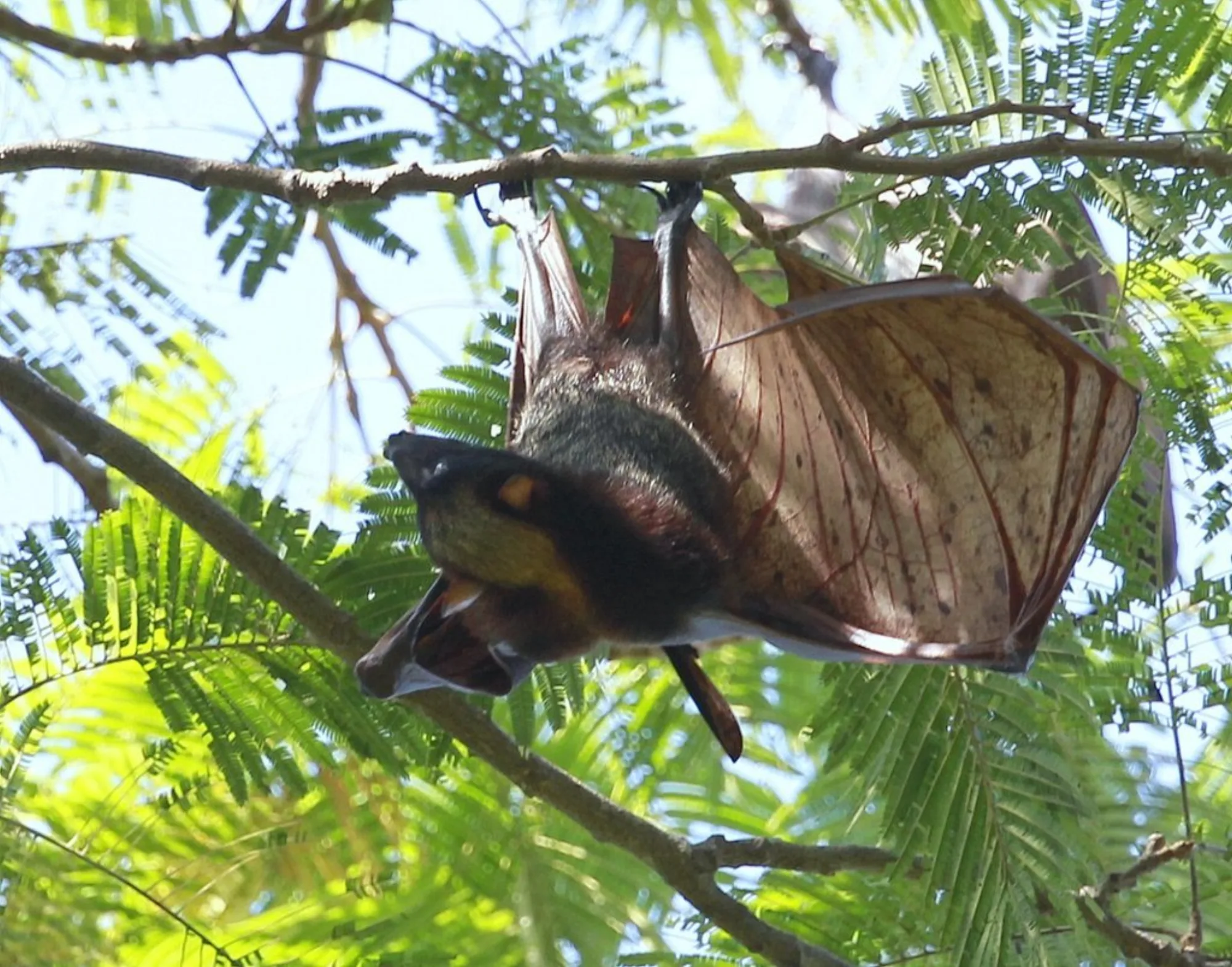
Golden-capped Fruit Bat
Acerodon jubatus
A sweep of gold across the head gives the Golden-capped Fruit Bat its name. The golden fur begins between the eyes and narrows into a V at the back of the neck, sometimes reaching the shoulders. Its face and throat are black, while maroon on the neck and upper back gives way to darker and then reddish-brown fur farther down. Among the world's largest bats, it can weigh up to 1.40 kg and has a wingspan of 1.5 to 1.7 m.
Found only in the Philippines, this forest specialist lives mostly from sea level to 1,100 m and favours places away from human habitation. It uses river corridors where fig trees provide a main source of food, and stays near agricultural fields only where forest remains undisturbed. It sleeps in trees for most of the day and leaves at night to forage, eating several kinds of fig as well as leaves. Roosts can hold thousands of bats, often alongside large flying foxes, which leave in the same direction to feed. Some bats have travelled more than 12 km between a roost on Maripipi and feeding sites on Biliran. Females give birth to one pup at a time, with births observed from April to June in different parts of the range.
Deforestation and hunting for bushmeat threaten the species, and illegal hunting continues even in protected areas. Shooting at roosts can kill more bats than hunters recover, since dead animals may stay in the tree and wounded ones may glide away. Even at roosts protected from hunting, tourists and guides sometimes clap or strike tree trunks to make the bats fly, interrupting their sleep and separating young from their mothers.
Written from the English Wikipedia article Giant golden-crowned flying fox (CC BY-SA 4.0).
- Records
- 4
- Countries
- 1
No atlas park has a record of the Golden-capped Fruit Bat in or around it yet.
These are open occurrence records, so they show where people looked for and recorded the Golden-capped Fruit Bat as much as where it lives. Cells are up to 25 km across, and every location is generalised to its cell.
Generalised encounter areas, not exact locations. Each shape is a grid cell coloured by how likely the species is there.
- Very likelyPhilippines25 km zone · medium confidence · 4 records · updated 80 days ago
Conservation status not assessed here yet, so every location is generalised to its grid cell.