Eurasian Sparrowhawk
Accipiter nisus
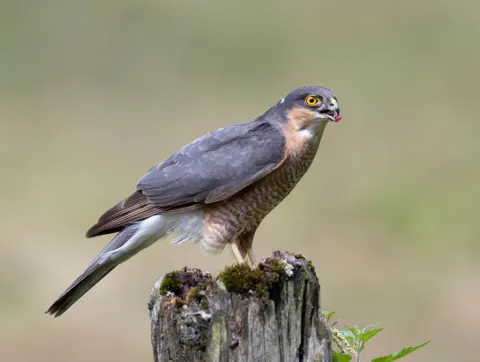
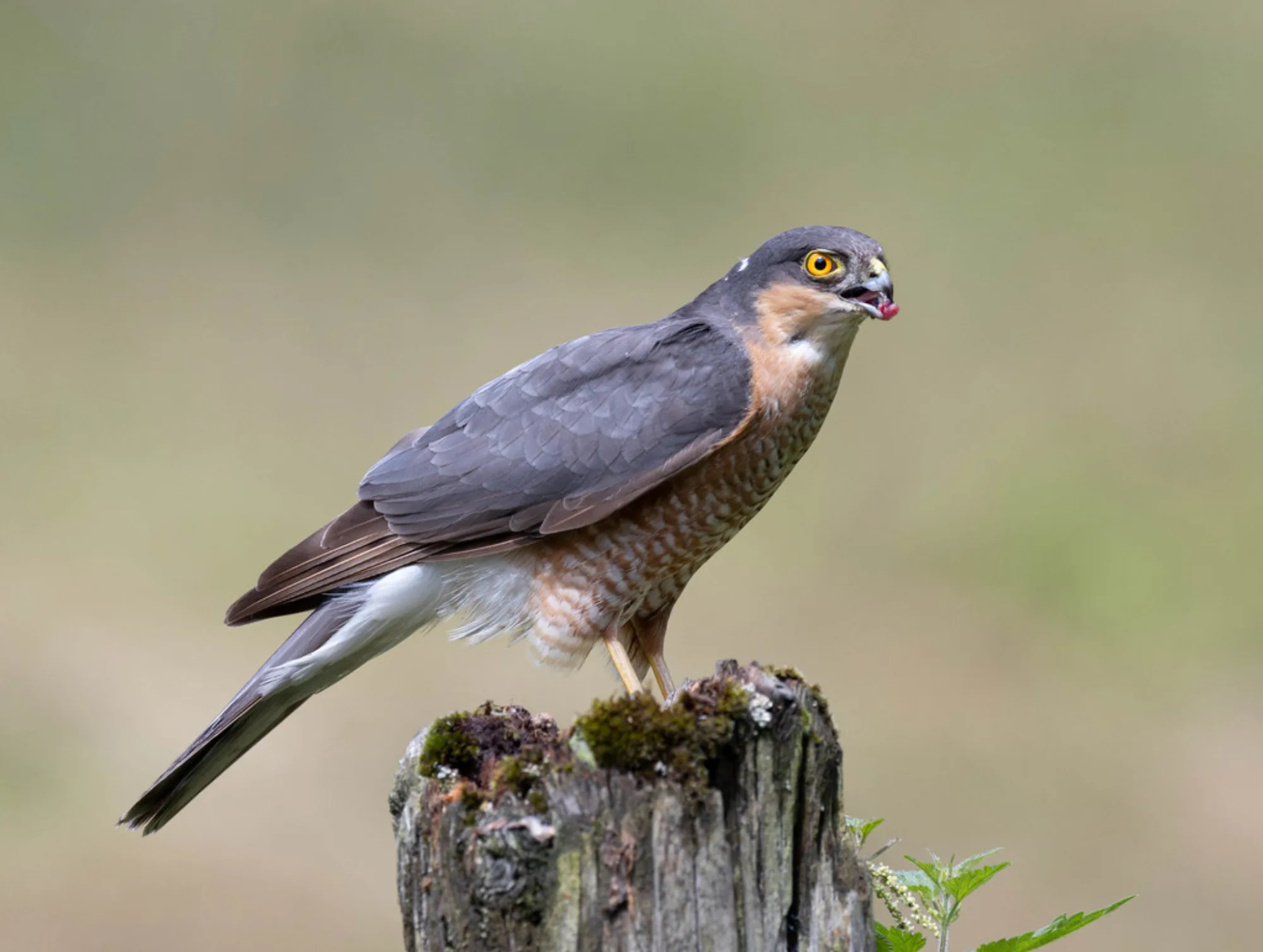
Short, broad wings and a long tail help the Eurasian Sparrowhawk manoeuvre through trees. This small bird of prey has a distinctive flight, with wingbeats followed by a glide that gives it an undulating course. Adult males are bluish grey above, with orange bars below, while females and young birds are brown above and barred brown underneath. A female may be as much as 25% larger than a male.
Across the Old World, the species occupies regions with temperate or subtropical climates and ranks among Europe's most common birds of prey. Look for it in woodland or open country with scattered trees, as well as in gardens and urban parks. Birds from colder northern regions travel south for winter, while southern populations stay put or disperse. A hunter of woodland birds, it often waits concealed by cover before bursting out in a fast, low flight. Males tend to catch smaller birds such as tits, finches and sparrows; females often take thrushes and starlings. Sparrowhawks also sometimes catch small mammals, including mice and voles.
Breeding pairs use woodland, building a nest of twigs in a tree. The female usually lays four or five pale blue eggs with brown spots, and the male brings her food. Chicks hatch after 33 days and begin to fly after 24 to 28 days. In Europe, populations crashed after insecticides accumulated in birds, poisoning hawks and causing fragile eggs to break, but recovered after the chemicals were banned. Shooting continues in many parts of Europe, while habitat loss, egg collecting and illegal hunting threaten the birds on Madeira and the Canary Islands. Hunting birds can also collide with buildings and other human-made structures.
Written from the English Wikipedia article Eurasian sparrowhawk (CC BY-SA 4.0).
- Records
- 526,379
- Countries
- 26
No atlas park has a record of the Eurasian Sparrowhawk in or around it yet.
These are open occurrence records, so they show where people looked for and recorded the Eurasian Sparrowhawk as much as where it lives. Cells are up to 25 km across, and every location is generalised to its cell.
Generalised encounter areas, not exact locations. Each shape is a grid cell coloured by how likely the species is there.
- Very likelyUnited Kingdom25 km zone · high confidence · 122875 records · updated 80 days ago
- Very likelyNorway25 km zone · high confidence · 120166 records · updated 80 days ago
- Very likelyBelgium25 km zone · high confidence · 115150 records · updated 80 days ago
- Very likelyFrance25 km zone · high confidence · 37742 records · updated 80 days ago
- Very likelyFinland25 km zone · high confidence · 35135 records · updated 80 days ago
- Very likelyIsrael25 km zone · high confidence · 15399 records · updated 80 days ago
- Very likelySpain25 km zone · high confidence · 12926 records · updated 80 days ago
- Very likelySweden25 km zone · high confidence · 11005 records · updated 80 days ago
- Very likelyPalestinian Territories25 km zone · high confidence · 8657 records · updated 80 days ago
- Very likelyNetherlands25 km zone · high confidence · 6538 records · updated 80 days ago
Conservation status not assessed here yet, so every location is generalised to its grid cell.