Cooper's Hawk
Accipiter cooperii
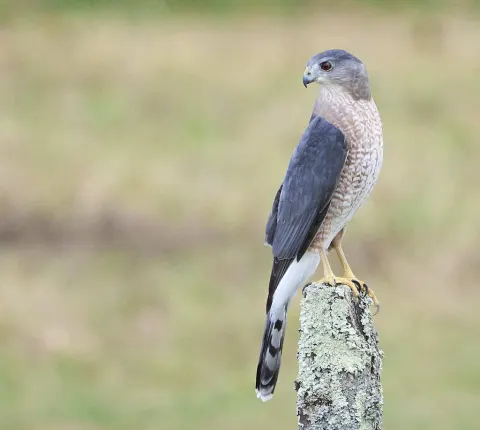
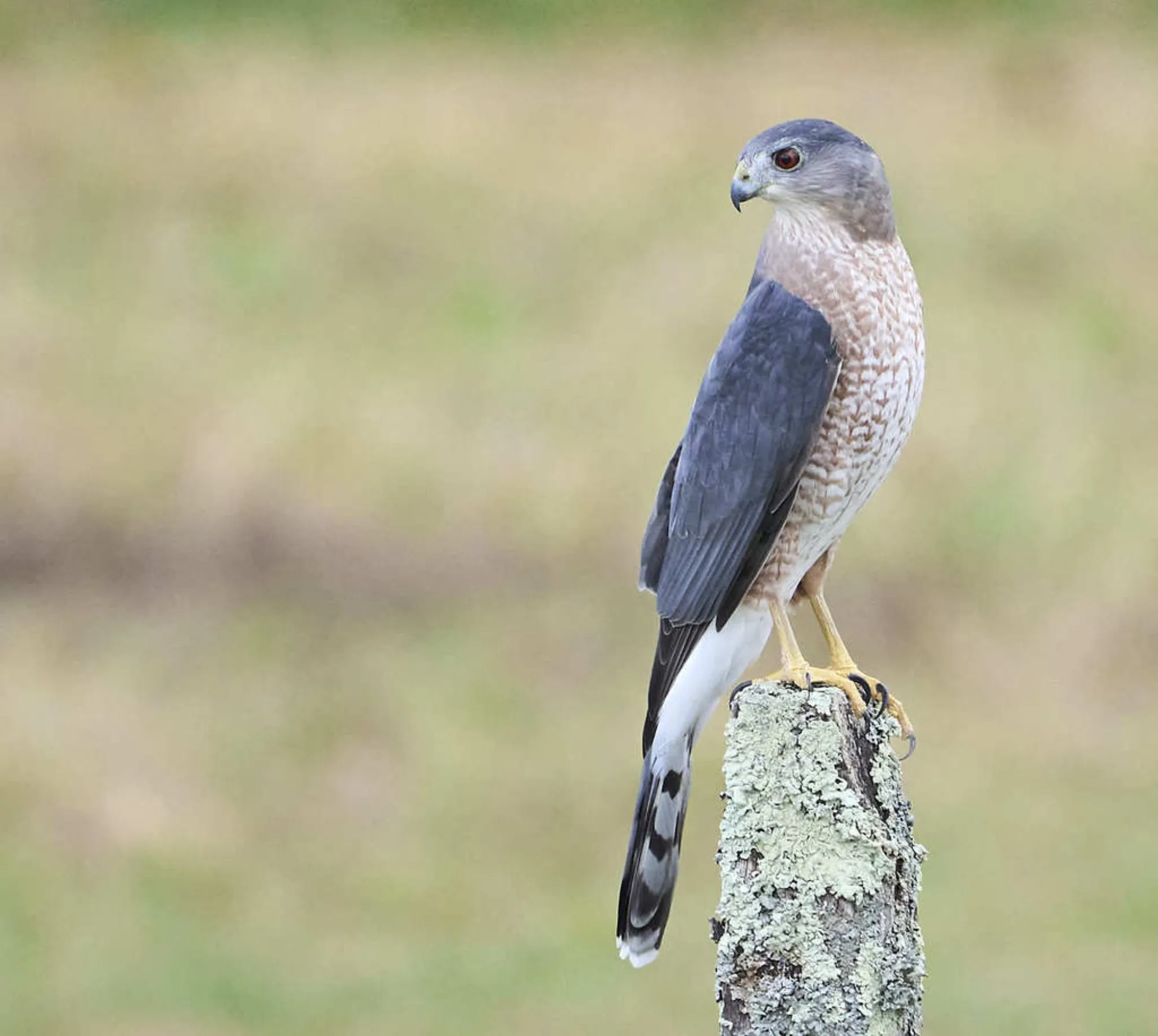
A medium-sized hunter of North American woods, the Cooper's Hawk has rounded wings and a long tail, with females considerably larger than males. Adults are blue-grey or brown-grey above, with a dark crown, a paler nape and a whitish underside marked by reddish-brown bands. Their barred tails have a conspicuous white tip. Young birds are dark brown above and pale below, with brown streaks on the breast and a hooded appearance. The smaller sharp-shinned hawk looks much alike, and even experienced birdwatchers can struggle to tell them apart in the field.
The species ranges from southern Canada to Mexico and occurs across the contiguous United States at some point in the year, except for the northernmost part of Maine. It uses deciduous and mixed forests, wooded foothills and open woodland, and has adapted to urban and suburban areas, where it can also nest. Forest edges are especially useful hunting grounds, while wintering birds may use parkland and scrub as well as open woods. Often secretive, the hawk perches within the canopy, although it also uses exposed perches, particularly in winter or in the west. Its flight combines strong, stiff wingbeats with short glides.
Small to medium-sized birds are its main prey, but it also takes small mammals and sometimes reptiles. A hunting hawk may circle towards trees or bushes, pause on a perch, then launch an attack, or chase prey from bush to bush. It favours tall, well-covered trees for nesting and can commonly raise two to four fledglings, depending on conditions. Poor weather and predators can compromise breeding, as can human causes, including industrial pesticides and other chemical pollution that affected the species in the 20th century.
Written from the English Wikipedia article Cooper's hawk (CC BY-SA 4.0).
- Records
- 62,174
- Countries
- 3
- Atlas places
- 2
These are open occurrence records, so they show where people looked for and recorded the Cooper's Hawk as much as where it lives. Cells are up to 25 km across, and every location is generalised to its cell.
Generalised encounter areas, not exact locations. Each shape is a grid cell coloured by how likely the species is there.
- Very likelyUnited States25 km zone · high confidence · 59511 records · updated 80 days ago
- Very likelyCanada25 km zone · high confidence · 2262 records · updated 80 days ago
- Very likelyMexico25 km zone · high confidence · 401 records · updated 80 days ago
Conservation status not assessed here yet, so every location is generalised to its grid cell.