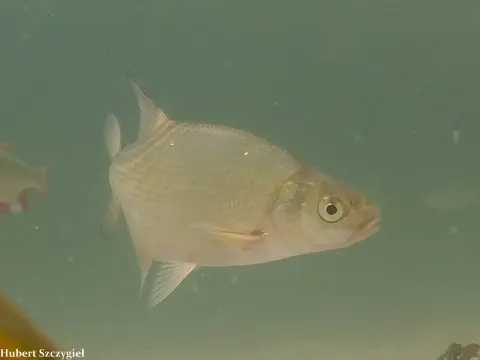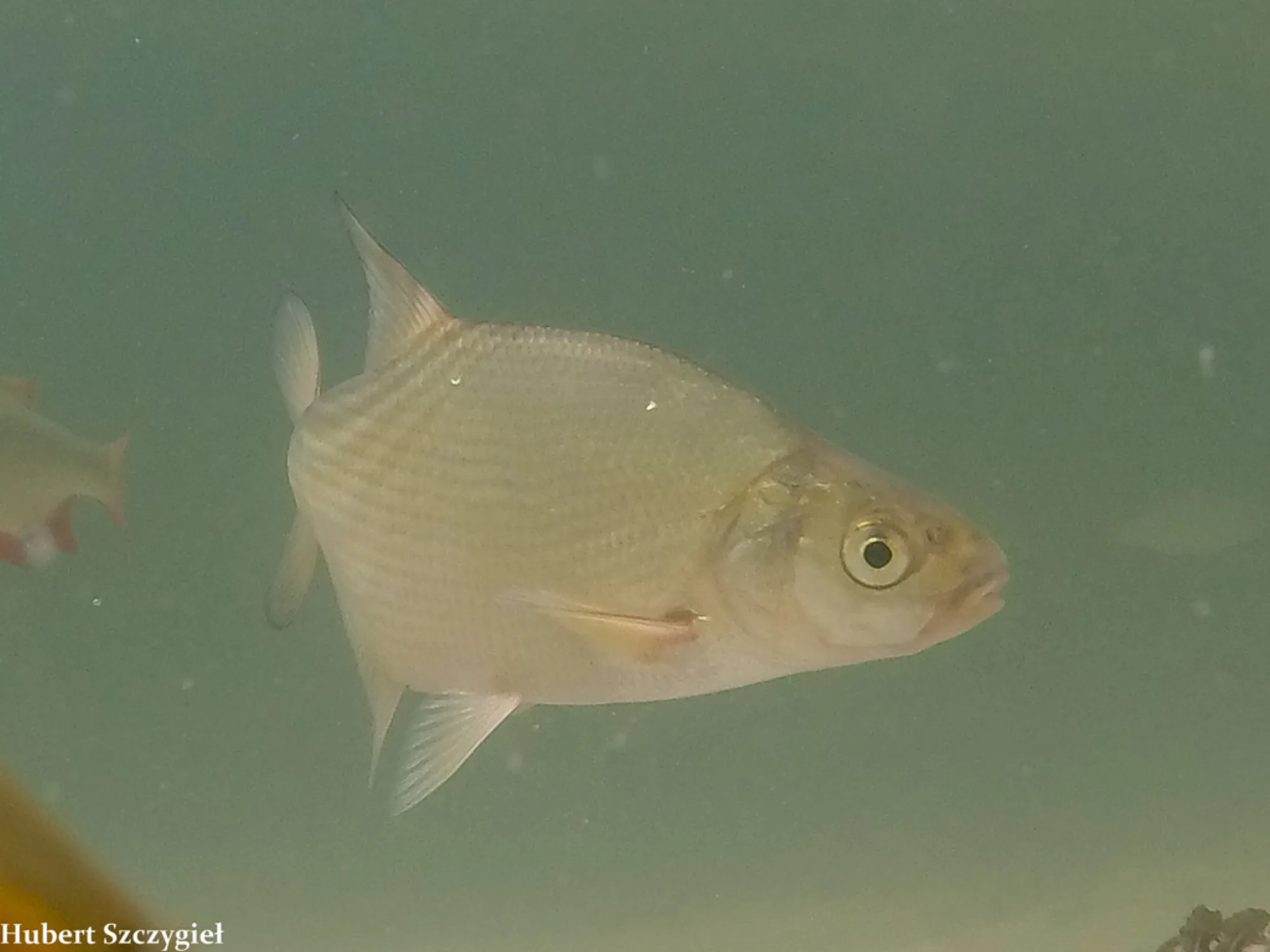
Bream
Abramis brama
With its deep, flattened body and bright silver colouring, the Bream is a freshwater fish of Europe. Older fish can turn bronze, particularly in clear water, while their fins range from greyish to black. Most measure 30 to 55 cm and weigh 2 to 4 kg, although larger fish have been recorded. Young Bream can be mistaken for other European breams, and even adults may be confused with silver bream. An adult silver bream has a reddish tint to its fins, a colour absent from those of the common bream.
Its range extends across Europe north of the Alps and Pyrenees, into the Balkans and east to the Caspian, Black and Aral seas. Look for it in ponds, lakes, canals and slow rivers, particularly lower river reaches and nutrient-rich waters with muddy bottoms and abundant algae. It also occurs in brackish sea water. Bream gather in schools near the bottom, but may feed close to shore at night. In clear water over sand, the pits left by feeding fish can be visible during the day. Their diet includes insect larvae, worms, bivalves and gastropods, as well as water plants and plankton.
Spawning takes place from April to June, and the young initially remain in warmer water around weeds and along the margins. They later form large shoals and gradually move into deeper water, changing from a diet of zooplankton to feeding on animals in the substrate. Bream can become so numerous that bottom-dwelling prey runs short, and overcrowding can leave fish slow-growing and stunted. They are also caught by sport and match anglers.
Written from the English Wikipedia article Common bream (CC BY-SA 4.0).
- Records
- 179,015
- Countries
- 8
No atlas park has a record of the Bream in or around it yet.
These are open occurrence records, so they show where people looked for and recorded the Bream as much as where it lives. Cells are up to 25 km across, and every location is generalised to its cell.
Generalised encounter areas, not exact locations. Each shape is a grid cell coloured by how likely the species is there.
- Very likelySweden25 km zone · high confidence · 122103 records · updated 80 days ago
- Very likelyNetherlands25 km zone · high confidence · 34684 records · updated 80 days ago
- Very likelyFrance25 km zone · high confidence · 16039 records · updated 80 days ago
- Very likelyUnited Kingdom25 km zone · high confidence · 2500 records · updated 80 days ago
- Very likelyBelgium25 km zone · high confidence · 1649 records · updated 80 days ago
- Very likelyGermany25 km zone · high confidence · 1644 records · updated 80 days ago
- Very likelyLuxembourg25 km zone · high confidence · 396 records · updated 80 days ago
Conservation status not assessed here yet, so every location is generalised to its grid cell.